Free download
Download it free.
Download the Word file to fill in on your computer, or the PDF to print.
Editable checklist
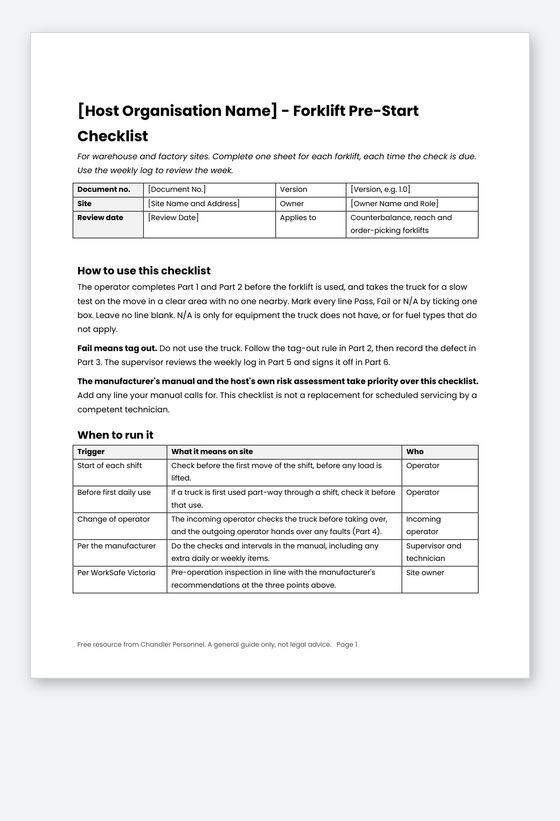
A forklift pre-start checklist is the quickest way to catch a worn chain, a weeping hose or a dead reverse alarm before the truck moves a pallet. This free, editable Word checklist is built for warehouse and factory hosts who run shared forklifts, including trucks driven by agency workers and casual operators.
It gives each operator one place to record Pass, Fail or N/A for the walk-around, the power source, the operator position and the test on the move. The supervisor gets a defect and tag-out report, a one-page weekly log and a sign-off. Print it or edit it, and put your own site and fleet numbers in the brackets.
Why a daily forklift check matters on shared fleets
WorkSafe Victoria's forklift maintenance and inspection guidance says forklifts and attachments must be regularly inspected and maintained, and that a pre-operation inspection should be done in line with the manufacturer's recommendations at the start of each shift, before first daily use and when there is a change of operator. It adds that defects must be reported and that a system should lock out any forklift with an unsafe defect.
SafeWork NSW says people are most often killed or seriously injured by being hit or crushed by a forklift, hit or crushed by its load, or crushed in a tip-over, and it lists forklifts as a regulatory priority for 2026-2027.
Shared fleets add a gap: when several operators use one truck, each assumes the last person looked. The change-over record closes that gap, which matters most when agency workers rotate through a peak.
What is inside the checklist
- Control table and header details: document number, version, site, owner and review date, then forklift ID, fuel type, operator, shift, date and hour meter.
- When to run it: start of each shift, before first daily use, change of operator, the manufacturer's schedule and WorkSafe Victoria's guidance.
- Pass, Fail or N/A checks: walk-around, fluids and power by fuel type, operator position and a test on the move, with a Fail means tag out rule.
- Defect and tag-out report: defect, severity, tagged out Y or N, who it was reported to, date and time, who fixed it and the return to service sign-off.
- Weekly log: one row per day with room for several shifts, so a week fits on one page.
- Operator change-over record and supervisor review: hand-over of faults between operators, then a weekly review and sign-off.
- Before you sign the licensed operator: a short box covering the high risk work licence class check and site authorisation, linked to the forklift register.
How to use it
- Fill in the control table once, then print one sheet per truck per check.
- The operator completes the header and every line before the truck does any work.
- Any Fail is tagged out, entered in the defect report and reported to the supervisor straight away.
- The supervisor reviews the weekly log, clears tags only after a competent person has fixed the fault, and signs the week off.
Who should use it
Warehouse, manufacturing, food and logistics sites in Victoria and New South Wales that run counterbalance, reach or order-picking forklifts, especially with agency operators at peak. WorkSafe Victoria lists the high risk work licence classes, including LF for forklift trucks and LO for order-picking forklift trucks.
Related Resources
- Forklift driver hire: what to check before you book an agency operator
- High risk work licence classes: match the machine to the ticket
- Seasonal forklift driver hiring and peak safety
- Free forklift licence and site authorisation register
- Free toolbox talk, JSA and hazard report pack for agency workers
- WorkSafe Victoria forklift maintenance and inspection guidance
- SafeWork NSW forklift safety guidance
Frequently Asked Questions
How often should a forklift pre-start check be done?
WorkSafe Victoria says a pre-operation inspection should be done in line with the manufacturer's recommendations at the start of each shift, before first daily use and when there is a change of operator. SafeWork NSW says to check at the start of each shift and whenever an operator changes to a different forklift.
Who is allowed to complete the checklist?
The operator who is about to drive the truck, and that person needs the right high risk work licence class and your site authorisation first. The forklift licence and site authorisation register is a simple way to keep those two checks on record.
What should happen when an item fails?
The truck is tagged out, the key goes to the supervisor and the defect is logged. It returns to service only after a competent person fixes the fault and a named person signs it back in.
Does this replace servicing or the manufacturer's manual?
No. The manufacturer's manual and your own risk assessment take priority, and a pre-start check is not a substitute for scheduled servicing by a competent technician. It is a general guide only, not legal advice, and it sits alongside those.
Can I use it for telehandlers or pallet jacks?
It is written for counterbalance, reach and order-picking forklifts. You can adapt the lines for other plant, but follow that machine's manual and your own risk assessment.
Start every shift on a safe truck
If you need forklift operators for your site, request staff from Chandler Personnel and say which truck types and licence classes the work involves.