Forklift Driver Hire: What to Check Before You Book an Agency Operator
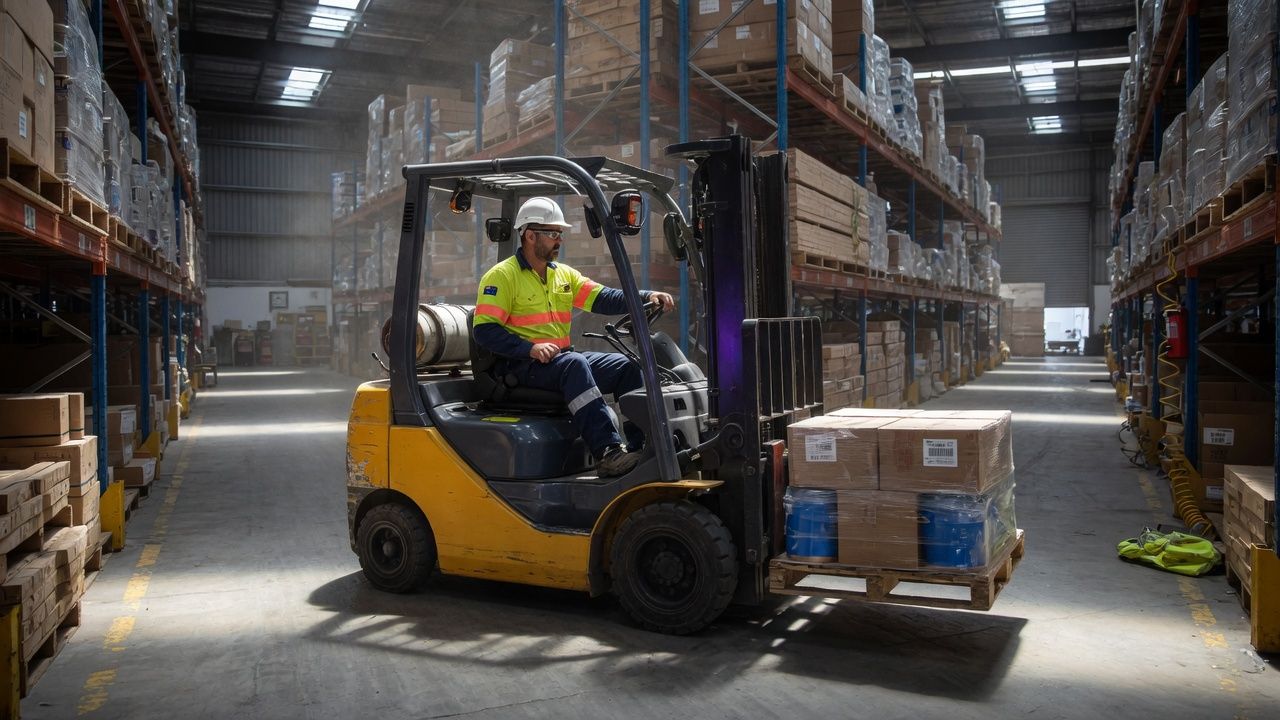
A forklift is the most dangerous machine most warehouses own, and the operator sitting on it tomorrow morning may have been booked with a two-minute phone call. That gap between the risk and the process is where incidents come from. Choosing a forklift driver hire agency well is less about price per hour and more about what the supplier verified before anyone got in the seat.
This guide is written for warehouse, distribution and production managers who book agency operators regularly. It covers the licence classes, how to verify them, why a licence is not the same as competency on your machine, what a capable agency does before the operator arrives, what stays your responsibility as the host business, and the warning signs of a supplier who is guessing.
Key Takeaways
- There are two forklift high risk work licence classes in Australia: LF for forklift trucks including counterbalance and reach trucks, and LO for order picking forklifts where the operator's controls rise with the load. One does not cover the other.
- A current licence card proves the operator passed an assessment, not that they can run your specific machine, attachment or racking layout. Site verification of competency covers that gap.
- Pedestrian-operated walkie stackers and telehandlers fitted with forks generally sit outside the licence classes, but the business still has a duty to provide training and confirm competency.
- As the host business you keep a work health and safety duty for agency operators: site induction, traffic management, safe plant and supervision are yours, and cannot be contracted out to the agency.
- In Victoria, Queensland and South Australia the provider must hold a labour hire licence and you must only engage licensed providers, with penalties for hosts who do not check.
The Two Licence Classes That Matter: LF and LO
High risk work licences are issued by state regulators such as WorkSafe Victoria, SafeWork NSW, SafeWork SA and Workplace Health and Safety Queensland, under nationally harmonised classes. They are valid for five years and recognised across states while current. For forklifts there are exactly two classes, and mixing them up is the most common booking error we see.
LF: licence to operate a forklift truck
LF, assessed against the unit TLILIC0003, covers a forklift truck with a mast and a load carriage carrying fork arms or another attachment. In practice that is the counterbalance forklift in nearly every dock and yard, plus reach trucks where the operator stays in a fixed cab. If your order says "forklift licence" without qualification, LF is what you are asking for.
LO: licence to operate an order picking forklift
LO, assessed against TLILIC0004, covers order picking forklifts where the operator's control position rises with the load carriage, so the person travels up to the pick face. Turret trucks used in narrow-aisle high-bay racking fall under this class too. An LF holder is not authorised to run an order picker, and an LO holder is not authorised to run a counterbalance. If your site runs both, say so in the booking and ask for an operator carrying both classes.
Machines that sit outside the two classes
A pedestrian-operated walkie stacker or an electric pallet truck usually does not require a high risk work licence, and a telehandler fitted with forks or a bucket does not attract one either. That does not make them low risk. The business still has a duty to provide information, training and supervision, and to confirm the operator is competent on that machine before use. This is the area where agency operators are most often put on plant with no documented check at all.
How to Verify a Licence Properly
Asking to "see the ticket" is not verification. A useful check takes about three minutes and covers five things.
- The card is current, not expired, and the photograph matches the person at the gate.
- The class listed matches the machine they will operate. Read the letters, do not assume.
- The name matches the photo identification and the agency's placement record.
- Where the state regulator offers an online licence check, the number returns a valid current result.
- A new holder may present a Notice of Satisfactory Assessment while the card is produced. Confirm the date and that it is still inside its validity period.
A good supplier does all of this before the placement and sends you the evidence with the confirmation, not after an incident. When you book forklift driver roles through us, licence class, number and expiry are recorded against the worker's file and rechecked before renewal dates pass.
Licence Is Not Competency
An assessment proves a person met a standard on an assessor's machine, on one day, in a controlled yard. Your site is different, and the differences are exactly where things go wrong.
Equipment and attachments change the machine
A counterbalance, a reach truck, an order picker and a walkie stacker handle nothing alike. Attachments change the machine again. A carton clamp, paper roll clamp, rotator, slip sheet push-pull or fork positioner alters the rated capacity, the load centre and the way the truck behaves under load. An operator who has run clamps for years in a paper plant may have never touched one in a chilled food environment. Name the machine, the attachment and the load type in your booking.
Load charts and data plates
Every truck carries a data plate giving its rated capacity at a stated load centre and lift height. Attachments come with a derated capacity chart. A competent operator should be able to read the plate, find the derated figure for the attachment fitted, and explain what happens to capacity as the mast goes higher. If that question draws a blank during your verification, you have found a training need before it becomes an incident.
Verification of competency on your site
A verification of competency, or VOC, is a short practical check on your equipment, in your aisles, against your procedures. It normally covers a pre-start inspection, a load handling exercise at the heights you actually pick, reversing and blind corner behaviour, interaction with pedestrians, load restraint on the dock, and correct shutdown and parking. Twenty to thirty minutes with a competent assessor is enough for most operators, and it is the single most useful control available to a host business. Sites running large seasonal intakes should build this into the ramp-up plan, which we cover in detail in our guide to seasonal forklift driver hiring and peak safety.
Energy Source: Battery and LPG Handling
How the truck is powered introduces its own hazards, and agency operators often move between fleets with different arrangements. Battery-electric trucks need correct charging procedure, ventilation in the charging bay, eye protection and an emergency eyewash where flooded lead-acid batteries are used, and safe battery exchange where that applies. Lithium fleets have different charging and damage-response rules that operators may not have met before.
LPG trucks bring cylinder changeover into scope: correct handling and lifting of the cylinder, checking the connection and hose condition, leak testing, and storing cylinders upright in a ventilated cage away from ignition sources. Ask candidly whether the operator has changed a cylinder before. Many warehouse-only operators have not.
Pre-Start Checks and Pedestrian Traffic Management
A documented pre-start check at the beginning of every shift is standard practice and the easiest thing to audit. It should cover tyres, forks and heel wear, mast chains, hydraulic leaks, horn, lights, beacon, seatbelt, brakes, steering, data plate legibility, and the load backrest. The sheet should be signed and kept, and any defect should take the truck out of service until it is cleared.
Pedestrian separation is the risk that causes the most serious harm. Safe Work Australia's guidance on workplace traffic management sets the order of controls: remove the interaction where you can, separate people from plant with barriers, walkways and dedicated doors where you cannot, then add engineering aids such as reversing cameras, sensors and blue spot lights, and only then rely on rules, signage and supervision. An agency operator will follow your traffic plan only if someone actually walks them through it, including the one-way aisles, the exclusion zones around the charging bay, and the rules for the dock when trailers are being loaded. For multi-site operations, we align this induction content with each host's plan across our warehousing and logistics recruitment placements.
What a Good Agency Does Before Sending an Operator
- Verifies licence class, number and expiry against the regulator's record and keeps a dated copy.
- Confirms right to work with a current VEVO check where the worker holds a visa.
- Interviews for equipment-specific history: which trucks, which attachments, which environments, how recently.
- Runs a general safety induction covering manual handling, hazard reporting, PPE and incident procedure.
- Reference checks a recent forklift placement, not a role from five years ago.
- Holds current workers compensation and public liability cover and can produce certificates of currency on request.
- Holds a labour hire licence in each state where one is required and gives you the licence number without being chased.
What Stays Your Responsibility as the Host
Engaging forklift labour hire does not transfer your work health and safety duty. You control the workplace, so you retain responsibility for site induction and traffic plan briefing, plant that is maintained and safe to use, a documented pre-start process, supervision proportionate to the person's familiarity with the site, incident reporting and investigation, and consultation with the agency about risks and controls. The provider is responsible for employment, screening, licence verification, pay and workers compensation. Both duties run at the same time, and neither one cancels the other.
Red Flags in a Supplier
- Cannot state the licence class of the operator they are proposing.
- Offers a same-hour forklift fill without asking what machine you run.
- Sends no licence copy, no induction record and no name until the worker walks in.
- Quotes a charge rate far below the market band, which usually signals an incorrect award classification or missing on-costs.
- Cannot produce a labour hire licence number for Victoria, Queensland or South Australia.
- Has no process for handling an incident or a defect report raised by their worker on your site.
Booking Checklist
- Licence class matches machine - What good looks like: LF for counterbalance and reach, LO for order picker and turret, both where the site runs both; Who does it: Agency, confirmed by host at gate
- Card currency - What good looks like: Not expired, photo matches, number verified with the regulator where a check is available; Who does it: Agency
- Attachment experience - What good looks like: Named attachment and load type discussed before the booking is confirmed; Who does it: Agency
- Verification of competency - What good looks like: Practical check on the actual truck and aisles before unsupervised work; Who does it: Host
- Site induction and traffic plan - What good looks like: Walked route, exclusion zones, pedestrian doors, dock rules, charging bay; Who does it: Host
- Pre-start check - What good looks like: Signed sheet each shift, defects lock the truck out; Who does it: Operator, audited by host
- Labour hire licence - What good looks like: Current licence number supplied and checked on the state register; Who does it: Host
- Insurance - What good looks like: Current workers compensation and public liability certificates on file; Who does it: Host procurement
Cost and Lead Time Expectations
Charge rates for warehouse casual staff hire are built from the applicable award rate, casual loading, superannuation, workers compensation premium, payroll tax and the provider's margin. Under the Storage Services and Wholesale Award 2020 the minimum hourly rates for adult storeworkers currently run from $27.08 for grade 1 on commencement to $29.61 for grade 4, with a 25 per cent casual loading on ordinary hours and a guaranteed minimum four hour engagement per start. Licensed forklift work generally classifies above entry level, and once on-costs are loaded the charge rate typically sits meaningfully above the base. Treat any quote well below the market band as a question to ask, not a saving.
On timing, allow 12 to 48 hours for a properly checked operator rather than expecting an immediate start, and longer if you want a VOC completed before the first full shift. If you are covering a known peak, book earlier and ask for the same people back, because familiarity with your racking and traffic plan is worth more than the hourly difference. You can set a booking up through our team for warehousing labour hire in Victoria, or simply request staff with the machine, attachment and shift pattern listed.
Related Resources
Forklift Driver Recruitment | Chandler PersonnelWarehousing and Logistics Recruitment | Chandler PersonnelWarehousing Labour Hire Victoria | Chandler PersonnelHigh risk work licences | WorkSafe VictoriaHigh risk work licences | SafeWork NSWForklifts | SafeWork SATraffic management | Safe Work Australia
Frequently Asked Questions
What is the difference between an LF and an LO forklift licence?
LF covers forklift trucks with a mast and a load carriage, which includes counterbalance forklifts and reach trucks where the operator stays in a fixed cab. LO covers order picking forklifts and turret trucks, where the operator's control position travels up with the load. They are separate classes assessed against different units, and holding one does not authorise the other.
Do I need to run my own competency check if the operator already holds a licence?
Yes, in practice. The licence proves an assessed standard on an assessor's machine. It does not prove the person can run your truck, your attachment or your aisle layout. A short verification of competency on site is the accepted way to close that gap and is straightforward to document.
Does a walkie stacker or a telehandler need a high risk work licence?
Generally no. Pedestrian-operated stackers and telehandlers fitted with forks or a bucket usually fall outside the LF and LO classes. The business still has a duty to provide training, information and supervision, and to confirm the person is competent before they use the machine.
Who is responsible if an agency forklift operator has an incident on my site?
Both businesses hold duties at the same time. The host controls the workplace, the plant, the traffic management and the supervision, so those remain the host's responsibility. The provider is responsible for screening, licence verification, employment and workers compensation. Regulators look at what each party reasonably could have done.
How far in advance should I book a forklift operator?
Allow 12 to 48 hours for a standard booking so the agency can confirm the licence class matches your machine. Allow more where you want the operator verified on your equipment before their first unsupervised shift, or where the role needs a specific attachment such as a clamp or a slip sheet push-pull.
How do I check that a labour hire provider is licensed?
Victoria, Queensland and South Australia each run a labour hire licensing scheme with a public register. Ask the provider for their licence number, search the register, and record the expiry date in your supplier file. Host businesses in those states must only engage licensed providers, so this check protects you as well as the workers.
Conclusion
Booking an agency operator safely comes down to three habits: name the machine and attachment in the order, verify the licence class rather than the word "forklift", and run a short competency check on your own equipment before the first unsupervised shift. Those three steps cost under an hour and remove most of the risk in the arrangement. Build them into your standard booking form, then hold your supplier to the same standard every time you hire forklift drivers.