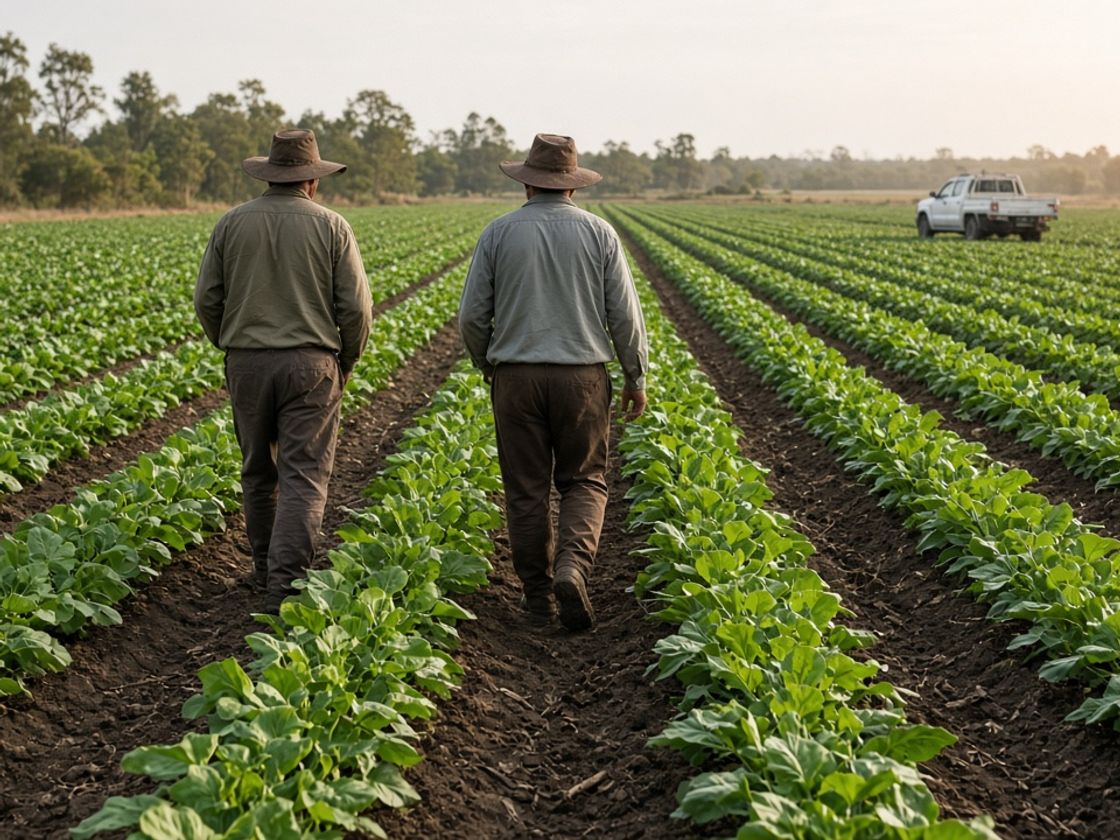
Farm labour hire in Queensland comes with duties for the grower as well as the provider. Before a crew arrives, the grower should confirm the provider's licence, plan for heat and sun, and agree in writing whether the work is paid by the hour or by the piece. Growers who settle those three points early start the first day with fewer open questions.
This guide is for Queensland growers, farm managers and packhouse supervisors who book farm hands or a harvest crew from an agency.
What farm labour hire covers in Queensland
Farm labour hire means an agency supplies workers to your property or packhouse and you direct the work. Farm work in Queensland covers general farm hand tasks, fruit picking and packing shed duties, and horticulture labour hire follows the same licensing rules as any other labour hire. The farm hand role page lists typical duties such as picking, packing and following heat and sun rules, and a separate page covers the general labourer role.
Chandler Personnel provides labour hire and permanent recruitment for Queensland hosts, and a grower looking for farm hand labour hire can request farm workers in Queensland through the request-staff form. For a harvest crew, the licence check and the pay basis matter most, and the sections below cover both.
Victorian growers plan around different seasons and state rules, and the post on how Victorian harvest crews are planned covers that setting. This guide stays with what a Queensland grower needs to check.
Why growers count as labour hire users
The licensing scheme speaks to farms directly. The Queensland labour hire licensing scheme page gives an example of a labour hire provider: a contractor who supplies workers to a farmer or fruit grower to pick produce for that farmer or grower. If you bring in workers who you do not employ directly, you should consider carefully whether the arrangement is labour hire.
The scheme calls the farm a labour hire user, and other terms such as host employer or client mean the same thing. Users must only engage licensed providers, and there are strong penalties for using an unlicensed one. The Labour Hire Licensing Act 2017 commenced on 16 April 2018, and the duty covers providers based interstate or overseas who supply workers in Queensland.
Users are also asked to take practical steps. These include keeping a list of every worker on your site, setting clear expectations that the provider will follow workplace laws, understanding any subcontracting, and checking that contract prices can cover labour costs under the relevant award or agreement.
Checking the register before a crew arrives
The check takes a few minutes and belongs with the grower. The public register lets you search by business name, ABN, address, industry or location, and you can print a verification of the licence. The licensing pages also list pending applications, but they are clear that you cannot use a provider who has only applied, because the provider must hold a current licence.
Do the check for each provider, and do it again if you change providers mid-season. The Queensland labour hire licence check walks through the steps, and the same register check applies to any provider you consider. Keep a dated print with your booking records, because inspectors may enter a user's workplace to check compliance.
Crews that move between states raise further questions. The guide to licence checks for crews that cross state borders covers that case.
Heat, sun and outdoor controls for farm crews
WorkSafe Queensland says there is no workplace exposure standard or limit for heat stress, so a temperature alone cannot tell you whether a day is safe. Risk depends on workplace conditions, the job and the individual worker. Its heat stress controls advise a walk-through of the workplace and asking workers about their heat concerns.
Its heat guidance for Queensland businesses lists practical actions a grower can take:
- Water: cool, portable drinking water close to where people are working.
- Shade: a cool rest area, shaded or air conditioned.
- Scheduling: strenuous tasks planned for the cooler parts of the day, with self-pacing and regular breaks.
- Training: information so workers recognise heat illness in themselves and others, know the controls and know what to do in an emergency.
- First aid: procedures and equipment suitable for heat-related illness, plus emergency procedures.
WorkSafe Queensland also advises outdoor workers to wear long pants and long-sleeved collared shirts, because outdoor workers generally receive five to ten times more ultraviolet radiation each year than indoor workers. A heat risk pre-start checklist lets a supervisor record conditions, task intensity, clothing and controls before the crew starts, and it is a planning aid rather than proof of compliance.
Piece rates, hourly pay and what the booking should say
Under the Horticulture Award, full-time, part-time and casual employees can be paid a piece rate, which means pay based on what they pick, pack, prune or make. The Fair Work Ombudsman's guidance on horticulture piece rates sets out the rules. A pieceworker who does other work beyond the piece task must be paid for that work at the relevant award hourly rate.
Pieceworkers also have a minimum wage guarantee. For each day worked, they must be paid at least their classification's hourly rate multiplied by the hours worked, and if the piece rate earns more, they receive the higher amount. A worker who is not yet competent at the task cannot be paid a lower training or introductory piece rate.
The grower's job is to be clear in the booking. State whether each task is paid hourly, by the piece or both, name the crop and task, and say how hours will be recorded. Ask the provider to confirm that its pay arrangements follow the award or agreement that covers the workers, because the scheme asks users to set the expectation that workplace laws are followed.
Transport, amenities and the first-day induction
Many farms sit well away from towns, so confirm how the crew gets to the paddock. Agree the pick-up point, the arrival time, and who is responsible if a vehicle is late. Keep the arrangement in writing with the provider.
On amenities, check that drinking water, shade and first aid are in place before day one. The WorkSafe Queensland heat guidance lists cool water close to the work and a cool rest area, shaded or air conditioned.
On the first morning, walk the crew through the block, the task, the hazards and the emergency plan. Point out where the water and first aid are, how to report an injury or heat symptoms, and who the supervisor is. Record who attended.
Related Resources
- Farm hand role
- Heat risk pre-start checklist
- Queensland labour hire licence check
- Licence checks for crews across state borders
- How Victorian harvest crews are planned
- Fair Work guidance on horticulture piece rates
- Managing heat stress exposure
Common Questions About Farm Labour Hire in Queensland
1. Does a grower need to check a labour hire provider in Queensland?
Yes. Users of labour hire must only engage licensed providers, and the public register shows who holds a current licence. The scheme names a contractor who supplies workers to a farmer or fruit grower to pick produce as a provider. Keep a dated print of the result.
2. What is a piece rate in horticulture?
A piece rate pays an employee by the amount they have picked, packed, pruned or made. Under the Horticulture Award it can apply to full-time, part-time and casual employees. A minimum wage guarantee applies each day, so a pieceworker covered by the Horticulture Award must be paid at least their hourly rate for the hours worked each day.
3. Who briefs farm workers on heat and chemicals?
The grower should lead both briefings, because they know the block, the task and the conditions. WorkSafe Queensland says workers should be trained to recognise heat illness, know the controls and know what to do in an emergency. For chemicals, brief to your farm's own procedures before any work near them.
4. Can I use the same provider across Queensland and interstate farms?
The Queensland scheme covers providers who supply workers in Queensland, wherever the provider is based. For farms in another state, check that state's rules separately. The post on licence checks for crews that cross state borders covers the cross-border case.
5. How do I plan a labour hire crew for harvest?
Work out the number of people needed per day, the task, the pay basis and the start time. Add the heat plan, transport and amenities, then book early and confirm the licence check. Review the numbers each week as the crop comes on.
Check the Provider Before the Crew Arrives
The grower carries the duty to engage a licensed provider, so the licence check comes before everything else. Add a heat plan, a clear pay basis and a first-day induction, and the crew arrives into a farm that is ready for them. Put each of those in the booking and keep a dated copy.