Hiring an A-Grade Electrician: How to Verify a Licence Before Anyone Touches Your Switchboard
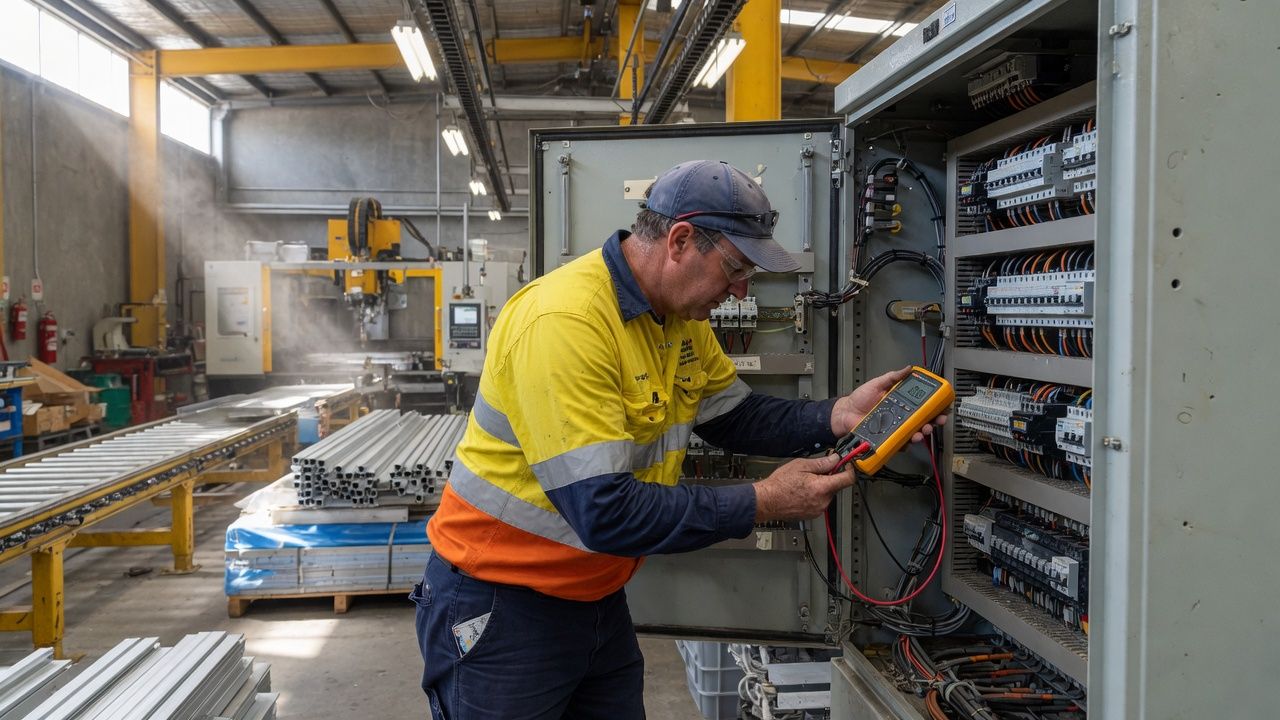
Hiring an A-grade electrician is one of the few staffing decisions where a paperwork shortcut turns into a safety incident, a regulator notice and an insurance argument in the same week. A card in a wallet proves almost nothing on its own. Cards get renewed, suspended and conditioned, and the photo a candidate emailed you was accurate on the day it was taken, not necessarily today.
The check below belongs in onboarding whether you hire directly or through a trades and services recruitment partner, and it matters most on sites with heavy fixed plant, which is why it is standard screening for our manufacturing recruitment clients. This is a verification guide, not a training one. For the qualifications behind the trade see maintenance electrician qualifications, and for local rates and lead times see hire an electrician in Melbourne.
Key Takeaways
- An A-grade electrician's licence in Victoria is formally the Electrician's Licence issued by Energy Safe Victoria, and it authorises unsupervised electrical installation work.
- Always verify a licence number on the issuing regulator's own public register, not from a photo, a PDF or a labour hire profile.
- Registered Electrical Contractor (REC) registration sits on the business, not the person, and is what allows a business to contract electrical work and issue Certificates of Electrical Safety.
- A Certificate of Electrical Safety certifies one completed job, not a person's current licence status.
- As the host employer you keep occupational health and safety duties even when the electrician is paid by someone else.
What an A-Grade Electrician's Licence Actually Authorises
In Victoria, the licence everyone calls A-grade is the Electrician's Licence issued under the Electricity Safety (Registration and Licensing) Regulations 2020 by Energy Safe Victoria. It authorises the holder to work unsupervised and to certify their own work. That last part separates it from every other class, and it is why the class on a resume matters more than the years of experience beside it.
Other states use different words for the same idea. New South Wales issues a qualified supervisor certificate and a tradesperson certificate through NSW Fair Trading. Queensland issues an electrical work licence through the Electrical Safety Office. South Australia registers electrical workers through Consumer and Business Services. The names are not interchangeable and neither are the registers you search.
Licence classes you will see on resumes
- Electrician's Licence (A-grade, VIC) - What it allows: Unsupervised electrical installation work and self-certification of that work; What it does not allow: Contracting electrical work to a third party without REC registration
- Supervised Electrical Installation Worker's Licence - What it allows: Installation work under the supervision of a licensed electrician; What it does not allow: Working alone, signing off work, night shift without a supervisor rostered
- Restricted Electrical Worker's Licence (REL, formerly "D" class) - What it allows: Low voltage disconnect and reconnect tied to the holder's primary trade; What it does not allow: General installation work, switchboard alterations, new circuits
- Lineworker's Licence - What it allows: Work on distribution and transmission networks, including cable jointing classes; What it does not allow: Installation work inside a customer's plant
- Registered Electrical Contractor (REC) - What it allows: A business contracting electrical installation work and issuing Certificates of Electrical Safety; What it does not allow: Performing the work, unless the individual also holds a licence
When REC registration matters and when it does not
If you put an electrician on your own payroll, or engage them through an agency as a labour hire worker on your site, you are not buying a contracting service, so the individual licence governs the work. If you engage a business to carry out the work under a contract, that business needs to be registered. Confirm which arrangement you are signing, because it changes who is responsible for certification.
State Regulators and Their Public Licence Registers
Every state publishes a free register. Searching it takes under two minutes and is the only check that carries weight in an investigation. Search by licence number and by surname, because a mismatch between the two is the fastest way to catch a doctored card.
- VIC - Regulator: Energy Safe Victoria; Where to check: Public register search on the ESV site; Job certificate: Certificate of Electrical Safety (COES)
- NSW - Regulator: NSW Fair Trading; Where to check: Verify.licence.nsw.gov.au licence check; Job certificate: Certificate of Compliance Electrical Work (CCEW)
- QLD - Regulator: Electrical Safety Office; Where to check: Electrical licence search on the ESO site; Job certificate: Certificate of Testing and Compliance
- SA - Regulator: Consumer and Business Services, with the Office of the Technical Regulator; Where to check: Find a licence holder search on the CBS site; Job certificate: Certificate of Compliance lodged through eCoC
Interstate hires need one extra step. Mutual recognition lets a licence holder apply for the equivalent licence in another state, but it is not automatic and not retrospective. A Queensland electrician who started on your Melbourne line last Monday needs a Victorian licence, not a Queensland one with an application pending. Run the check per site, not per candidate.
What a Certificate of Electrical Safety Proves
Under section 45 of the Electricity Safety Act 1998 (Vic), the person responsible for electrical installation work must make sure a Certificate of Electrical Safety is completed for it. The certificate records what was done, who did it and that it was tested as electrically safe. Useful evidence, and narrower than most employers assume: a COES says nothing about whether that licence is current today, whether it carries conditions, or whether the holder is competent on your plant. Treat a folder of past certificates as a work history, not a licence check.
Prescribed work needs independent inspection by a Licensed Electrical Inspector as well as the certificate. That includes consumer mains, hazardous area equipment, high voltage installations, generation and battery energy storage systems, medical patient areas, safety services such as fire pump and smoke exhaust circuits, and electric security fences. If your site has any of these, put the inspection step in the job pack before the work is scheduled.
High Risk Work Licences and Site Tickets
An electrical licence is only the first document. Industrial sites usually need several more, issued by the work safety regulator rather than the energy regulator, so they sit on a separate register with separate expiry dates.
- High risk work licence classes such as boom-type elevating work platform (WP) for units of 11 metres and above, forklift truck (LF), dogging (DG) and scaffolding classes.
- An EWPA Yellow Card or equivalent training for scissor lifts and boom lifts under 11 metres, which are not covered by a high risk work licence.
- Low voltage rescue and CPR, refreshed annually on most industrial sites.
- Working at heights and confined space entry where the plant demands it.
- A construction induction card (White Card) for construction work.
When you are hiring industrial electricians for a maintenance team, list the tickets against the plant they relate to. "Forklift licence" is vague. "LF licence, counterbalance, used daily for reel handling in the despatch bay" is something a recruiter can screen against.
Employer Liability When Unlicensed Electrical Work Happens
Three separate exposures sit behind an unlicensed job. The first is electrical safety law. Performing or causing unlicensed electrical installation work is an offence in every state, and the person who directed the work can be exposed alongside the person who did it. The second is work health and safety law. In Victoria, changes to the Occupational Health and Safety Act 2004 that took effect on 22 March 2022 confirmed that labour hire providers and host employers share duties to the worker and must consult, cooperate and coordinate with each other. A service agreement does not contract that duty away.
The third is commercial. Insurers ask whether the work was done by a licensed person, and a claim on a plant fire is hard to run when that answer is uncertain. Labour hire licensing applies too: in Victoria, Queensland and South Australia, providers must hold a licence and hosts must only engage licensed providers. Check your agency's licence number as carefully as the electrician's.
A Step-by-Step Verification Workflow
- Collect the full legal name as it appears on the licence, the licence number and a second identifier such as date of birth.
- Search the issuing regulator's public register yourself. Do not accept a screenshot from the candidate or the agency.
- Match the licence class to the scope in the position description. A supervised or restricted licence needs a named supervisor rostered on the same shift.
- Check expiry, conditions, suspensions and disciplinary notations, not just the word "current".
- If you are contracting a business rather than hiring a person, confirm REC registration separately and record who will issue the Certificate of Electrical Safety.
- Verify high risk work licences and site tickets against the safety regulator's record or the original card.
- Sight photo identification and confirm the person in front of you is the person on the register.
- Save a dated record of the search in the personnel or contractor file, and diarise a reminder 60 days before the earliest expiry.
- Re-verify at renewal, after any break in service, and before mobilising the worker interstate.
Document checklist before the first shift
- Electrician's licence (A-grade or state equivalent) - Verified against: Regulator public register; Record kept by: Host and agency
- REC registration, if contracting a business - Verified against: Regulator register of contractors; Record kept by: Procurement
- High risk work licence classes - Verified against: Work safety regulator record or original card; Record kept by: Site safety officer
- Low voltage rescue and CPR currency - Verified against: Training provider statement of attainment; Record kept by: Host site
- Labour hire provider licence - Verified against: State labour hire authority register; Record kept by: Procurement
- Site induction and isolation authority - Verified against: Signed permit system records; Record kept by: Maintenance supervisor
Where a Recruitment Partner Fits
A specialist electrician recruitment agency should hand you the licence number, class, expiry date and register result before you interview, not after you accept. Chandler Personnel has placed licensed trades across Victorian, South Australian and Queensland sites since 1991, and the register search is a standard screening step rather than a request you have to make. Employers who hire electricians regularly should keep a standing register of expiry dates, because that is what makes a licensed electrician for hire available at same-week notice.
Related Resources
Trades and Services Recruitment | Chandler Personnel
Manufacturing Recruitment | Chandler Personnel
Maintenance Electrician Qualifications: A Hiring Guide for Employers
How to Hire an Electrician in Melbourne: An Employer Guide
Electrical licence search | Electrical Safety Office
Find a licence holder | Consumer and Business Services
Frequently Asked Questions
How do I check if an electrician's licence is valid in Victoria?
Use the public register search published by Energy Safe Victoria. Enter the licence number and surname, then confirm the class matches the work you need and that no conditions or suspensions are recorded. Keep a dated copy of the result on file.
Is an A-grade licence the same as REC registration?
No. The A-grade licence sits on the individual and authorises them to carry out and certify electrical installation work. REC registration sits on a business and lets it contract that work and issue Certificates of Electrical Safety. A sole trader offering electrical services usually needs both.
Can a worker with a restricted electrical licence cover a maintenance electrician role?
Not as a like-for-like replacement. A Restricted Electrical Worker's Licence covers low voltage disconnection and reconnection tied to the holder's primary trade, such as a fitter reconnecting a motor they have just replaced. It does not cover general installation work, switchboard changes or new circuits.
Does a Certificate of Electrical Safety prove the electrician is licensed right now?
No. A certificate documents one completed job and who took responsibility for it at that time. Licence currency has to be confirmed separately on the regulator's register, ideally on the day the worker starts.
Who is liable if unlicensed electrical work is done on my site?
Liability can reach both the worker and the business that directed or allowed the work. Host employers also retain health and safety duties for labour hire workers and must consult, cooperate and coordinate with the provider.
What should I ask an agency to supply before an interview?
The licence number and class, the expiry date, the date the register was checked, any high risk work licence classes, low voltage rescue and CPR currency, and the agency's own labour hire licence number.
Conclusion
Licence verification is a ten minute task sitting between your plant and a very expensive day. Build the register search, the class check and the expiry diary into onboarding rather than treating them as a favour your recruiter does for you. If you are hiring an A-grade electrician in Victoria, South Australia or Queensland and want that done before the shortlist lands, call Chandler Personnel on (03) 9656 9777 and ask for the trades desk.