Food Production Casual Staff: Induction, Hygiene and Allergen Training That Protects Your Audit
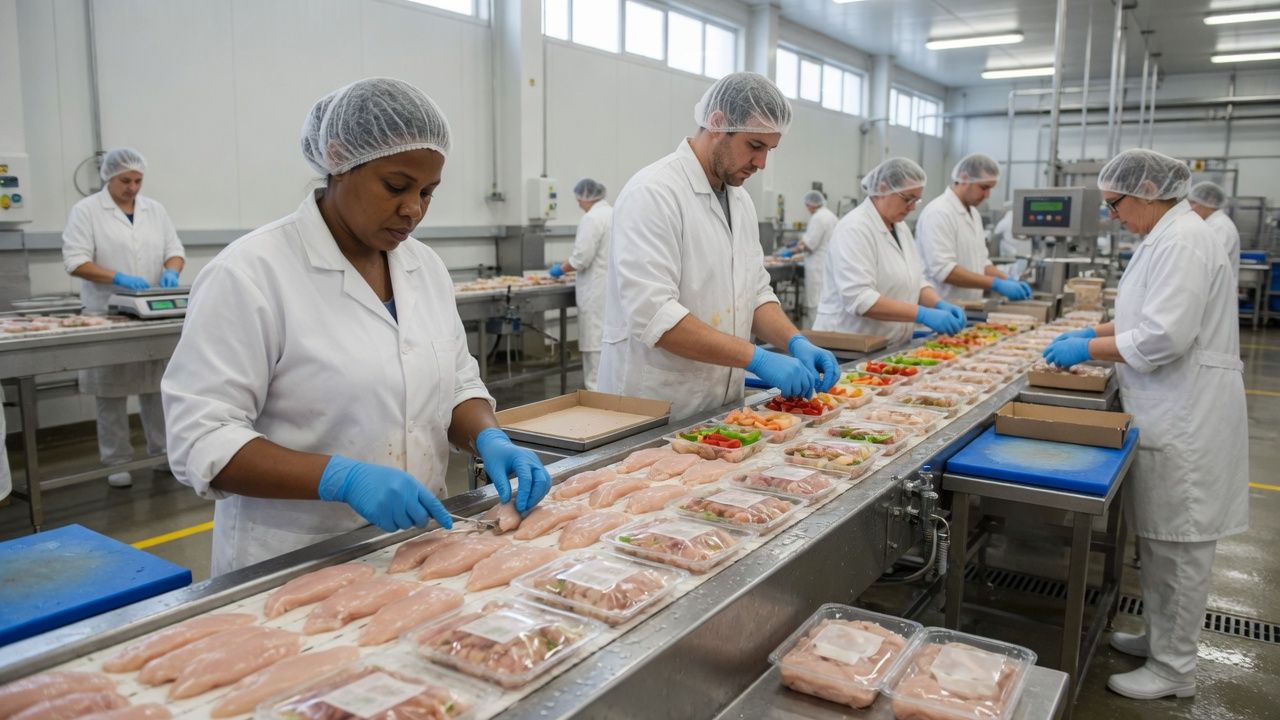
An auditor will not ask whether your food production casual staff are agency workers or your own employees. They will ask for the training record of the person who was standing on the allergen changeover last Tuesday, and they will expect it in the same file, in the same format, signed and dated. If that record sits on a labour hire provider's system instead of yours, you are the one holding the non-conformance.
This is a practical guide for food manufacturers who run casual and on-hire labour through production. It covers what the Food Standards Code actually requires of a manufacturing site, how to split training duties between host and supplier so nothing falls into the gap, and what a day-one induction has to contain before someone touches product.
Key Takeaways
- Responsibility for food safety competence sits with the food business operating the site, not with the labour hire provider, regardless of who employs the worker.
- Standard 3.2.2 of the Australia New Zealand Food Standards Code requires every food handler to have skills and knowledge in food safety and hygiene appropriate to the work they do, before they do it.
- The records an auditor asks for are the induction sign-off, the allergen and hygiene training evidence, the trainer's name, and proof of supervision until the worker is signed off as competent.
- Write the host and supplier training split into the supply agreement, because a verbal understanding will not survive a certification audit.
- Glass, hard plastic and metal detection rules must be taught on day one, since a casual who does not know the breakage procedure will hide a broken lens rather than stop the line.
What an Auditor Actually Asks About Agency-Supplied Workers
Certification audits under schemes such as BRCGS Global Standard Food Safety Issue 9, SQF and FSSC 22000 treat contract and agency personnel as site personnel. The auditor will usually pull a production record, identify who was rostered, and trace that person back to a training file. Three questions follow almost every time.
Who trained this person and what were their qualifications to train. What was the content, and does it match the hazards of the specific task. How did you verify competence rather than attendance. A signature on a sign-in sheet answers none of those, which is why sites that run large casual pools are the ones that most often pick up training non-conformances.
The fix is unglamorous. Keep one training matrix per production area listing every task that requires competence, with a row for every person who has performed it in the last 12 months, agency and permanent together. When your food production recruitment partner supplies workers, ask them to feed their pre-placement records into that same matrix rather than keeping a parallel set.
Where the Food Standards Code Sits for a Manufacturer
Food Standards Australia New Zealand develops the Code, while enforcement sits with state and territory agencies and local councils, with sector regulators such as PrimeSafe and Dairy Food Safety Victoria handling meat, seafood and dairy in Victoria. Export registered establishments answer additionally to the Department of Agriculture, Fisheries and Forestry.
For a manufacturing site, the operative requirement is Standard 3.2.2, which obliges the food business to make certain that every person who handles food, or handles surfaces likely to contact food, has skills and knowledge in food safety and food hygiene commensurate with their work. Standard 3.2.2A, which adds a certified food safety supervisor and mandatory food handler training, applies to food service, catering and related retail businesses rather than to general manufacturing, though many manufacturers adopt its structure voluntarily because it is a clean way to evidence competence.
Allergen management runs on Standard 1.2.3 and Schedule 9. Plain English Allergen Labelling has been mandatory since 25 February 2024, with the sell-through period for older stock closing on 25 February 2026. Declared allergens must appear in bold within the ingredient list and in a separate summary statement. That labelling obligation is only credible if the people running the changeover understand what they are preventing.
Splitting Training Responsibility Between Host and Supplier
The most common failure in food production labour hire is an assumption gap: the site assumes the agency covered hygiene basics, the agency assumes the site covers everything on arrival. Put the split in writing. The table below is a workable default that suits most factories.
- Right to work, identity, referee checks - Owner: Supplier; Evidence held by the site: Compliance summary per worker, refreshed on each placement
- General food handling and personal hygiene basics - Owner: Supplier; Evidence held by the site: Certificate or assessment record with date and assessor
- Health declaration and exclusion rules for illness - Owner: Supplier, re-confirmed by site; Evidence held by the site: Signed declaration on file before first shift
- Site GMP, gowning and zoning rules - Owner: Host; Evidence held by the site: Induction record with trainer name and competency check
- Allergen matrix and changeover procedure - Owner: Host; Evidence held by the site: Task-specific sign-off, supervised until verified
- Glass, hard plastic and foreign object control - Owner: Host; Evidence held by the site: Induction record plus breakage drill participation
- Metal detector checks and reject handling - Owner: Host; Evidence held by the site: Signed authorisation list of who may perform checks
- Chemical handling, cleaning and sanitising - Owner: Host; Evidence held by the site: Task training record, safety data sheet briefing
- Plant and machinery operation, guarding, isolation - Owner: Host; Evidence held by the site: Competency assessment signed by a supervisor
Under work health and safety law the host and the labour hire provider hold concurrent duties, and in Victoria on-hire providers must also be licensed with the Victorian Labour Hire Authority. Ask your provider for their licence number and check what they measure. Chandler Personnel publishes an OHS scorecard for exactly this reason, so a host can see safety performance before the first worker walks in.
Allergen Control and Changeover
Allergen incidents involving casual workers rarely come from ignorance of allergens in general. They come from not knowing this site's specific sequencing rules. Teach the plant's allergen matrix as a physical thing, not a document: which products contain which of the declared allergens, which line runs before which, and what colour the dedicated scoops and utensils are.
The changeover itself needs a documented sequence, a cleaning verification step with a defined acceptance point, and a second person to authorise the restart. Never let a casual worker sign their own changeover release in their first weeks. Where the site follows the Allergen Bureau's cross-contact risk assessment approach, explain that precautionary statements are an outcome of the assessment, not a substitute for cleaning.
GMP, Gowning and Personal Hygiene Rules
Good manufacturing practice rules are the ones casual workers break first because they feel arbitrary. Explain the reason with each rule and compliance improves sharply.
- Gowning order and the change line, including what may cross it and what may not.
- Hair nets covering all hair, and beard snoods where facial hair is present, a requirement written into scheme standards.
- No jewellery beyond a plain wedding band where the site permits it, no watches, no false nails, no nail polish, no false eyelashes.
- Handwashing points, the required duration and technique, and when rewashing is mandatory after glove change or waste handling.
- Personal medicines, plasters that are blue and metal-detectable, and the rule on reporting cuts and illness before starting a shift.
- No personal items, phones, pens or loose paper beyond the designated area.
Foreign Object Control: Glass, Hard Plastic and Metal Detection
Every site should hold a glass and brittle hard plastic register listing each item in a production area, its condition and its inspection frequency. Factory casual workers need to know two things from that register: where those items are in their work zone, and exactly what to do the moment one breaks. The procedure should be a stop-the-line action with an isolation zone, product quarantine, supervisor notification and a recorded investigation, and it should be taught by walking the zone rather than reading a page.
Metal detection is a control point, not a formality. Train casual workers on what the routine check intervals are, which test pieces are used for ferrous, non-ferrous and stainless steel, what happens when a test fails, and the rule that all product back to the last good check is held. Make clear who is authorised to clear a reject, and restrict that authorisation until competence is verified. Never let a new worker restart a detector after a reject.
Temperature-Controlled Area Induction
Chilled and frozen areas carry both a food safety and a work health and safety obligation. Cover the target ranges the site works to, typically 0 to 5 degrees for chilled storage and at or below minus 18 for frozen, the maximum time product may sit outside those ranges, and where the monitoring probes and logs live. Then cover the human side: issued cold-room clothing, rotation limits, break scheduling and the door and duress alarm arrangements. Workers who are cold cut corners, and cold-store injuries are over-represented among short-tenure staff.
Day-One Induction Checklist
Before anyone touches product, work through a fixed list and sign it. This is the document an auditor will reach for first when they find an agency worker on the line.
- Step: Completed before first product contact
- 1: Health and illness declaration signed, exclusion rules explained
- 2: Site emergency procedures, muster point, first aid and incident reporting
- 3: Gowning demonstrated and performed correctly under observation
- 4: Zoning walk: high care boundaries, change lines, one-way flow
- 5: Handwash technique demonstrated and observed at the station
- 6: Allergen matrix for the assigned line, plus the do-not-touch rules
- 7: Glass and hard plastic register items in zone, breakage response
- 8: Metal detection checkpoint explained, reject handling boundaries set
- 9: Chemicals in the area, labels, safety data sheets, no decanting rule
- 10: Named buddy and supervisor, and the stop-the-line authority explained
- 11: Sign-off filed in the training matrix, copy returned to the supplier
Sites that hire casual staff in volume should time this properly. A real induction for a food factory runs 90 minutes to half a day depending on zone, and trying to compress it into 15 minutes at shift start is where audit findings are born. Good food manufacturing recruitment partners will brief workers before they arrive so your induction time is spent on site-specific content, and will hold a stable pool so you are not re-inducting strangers every week. If you need cover for a production run or a seasonal peak, request staff with enough lead time for that briefing to happen.
Related Resources
Food Production Recruitment | Chandler PersonnelManufacturing Recruitment Agency | Chandler PersonnelFood Standards Australia New ZealandAllergen labelling for food businessesFood handler training | Food Standards Australia New ZealandThe Allergen BureauVictorian Labour Hire Authority
Frequently Asked Questions
Do agency workers need the same food safety training as our own employees?
Yes. The Food Standards Code places the obligation on the food business handling the food, and certification schemes treat agency personnel as site personnel. Training must match the task, not the employment type.
Can the labour hire provider do the food safety training for us?
They can cover general food handling, hygiene basics and health declarations, and that is worth having. Site-specific content such as your allergen matrix, zoning, glass register and metal detection procedure has to be delivered by you, because only you hold it.
What training records will an auditor ask for?
The induction sign-off with date and trainer, evidence of the training content, the competency verification, and the supervision arrangement until sign-off. They will also check that the record exists for a worker they pick at random from a production record, not just for the file you offer them.
How long should a food factory induction take?
Plan for at least 90 minutes for a low-risk packing role and up to a full shift for high care or allergen-handling work. Split it so the compliance content happens before product contact and the equipment competency is signed off over the first few shifts.
How do we handle a worker who fails a hygiene rule on their first day?
Correct it immediately, record it, and treat repeat breaches as a competency issue rather than a discipline issue. Tell the supplier, because a pattern across several placements is something they should be managing at their end.
Is casual staff labour hire compatible with a certified food safety system?
It is, provided the training matrix covers every person who touches product and the host and supplier duties are written down. The risk is not the employment model, it is an undocumented handover between two organisations.
Conclusion
Casual and on-hire labour is how most food factories cover seasonal peaks and contract runs, and it does not have to cost you an audit finding. Write the training split into your supply agreement, keep one training matrix for everybody on site, and hold the day-one induction before anyone reaches the line. Start by pulling a production record from last month and checking whether you can produce the training file for every name on it.