Electrician Salary Benchmarks 2026: Melbourne vs Sydney

If you're an electrician weighing up your next move, or an employer trying to land the right hire, one question always comes first: what should the job actually pay? Electrician salaries in Australia move fast, and the gap between Melbourne and Sydney rates can catch both sides off guard if you're working from last year's numbers.
This guide breaks down current 2026 base salary benchmarks for maintenance electricians and related trades across both cities, what drives the pay range you'll actually be offered, and how to know if a number on the table is fair.
2026 Salary Benchmarks: Melbourne & Sydney
The table below reflects current market ranges for permanent maintenance and engineering roles, based on live recruitment activity across both cities in 2026. These are indicative base salary ranges, excluding superannuation, and will vary depending on industry, experience, shift requirements, qualifications, and level of responsibility.
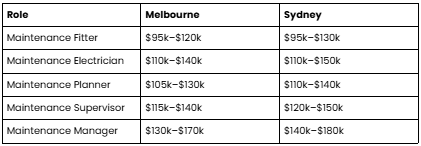
Independent salary data broadly supports these ranges. Job ads aggregated across Seek show maintenance electrician roles advertising with a typical midpoint of around $113,000, while industrial electricians sit at a similar level, and electrical supervisors climb to a typical midpoint near $153,000. Site-based and shift-loaded roles, particularly in manufacturing, FMCG, and heavy industry, tend to price toward the upper end of these bands once penalty rates and allowances are factored in.

Sydney vs Melbourne: Why the Gap Exists
Sydney consistently benchmarks $5k–$10k above Melbourne at the electrician and supervisor level, widening further at manager level. A few factors explain the difference:
- Cost of living. Sydney's housing and general living costs remain higher than Melbourne's, and employers factor this into base salary offers to stay competitive.
- Demand concentration. Sydney's industrial, FMCG, and infrastructure sectors are drawing heavily on a limited pool of licensed, multi-skilled electricians, pushing offers up faster than supply can respond.
- Site density and travel. Sydney's geography spreads industrial and logistics sites further apart, so employers often pay a premium to secure electricians who won't be lost to a shorter commute elsewhere.
Melbourne's market is not far behind, particularly for electricians with automation, PLC, or dual-trade experience, where the two cities' upper ranges start to converge.
What Pushes an Electrician's Salary to the Top of the Range
Not every electrician role sits at the midpoint. Employers consistently pay above benchmark for candidates who bring one or more of the following:
- Highly experienced, shift-based maintenance electricians. Electricians comfortable working rotating or night shifts in a live production environment attract a premium over standard day-rate roles.
- Dual-trade candidates. Electricians who also hold a mechanical, refrigeration, or instrumentation ticket are difficult to source and are typically offered toward the top of the band or above it.
- PLC and automation experience. Programmable logic controller troubleshooting and automation systems knowledge is one of the fastest-growing pay differentiators in maintenance electrical roles right now.
- FMCG and heavy industry background. Electricians who've worked in fast-moving consumer goods, food processing, or continuous-production environments understand uptime pressure in a way that's hard to teach on the job, and employers pay for that experience.
- Supervisory and coordination experience. Even in a hands-on electrician role, prior experience leading a small team, coordinating shutdowns, or managing contractors adds negotiating weight.
Career Progression and Pay: Electrician to Manager
Maintenance electrical careers in Australia typically follow a fairly clear ladder, and salary tends to track it closely:
- Maintenance Electrician – hands-on fault-finding, PPM, and repair work across electrical and increasingly automated systems.
- Maintenance Planner – shifts focus to scheduling, parts, and shutdown planning rather than tools-in-hand work, often a lateral step for electricians who want less shift work.
- Maintenance Supervisor – takes on team leadership, contractor management, and site compliance, usually requiring 3–5+ years of trade experience plus some leadership exposure.
- Maintenance Manager – full accountability for the maintenance function across a site or region, blending technical oversight with budget and workforce planning.
Each step up typically adds $15k–$30k to the base salary range in both cities, with Sydney maintaining its premium at every level.
How Employers and Candidates Should Use These Benchmarks
For candidates, these ranges are a starting point for negotiation, not a ceiling. If you hold a dual trade, automation experience, or FMCG background, it's reasonable to expect an offer toward or above the top of the relevant band.
For employers, offering below benchmark in the current market is one of the fastest ways to lose a strong candidate to a competing offer, particularly in Sydney where demand for licensed electricians continues to outpace supply. Building superannuation, shift loadings, and any site allowances into the total package (rather than just the base) also helps close the gap between what's advertised and what candidates are comparing it against.

Frequently Asked Questions
Are these salary ranges inclusive of superannuation? No. All figures above are base salary ranges and exclude superannuation, which is paid on top in line with current legislated rates.
Why is Sydney consistently higher than Melbourne for the same role? A combination of higher cost of living, tighter candidate supply in industrial and FMCG sectors, and greater site dispersion across Sydney's industrial precincts keeps base salaries running ahead of Melbourne's.
What qualifies as "top of the range" for a maintenance electrician? Typically a combination of shift-based experience, a second trade or automation/PLC skillset, and a background in a high-uptime environment like FMCG or heavy manufacturing.
How often should these benchmarks be reviewed? Given how quickly demand for licensed, multi-skilled electricians is shifting, we'd recommend revisiting salary benchmarks at least every 6–12 months, or sooner if you're seeing consistent candidate drop-off during the offer stage.
I'm not sure where my current role sits against these numbers. Who can I ask? Get in touch with our team for a confidential, personalised benchmark based on your specific experience, location, and industry, whether you're weighing up a new role or setting salaries for your next hire.
Benchmarks reflect current market data for permanent maintenance and engineering roles across Melbourne and Sydney as of 2026 and are provided as a general guide. Actual salary will vary based on individual experience, qualifications, industry, and role scope.