Casual Staff Agency Brisbane: The Questions That Separate a Compliant Supplier From a Cheap One
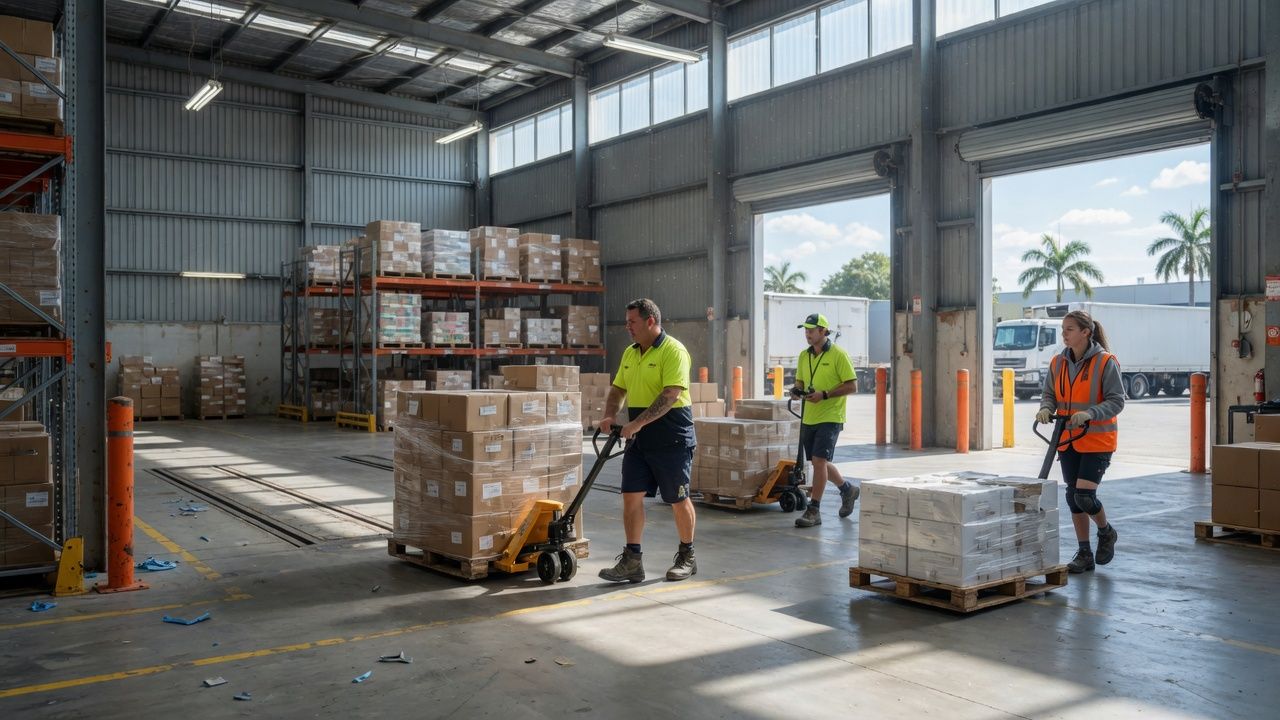
Every casual staff agency Brisbane employers meet will quote an hourly charge rate. Very few will volunteer what sits inside it, whether their licence is current, or what happens to your dispatch dock when the Brisbane River catchment gets three hundred millimetres in a weekend. Those three things decide whether a supplier saves you money or quietly transfers risk onto your balance sheet.
This is a buyer's guide for operations, HR and procurement people in Brisbane and South East Queensland who are selecting or reviewing a casual staffing supplier. It covers the licensing law that applies here and nowhere else in quite the same form, the pay and loading rules that set the floor under any quote, the heat and wet season controls a Queensland site genuinely needs, and a question checklist you can take into a supplier meeting.
Key Takeaways
- Under the Labour Hire Licensing Act 2017 (Qld), any provider supplying workers in Queensland must hold a licence, and it is also an offence for a host to engage an unlicensed provider. Licence numbers are searchable on the public register at labourhire.qld.gov.au.
- Queensland licensees must report to the chief executive every six months, within 28 days of the reporting period ending, covering matters such as worker numbers, visa workers and accommodation arrangements. Ask a supplier whether their reporting is up to date.
- Casual employees receive a 25 per cent casual loading on the base rate under the Fair Work system, and the National Minimum Wage from 1 July 2026 is $26.44 per hour, so any casual quote materially below the award floor deserves a written explanation.
- A charge rate is the pay rate plus superannuation at 12 per cent, WorkCover premium, payroll tax where applicable, and the agency margin. WorkCover Queensland's target average premium rate is $1.343 per $100 of wages for 2026-27.
- Queensland's heat, humidity and summer storm season are operational risks, not weather small talk, so build acclimatisation, hydration, rest cycles and a wet season staffing plan into the service agreement rather than improvising in January.
Start With the Licence, Not the Rate
Queensland introduced mandatory labour hire licensing in 2018, and the scheme is administered under the Labour Hire Licensing Act 2017 and the Labour Hire Licensing Regulation 2018. The obligation runs both ways. The provider commits an offence by supplying workers without a licence, and the business using those workers commits a separate offence by engaging an unlicensed provider. Penalties for unlicensed supply run into the hundreds of thousands of dollars for a corporation.
How to check a licence number on the public register
The check takes under two minutes and should be repeated, not done once at onboarding. Ask the supplier for the licence number and the exact legal entity name, then search the register published by Queensland Labour Hire Licensing. Confirm four things: the licence status is active, the entity name matches the entity that will invoice you, the licence has not been recently suspended or subject to conditions, and the expiry date is beyond the term of your engagement.
Trading names are where this goes wrong. A supplier may quote under a brand name while the licence sits with a different company, and the invoice may come from a third entity again. If those three names do not reconcile, stop and ask why before any worker walks on site.
The six-monthly reporting obligation
Queensland licensees must give the chief executive a report within 28 days after the end of each six month reporting period. The report covers the licensee's activity, including the number of workers supplied, visa workers and the visa classes held, accommodation provided or arranged, and compliance matters. It is a reasonable question to put to a supplier: are your reports lodged on time, and has the regulator raised any condition on your licence. A provider with clean reporting history is usually a provider with functioning payroll and records.
What Casual Pay and Loading Actually Look Like in Queensland
Queensland employers sit inside the national Fair Work system, so award coverage and the 25 per cent casual loading are the same as the rest of the country. What changes locally is the mix of awards, the WorkCover premium and the payroll tax settings. Warehouse and distribution roles generally fall under the Storage Services and Wholesale Award [MA000084]. Food processing sits under the Food, Beverage and Tobacco Manufacturing Award, and general manufacturing under the Manufacturing and Associated Industries and Occupations Award.
Casual employees receive a 25 per cent loading on the ordinary base rate in place of paid leave, notice and public holiday pay, and that loading must be identifiable as a separate line on the payslip. The casual employment rules changed under the 2024 Closing Loopholes amendments, so an agency still using pre-2024 paperwork is behind.
A rate-card transparency worked example
The single most useful thing you can ask a staffing agency for casual workers is a build-up of the charge rate rather than a headline number. Below is an illustrative build for a general warehouse casual on a day shift. The figures are indicative and rounded for clarity, not a quote, because the correct base rate depends on the award classification and the actual on-costs vary by employer.
- Award base rate, casual classification - Indicative amount (AUD per hour): $28.00; What you should ask: Which award and which grade is this person classified under?
- 25 per cent casual loading - Indicative amount (AUD per hour): $7.00; What you should ask: Is the loading shown separately on the payslip?
- Superannuation guarantee at 12 per cent - Indicative amount (AUD per hour): $4.20; What you should ask: Is super paid on the full ordinary hours figure?
- WorkCover premium - Indicative amount (AUD per hour): $0.47; What you should ask: Which WorkCover classification applies to this work?
- Payroll tax and payroll administration - Indicative amount (AUD per hour): $1.60; What you should ask: Is payroll tax charged as a percentage or a fixed add-on?
- Agency margin - Indicative amount (AUD per hour): $4.00; What you should ask: What does the margin cover: recruitment, replacement, site visits?
- Indicative charge rate - Indicative amount (AUD per hour): $45.27; What you should ask: Does this change for overtime, weekends and public holidays?
When a competing quote comes in several dollars under this structure, the difference has to come from somewhere. Usually it is a lower award classification than the work justifies, super or loading calculated on a narrower base, or a margin so thin the supplier cannot afford to staff a 4am replacement call. Ask which one it is. For distribution and cold chain sites specifically, a supplier offering warehousing labour hire across QLD should be able to hand you this build-up for each role type on your site without rework.
Heat, Humidity and the Wet Season
Queensland's climate changes how casual work has to be planned. There is no legal maximum workplace temperature in Australia. Instead, the Work Health and Safety Act 2011 (Qld) and the WHS Regulation place a duty on the person conducting a business or undertaking to manage the risk, and WorkSafe Queensland and Safe Work Australia both publish guidance on working in heat. Humidity is the part employers underestimate, because sweat evaporates poorly in high humidity and the body loses its main cooling mechanism even at moderate air temperatures.
Practical controls for warehouse and outdoor crews
- Acclimatise new casual workers over their first week rather than putting them straight into a full summer shift in a steel-clad shed. This is the single most common gap when a casual starts in December.
- Move the heaviest manual tasks, container unloads and yard work into the early morning, and reschedule rather than push through the middle of the day.
- Set a hydration routine with cool water within walking distance of the work area, and rest cycles in genuinely shaded or air conditioned space.
- Brief supervisors on the early signs of heat illness, including confusion, cramping and a worker who stops sweating, and give them authority to stand someone down without argument.
- Review personal protective equipment for heat load. High visibility long sleeves, cut resistant gloves and respirators all add to the burden and may need a different rest ratio.
Planning for storm and wet season disruption
From roughly November to April, South East Queensland gets intense storms, flash flooding and occasional cyclone remnants tracking south. Two things then happen at once: your site may need more people for a clean-up or a recovery run, and fewer of your regular casuals can physically get there because roads and rail are cut. Build the plan before the season, not during it.
A workable wet season plan names a cut-off time for calling off a shift, defines who contacts workers and how, sets out whether workers are paid for a cancelled shift and on what terms, holds a reserve list of workers living on different sides of the river and rail network, and agrees a surge process for post-event recovery work. Put those terms in writing with the supplier, because the day the Ipswich Motorway closes is not the day to negotiate them.
The Supplier Question Checklist
Take this into the meeting. The answers, and the speed of them, tell you more than any capability statement.
- Licence - Question to ask: What is your Queensland labour hire licence number and licensed entity name?; What a good answer looks like: Given immediately, matches the register and the invoicing entity
- Reporting - Question to ask: Are your six-monthly reports lodged on time and are there conditions on your licence?; What a good answer looks like: Yes, with dates, and no unexplained conditions
- Pay compliance - Question to ask: Which award and classification applies to each role, and how is casual loading shown?; What a good answer looks like: Named award, named grade, loading as a separate payslip line
- Right to work - Question to ask: How do you verify work rights and monitor visa conditions and expiry?; What a good answer looks like: VEVO checks with diarised re-checks, not a photocopy on file
- Safety - Question to ask: What is your induction, and who owns site-specific training and incident reporting?; What a good answer looks like: Written split of duties in the service agreement
- Heat - Question to ask: How do you acclimatise new starters in summer and brief them on heat illness?; What a good answer looks like: A defined first-week ramp and a supervisor escalation rule
- Continuity - Question to ask: What is your replacement time for a no-show, and your wet season contingency?; What a good answer looks like: A named cut-off time and a reserve pool across different suburbs
- Cost - Question to ask: Can I see the charge rate build-up, and what triggers a rate change?; What a good answer looks like: A line-by-line build and award increases flagged in advance
- Conversion - Question to ask: What is the fee if we hire a casual permanently, and does it taper with hours worked?; What a good answer looks like: A written scale that reduces over time, ideally to nil
If a supplier cannot answer the licence and rate build questions in the first meeting, the rest of the list is unlikely to improve. Most of these points are covered in a supplier's own client FAQ, and a provider that publishes its terms openly is usually a provider comfortable being audited.
Matching the Agency to the Work
A temp staff agency built for office and administrative cover is not the same operation as one that runs night shift warehouse crews. When you hire casual staff for industrial sites, the capabilities that matter are ticket verification for forklift and plant, a consultant who visits your site rather than emailing resumes, after-hours phone coverage that a real person answers, and enough local depth in Brisbane, Ipswich, Logan and the Gold Coast corridor that a replacement is genuinely available.
Multi-state employers have an extra consideration. Casual staff labour hire compliance differs by state: Queensland, Victoria, South Australia and the Australian Capital Territory each run their own licensing scheme with separate registers and obligations. A national supplier should be able to show you a current licence in every state where they place workers, which is a fair question to raise when you are comparing a local operator against a business offering warehouse recruitment Australia wide. When you have shortlisted, the fastest way to test performance is a small live order, so request staff in Queensland for one defined shift pattern and measure fill rate, retention and invoice accuracy over the first month.
Related Resources
Labour Hire Licensing Queensland
Laws and compliance | Labour Hire Licensing Queensland
Heat stress | WorkSafe.qld.gov.au
Storage and Wholesale Award [MA000084] - Fair Work Ombudsman
Warehousing Labour Hire QLD | Chandler Personnel
Warehouse Recruitment Australia | Chandler Personnel
Client FAQ | Chandler Personnel
Frequently Asked Questions
How do I check if a labour hire provider is licensed in Queensland?
Ask for the licence number and the licensed legal entity name, then search the public register on the Labour Hire Licensing Queensland website. Confirm the licence is active, the entity matches the business that will invoice you, and there are no conditions or suspensions attached to it.
Is it illegal to use an unlicensed labour hire provider in Queensland?
Yes. Under the Labour Hire Licensing Act 2017 (Qld) it is an offence both to provide labour hire services without a licence and to enter into an arrangement with an unlicensed provider. Maximum penalties for unlicensed supply run to hundreds of thousands of dollars for a corporation, so the register check is not optional paperwork.
What should a casual charge rate include?
The award base rate for the correct classification, the 25 per cent casual loading, superannuation, WorkCover premium, payroll tax and the agency margin, each as a separate line. Ask how overtime, weekend, night and public holiday rates are calculated, because that is where two similar quotes diverge.
Who is responsible for safety when a casual worker is placed on our site?
Both parties hold a duty under the Work Health and Safety Act 2011 (Qld). The labour hire provider remains the employer and must consult, cooperate and coordinate with you, while you control the workplace and the task. In practice, the provider covers general induction and work rights, and you cover site specific induction, plant familiarisation and supervision. Write the split into the agreement.
How do we keep casual crews working safely through a Queensland summer?
Acclimatise new starters over their first week, shift heavy work to the cooler part of the day, set hydration and rest cycles in genuinely shaded or air conditioned space, and train supervisors to recognise heat illness and stand a worker down. WorkSafe Queensland publishes guidance on managing the risks of working in heat.
Can we hire a casual worker permanently after they have been on site for a while?
Usually yes. Most suppliers allow it under a transfer fee that reduces as the worker accumulates hours through the agency, and some remove it entirely after an agreed number of hours. Agree the scale in writing at the start, and check it against the employee choice pathway rules introduced by the 2024 casual employment amendments.
Conclusion
Choosing a casual staffing supplier in South East Queensland comes down to three checks that take an afternoon: the licence on the public register, the charge rate broken into its parts, and a written plan for heat and wet season disruption. A supplier who answers all three without hesitation will usually cost slightly more per hour and considerably less per year. Run one small live order against the checklist above, measure fill rate and invoice accuracy over the first month, and then decide. If you want a starting point, call (03) 9656 9777 to talk through your Queensland shift requirements.