Temp Electricians: When Electrical Labour Hire Beats Hiring Permanently
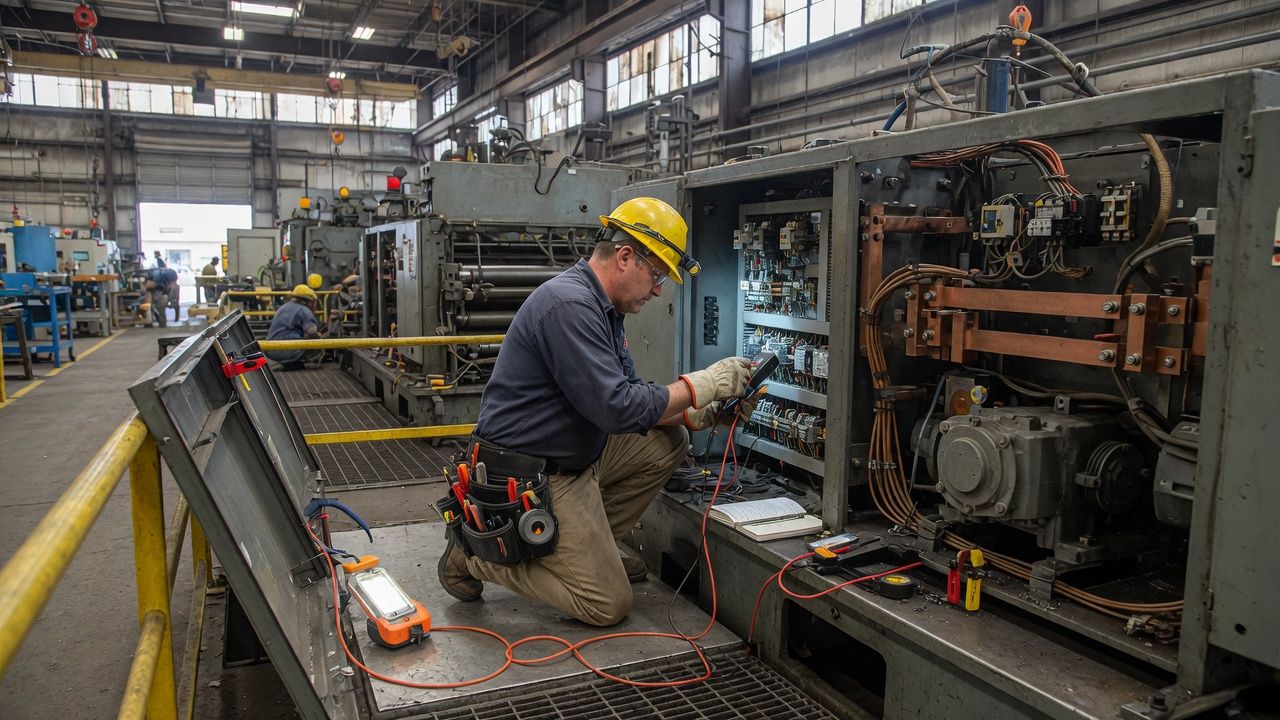
Temp electricians get treated as the expensive option because the hourly charge rate lands on a purchase order while a permanent salary sits quietly in a budget line. Compare those two figures directly and temporary electrical labour hire always looks dearer. Compare the fully loaded cost of an employed electrician against the hours you actually need covered, and the answer changes for a large share of plant and facilities work.
This guide is for the person who has to make that call: the maintenance manager with a shutdown eight weeks out, the facilities manager covering parental leave, or the plant manager who cannot justify a fifth full-time sparky for work that exists four months a year. It covers the scenarios that favour electrician labour hire, the loaded cost model, the safety obligations you keep as the host, and how to stop plant knowledge walking out the gate. Chandler Personnel runs both a labour hire desk in Melbourne and a permanent recruitment team, so the comparison below is the one we run with clients before recommending either.
Key Takeaways
- A permanent electrician typically costs 25 to 35 per cent more than base salary once superannuation at 12 per cent, leave, leave loading, workers compensation and payroll tax are added.
- Labour hire wins when the work has a defined end date, an unpredictable volume, or a shift pattern you cannot staff permanently.
- A permanent hire wins when the work is continuous, the plant knowledge is deep and specific, and the role carries responsibility for systems documentation.
- Host employers keep health and safety duties for labour hire workers, including site-specific induction, isolation authority and supervision.
- Protect plant knowledge by requiring the agency worker to update the maintenance system during the placement, not at the end of it.
The Scenarios Where Temporary Electrical Labour Hire Wins
Planned shutdowns and turnarounds
A shutdown compresses six months of maintenance into four to ten days, often across 12 hour shifts and seven day rosters. No plant carries the headcount to absorb that. Bringing in four to eight electricians for the window, licences and high risk work tickets already verified, costs less than the overtime bill for running your own team into fatigue limits, and keeps your permanent crew available for the restart.
Installations and capital projects
New line installations, switchboard upgrades and conveyor extensions have a start and a finish. The work needs licensed people, but the headcount disappears when commissioning is signed off. Hiring permanently for a project and making the role redundant nine months later costs more than the labour hire premium ever would, and it damages the reputation you rely on when you next advertise.
Plant relocations
Relocations need a surge of decommissioning, cabling and recommissioning across two sites at once, usually under a fixed lease handover date. Labour hire lets you run both sites at once without leaving the operating plant uncovered.
Leave cover
Parental leave runs 12 months. Long service leave might be two or three months. Annual leave for a two-person electrical team creates a coverage hole every January. These are the most straightforward cases because the duration is known in advance and the role already exists with a written scope.
Night shift and weekend coverage
Night coverage is where temp electricians most often outperform a permanent hire. Extending coverage to afternoon or night shift is where permanent hiring gets hard. Experienced electricians with families often will not take a permanent night roster, but many will take a defined three or six month night placement at a shift-loaded rate. That also lets you test whether the coverage actually reduces downtime before you commit to a permanent position.
Seasonal production peaks
Food production, agribusiness and beverage sites have predictable peaks. If your line runs 24 hours from November to March and one shift the rest of the year, staffing the electrical team for the peak means carrying idle labour for seven months. A core permanent team sized for the base load, supplemented with temporary workers for the peak, matches cost to output. This is the most common pattern across our manufacturing recruitment client base.
The True Cost Comparison
The usual comparison is wrong because it puts an agency charge rate next to a base salary. The charge rate already contains everything an employer pays; the salary contains almost none of it. Use the structure below instead, with your own payroll tax and WorkCover rates, because both vary by state and claims history.
- Base salary or hourly rate - Permanent employee: Indicative $95,000 to $120,000 for an industrial maintenance electrician; Labour hire electrician: Charge rate per hour worked, all inclusive
- Superannuation - Permanent employee: 12 per cent of ordinary time earnings from 1 July 2025; Labour hire electrician: Included in the charge rate
- Annual leave - Permanent employee: 4 weeks, plus 17.5 per cent leave loading where the award or agreement provides it; Labour hire electrician: Not payable; casual loading sits inside the rate
- Personal and carer's leave - Permanent employee: 10 days per year, plus the cost of covering the shift; Labour hire electrician: You pay only for hours worked
- Public holidays - Permanent employee: Paid whether the plant runs or not; Labour hire electrician: Paid only if worked, at the applicable penalty
- Long service leave - Permanent employee: Accrues from year one, provisioned on the balance sheet; Labour hire electrician: Provider obligation, including portable schemes where they apply
- Workers compensation - Permanent employee: Premium on your policy, rated to your claims history; Labour hire electrician: Provider's policy, though host duties and claims influence still apply
- Payroll tax - Permanent employee: Applies above the state threshold; Labour hire electrician: Usually captured in the charge rate; confirm treatment in your state
- Recruitment cost - Permanent employee: Placement fee or advertising, plus 20 to 60 hours of manager time; Labour hire electrician: Nil; screening and licence checks sit with the provider
- Time to start - Permanent employee: 6 to 12 weeks including notice periods; Labour hire electrician: Days to about two weeks for a licensed electrician
- Downtime exposure while unfilled - Permanent employee: Carried by you for the whole search; Labour hire electrician: Reduced to the fill time
- Exit cost - Permanent employee: Notice, redundancy where it applies, accrued leave payout; Labour hire electrician: End the assignment on the agreed notice
Two numbers decide it. Utilisation: if you genuinely have 38 hours of electrical work every week of the year, a permanent hire is cheaper per productive hour. Downtime cost: an unfilled electrical role on a continuous line is not a saving, it is a risk with a dollar value per hour of stoppage, and that figure usually dwarfs any rate difference. Work out your own cost per hour of unplanned downtime before comparing rates at all. Our breakdown of permanent recruitment vs labour hire for trades applies the same model to mechanical trades.
A simple decision rule
- Defined end date, or work under about nine months: labour hire.
- Continuous work with deep plant-specific knowledge: permanent.
- Unclear whether the volume will last: labour hire first, convert if it does.
- Shift pattern the local market will not accept permanently: labour hire on a rotating basis.
- Role owns compliance records, drawings or the maintenance system: permanent.
Induction, Supervision and Safety Obligations
The most common mistake is treating induction as a formality because the worker is licensed. A licence proves electrical competence. It says nothing about your isolation procedure, your permit system, your hazardous area classification, or which switchboard feeds the fire pump.
In Victoria, changes to the Occupational Health and Safety Act 2004 effective 22 March 2022 confirmed that labour hire providers and host employers share duties to labour hire workers and must consult, cooperate and coordinate. The host controls the site, so the host controls most of the risk. A workable split looks like this.
- Obligation: Owner
- Licence verification on the regulator's register before the first shift: Provider, confirmed by host
- General safety induction and labour hire worker rights: Provider
- Site-specific induction: isolation points, permits, hazardous areas, emergency plan: Host
- Authority to isolate and apply locks and tags: Host, in writing and per person
- Supervision arrangements and who the worker reports to each shift: Host, agreed with provider
- Incident reporting to both parties: Shared
- Certificate of Electrical Safety for completed installation work: The licensed person doing the work, with records held by the host
Supervision deserves a decision, not an assumption. An A-grade licence holder can work unsupervised on electrical work, but "unsupervised" is not "unaccompanied on night shift on unfamiliar plant". Set a supervision level for the first two weeks, write it down, review it. If the placement holds a supervised or restricted licence, the supervising electrician must be rostered on the same shift, every shift, including during shutdowns.
Protecting Plant Knowledge and IP on Short Tenures
The genuine argument against short tenures is knowledge leaving the site. It is manageable, but only if you build it into the placement from day one rather than asking for a handover in the last week.
- Require maintenance system entries during each shift, not batched at the end. Make it a condition of timesheet approval.
- Keep drawings, PLC programs and switchboard schedules on your own systems. Never let a program exist only on an agency worker's laptop.
- Use a confidentiality clause covering process information, formulations and control logic, and confirm it flows through to the individual worker.
- Control PLC and SCADA access by named account with an end date tied to the assignment, then revoke it the day the placement finishes.
- Pair a returning temporary electrician with the same plant area each time. Consistency recovers most of the knowledge advantage of a permanent hire.
- Record a short note or video for each non-routine fault fixed. Fifteen minutes during the assignment beats a two hour exit meeting.
Ask your electrical staffing agency to hold a named pool for your site rather than sending whoever is available. Repeat placement is the single biggest factor in whether temporary electrical cover feels like an extension of your team or a rotating stranger, and it is why we keep licence and ticket currency on file per site rather than per assignment.
What to Give an Agency to Get a Fast, Accurate Fill
Temp labour hire fills fast when the brief is specific: licence class, high risk work tickets, shift pattern and start date, the plant and control systems in use, site location and parking, the rate range you expect, and the supervisor's name. Vague briefs get a slow shortlist and the wrong people. Send those details when you request staff and a licensed electrician for hire is usually on site within days rather than weeks.
Related Resources
Labour Hire Melbourne | Chandler Personnel
Permanent Recruitment | Chandler Personnel
Manufacturing Recruitment | Chandler Personnel
Permanent Recruitment vs Labour Hire for Maintenance Trades
Request Staff | Chandler Personnel
Labour hire hosts | WorkSafe Victoria
Labour Hire Authority Victoria
Pay guides | Fair Work Ombudsman
Frequently Asked Questions
Are temp electricians more expensive than permanent employees?
Per hour worked, usually yes. Per year of actual coverage, often no. Add superannuation at 12 per cent, four weeks of annual leave with loading, personal leave, public holidays, long service leave accrual, workers compensation, payroll tax and recruitment cost, and an employed electrician typically costs 25 to 35 per cent above base salary before a single hour of overtime.
How quickly can an electrical staffing agency fill a role?
For a licensed electrician with common tickets, a few days to about two weeks if the brief is clear and induction can be scheduled. Specialist requirements such as hazardous area competency, high voltage switching or a specific PLC platform take longer. A permanent search for the same role usually runs 6 to 12 weeks including notice.
Who is responsible for safety when a labour hire electrician is on my site?
Both parties. The provider and the host share duties and must consult, cooperate and coordinate. The host controls the site, so site-specific induction, isolation authority, permits and supervision sit with you. Put the split in writing in the service agreement.
Can a temporary electrician become a permanent employee?
Yes, and it is a common path. Temporary-to-permanent lets both sides assess fit on the actual plant before committing. Agree the conversion terms and any transfer fee up front so the conversation is straightforward later.
What licences should I verify before temp electricians start on site?
The electrical licence on the issuing regulator's register, any high risk work licence classes the role needs such as forklift or boom-type elevating work platform, low voltage rescue and CPR currency, and any site-specific tickets. Also check the provider's labour hire licence in Victoria, Queensland and South Australia.
Does using labour hire mean I lose control of the work?
No. You direct the day-to-day work, set the priorities and control access. The provider handles employment, payroll, insurance and licence currency. The practical difference is administrative, not operational.
Conclusion
This is not temporary versus permanent as a philosophy, it is a match between the shape of the work and the shape of the cost. Continuous, knowledge-heavy work belongs on your payroll; bounded, peaked or shift-awkward work belongs with a provider. Run the loaded cost comparison with your own payroll tax and WorkCover rates before the next shutdown or leave gap, then call Chandler Personnel on (03) 9656 9777 with the licence class, the tickets and the start date.