Robotics Technician Hiring: A Warehouse Guide
Key Takeaways
- Automated distribution facilities require technicians with balanced skills in electrical work, mechanical repair, and computer control logic.
- Practical, bench-based tests are far more reliable than traditional interviews for checking diagnostic abilities.
- Safety knowledge regarding machinery directives, emergency stops, and interlocks is non-negotiable.
- Cross-training electro-mechanical specialists and maintenance workers provides a sustainable talent pipeline.
The Shift Toward Warehouse Automation Recruitment
Distribution centres look very different today than they did a decade ago. Automated storage and retrieval systems (ASRS), autonomous mobile robots (AMRs), and high-speed sortation conveyors handle goods across thousands of square meters. To keep these systems running smoothly, businesses require dedicated technical support on site.
When you look at modern operations, Warehousing and Logistics Recruitment must focus on skilled technical trades alongside general logistics labor. Automated systems run continuously, and every hour of unplanned downtime represents lost revenue and delayed customer shipments.

Why the Technical Talent Shortage Exists
The rapid installation of robotic systems has outpaced the supply of qualified maintenance personnel. Several factors contribute to this condition:
- Rapid adoption of complex robotic cells across retail and third-party logistics.
- An aging workforce in traditional mechanical and electrical trades.
- Educational programs that teach software or mechanical theory separately rather than together.
- Competition for maintenance personnel from manufacturing, mining, and food packaging sectors.
For a broader perspective on the technological concepts behind these automated tools, you can review the Wikipedia Robotics Overview.
Key Roles in Automated Logistics Staffing
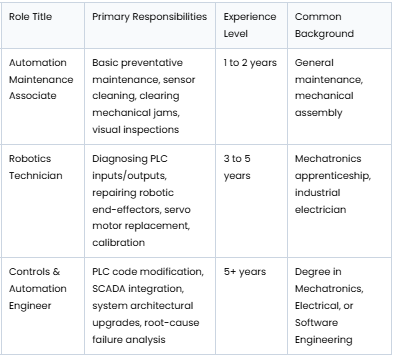
Before posting a job ad, you must clarify the exact level of support your facility needs. Maintenance teams in automated warehouses typically divide tasks into distinct operational tiers.
The following table breaks down common job roles, their main responsibilities, and the background experience to look for:
What Makes Industrial Robotics Talent Different?
Traditional maintenance workers often specialize in single trades. An electrician focuses on wiring, panels, and power distribution. A mechanic focuses on gearboxes, hydraulics, and bearings.
Industrial robotics specialists must understand how these two areas interact through digital controls. They need to understand:
- How a faulty proximity sensor sends a digital signal back to a central controller.
- How software logic gates interpret that signal to trigger pneumatic or mechanical motion.
- How bus networks (such as Profinet, Ethernet/IP, or DeviceNet) transmit commands across long distances.
Pro Tip: When defining job descriptions, avoid asking for a software engineer if your primary need is someone who can replace a burnt-out servo motor, realign an optical eye, and trace a short circuit on a live shift.
Essential Technical Skills and Core Certifications
Evaluating technical qualifications can be challenging if you come from an operational logistics background rather than an engineering one. To simplify your candidate screening, look for specific trade credentials, vendor certifications, and core competencies.
Required Mechanical and Electrical Competencies
Your technicians will handle physical hardware daily. Their core capabilities should include:
- Electrical Diagnostics: Reading electrical schematics, using multimeters to test continuity, measuring voltage drops, and troubleshooting 24VDC control circuits.
- Mechanical Maintenance: Aligning precision drive belts, inspecting planetary gearboxes, maintaining pneumatic actuators, and replacing bearings.
- Sensor Technology: Adjusting optical, inductive, capacitive, and ultrasonic sensors to detect totes, pallets, and items reliably.
- Motor Drives: Setting up and tuning variable frequency drives (VFDs) and servo motor systems.
PLC and Software Literacy
Technicians do not need to write thousands of lines of code from scratch, but they must know how to interact with control programs. Look for candidates who can:
- Open PLC programming software (such as Rockwell Studio 5000 or Siemens TIA Portal) and connect their laptop to a machine network.
- Read ladder logic diagrams to find which physical condition is blocking a system move.
- Force digital I/O points safely during controlled testing procedures.
- Navigate Human-Machine Interfaces (HMIs) to review error logs, cycle histories, and system status alarms.
Industry Certifications to Target
Formal certifications show that a candidate understands standard industrial practices:
- Trade Licenses: Recognized electrical trade certificates (such as an A-Grade electrical license in Australia) or mechanical trade qualifications.
- Mechatronics Diplomas: Vocational qualifications covering electronics, mechanical systems, and computer controllers.
- Vendor-Specific Training: Certificates from major robotics manufacturers (such as FANUC, ABB, KUKA, or Yaskawa) covering safe operation and programming.
- Safety Training: Nationally recognized units covering lock-out/tag-out (LOTO), working at heights, and confined spaces.
If your facility requires specialists across various trades, partnering with a dedicated Trade Recruitment Agency can help you identify candidates who hold these specific technical licenses.
Designing Practical Hands-On Skills Assessments
Resumes often state that a candidate knows how to work with PLCs and robots. However, paper credentials do not always prove that an individual can troubleshoot a broken conveyor under tight deadlines. Practical evaluations provide clear evidence of true diagnostic capability.
The Bench Troubleshooting Test
Set up a controlled testing station in your workshop or training room. Create three distinct fault scenarios:
- The Electrical Fault: Introduce a broken wire inside an insulated harness or install a blown fuse in a 24V power rail. Hand the applicant a multimeter and an electrical print. Ask them to isolate the issue within fifteen minutes.
- The Sensor Misalignment: Position a photo-eye slightly out of range or misconfigure its sensitivity trimmer. Check if the candidate knows how to inspect the indicator lights and verify the reflector target.
- The Pneumatic Leak: Disconnect an air supply line or turn off an air regulator valve to test if they check supply pressures before assuming an electrical fault.
Observe the candidate's diagnostic process:
- Do they work methodically using prints, or do they randomly change parts hoping to fix the issue?
- Do they verify that power is disconnected before touching live mechanical linkages?
- Do they use testing meters correctly and safely?
Ladder Logic Reading Test
Provide the applicant with a printed excerpt of ladder logic showing five rungs controlling a diverter arm. Ask simple questions:
- What input must turn on before the pneumatic valve activates?
- If sensor PE-101 is blocked, which timer begins counting down?
- Why might this solenoid fail to trigger even if the photo-eye shows an object present?
Technicians who understand industrial controls can answer these questions within minutes without needing specialized software training.
Safety Standards and Machine Guarding Protocols
Robotics equipment presents unique hazards. Industrial robots make fast, powerful movements without human warning, and automated mobile robots navigate shared floor space with manual workers. Your candidates must demonstrate deep respect for safety regulations.
Core Safety Principles Every Technician Must Follow
During the evaluation process, verify that candidates strictly observe these foundational practices:
- Zero Energy State Verification: It is never enough to switch off a machine. Technicians must lock out the electrical isolator, bleed pneumatic pressure, install physical mechanical drop-stops, and meter test lines to confirm zero energy.
- Safety Interlock Knowledge: Technicians must understand safety circuits, dual-channel safety relays, and light curtains. Emphasize that jumping out or bypassing a safety switch to keep a line running is grounds for immediate dismissal.
- Emergency Stop Reset Procedures: Candidates must know the sequence for clearing machine jams: safely halt the machine, clear the physical obstruction, inspect the area, step outside the guarded zone, reset the e-stop, and reset the safety controller.
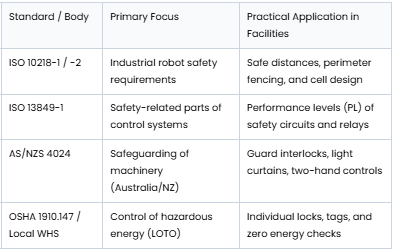
Safety Standards Comparison
Technicians should be familiar with the industrial standards applicable to warehouse machinery:
Key Insight: A technician who moves quickly but ignores lock-out rules creates massive liability for your facility. Always choose safety discipline over pure speed.
Sourcing Channels for Mechatronics Hiring Australia and Beyond
Finding experienced technicians requires expanding your search past traditional general job boards. You must connect with trade-specific networks and related engineering fields.
Effective Sourcing Methods
- Vocational Technical Colleges: Build relationships with institutions teaching mechatronics, electrical instrumentation, and industrial maintenance. Recent graduates with strong mechanical backgrounds make excellent junior technicians.
- Adjacent Industries: Look for maintenance staff working in packaging plants, bottling lines, automotive assembly, and mining processing plants. These environments use the exact same sensors, drives, and programmable logic units found in modern warehouses.
- Specialist Recruitment Agencies: Finding skilled talent takes significant time. Using Permanent Recruitment Services allows you to tap into pre-vetted talent pools without taking your focus away from daily shipping and receiving quotas.
- Apprenticeship Programs: Partner with registered training organizations to sponsor adult apprenticeships. Upskilling your existing material handler staff into maintenance roles builds exceptional organizational loyalty.
If you have urgent open shifts on your maintenance schedule, you can Request Staff Today to secure qualified personnel who can step in and keep your sorters running.
Best Practices for Interviewing Industrial Robotics Talent
A structured interview helps you determine whether a technician has both the problem-solving mindset and the interpersonal communication skills needed to support a round-the-clock operation.
Behavioral and Technical Interview Questions
Ask open-ended questions that require candidates to explain their troubleshooting logic:
- "Tell me about a time an automated conveyor line stopped and threw an unknown error. What were your first three diagnostic steps?"
- Look for candidates who check machine state lamps, inspect physical inputs, and review HMI fault records instead of blindly swapping components.
- "How do you handle a production manager who wants you to bypass a safety light curtain to clear a brief backlog?"
- The correct answer is always an absolute refusal to bypass safety systems, followed by an explanation of how they would clear the backlog safely.
- "Describe your hand-off routine between shifts."
- Reliable technicians keep clean shift logs. They pass along detailed notes about intermittent faults, replaced parts, and pending calibrations to the oncoming team.
- "How do you verify whether an issue is caused by physical mechanical wear or a sensor communication failure?"
- Strong candidates will describe checking mechanical alignment, checking sensor targets, and verifying input signals on the PLC input module.
To understand how a specialist firm screens candidates using proven methodologies, review the Chandler Recruitment Process.
Building Long-Term Retention in Automated Facilities
Hiring top-tier talent is only half the battle. Because the demand for skilled maintenance workers is high across all industrial sectors, you must build an environment that encourages them to stay.

Key Factors for Retaining Maintenance Teams
- Competitive Shift Structures: Continuous warehouse operations often require 24/7 coverage. Provide fair shift rotations, predictable rosters, and balanced weekend schedules to prevent technician burnout.
- Ongoing Training Budgets: Technology changes quickly. Supply your staff with vendor-certified training courses whenever you purchase new equipment, software suites, or automated trucks.
- Clean and Well-Equipped Workshops: High-performing technicians appreciate good tools. Provide calibrated multimeters, industrial diagnostic laptops, reliable hand tools, and a structured spare-parts room.
- Clear Career Ladders: Show entry-level technicians a defined path forward:
When technicians see an opportunity to advance their skills and compensation internally, they are far less likely to leave for competing facilities.
If you have specific operational questions about contracts, safety compliance, or placements, read through the Client FAQs to learn how to structure your staffing requirements effectively.
Frequently Asked Questions
What is the difference between an industrial electrician and a robotics technician?
An industrial electrician focuses on running conduit, pulling wire, terminating circuits, and maintaining primary power panels up to 415V and beyond. A robotics technician works down to the signal and software layer. They calibrate low-voltage sensors, troubleshoot digital communication networks, adjust programmable controllers, and service mechanical linkages on automated machinery.
Should I hire for mechanical skills or electrical skills first?
While candidates with balanced dual-trade skills are ideal, finding them can be difficult. Many warehouse operations find it easier to hire strong industrial mechanics and teach them basic 24V diagnostics and sensor setup. Alternatively, an electrician with strong mechanical curiosity can pick up pneumatic and drive servicing quickly.
Can software engineers fill robotics technician roles?
Software engineers understand code, algorithms, and networking, but they rarely have trade training in physical machine mechanics, three-phase power, or hand-tool safety. Unless they have completed vocational training or hands-on machine shop work, software engineers are better suited for control room roles rather than wrench-in-hand field maintenance.
How do autonomous mobile robots (AMRs) change warehouse maintenance requirements?
AMRs reduce the need for miles of fixed conveyor lines, but they bring new maintenance tasks. Technicians must understand optical lidar systems, wireless network access points, automated charging pads, drive wheel suspension alignments, and battery management systems.
How quickly can a business fill an open automation technician role?
Filling a permanent automation technician role through internal job postings often takes between six to twelve weeks due to the shortage of specialized trades. Working with specialized staffing partners who keep active candidate pipelines can significantly reduce this timeline.
Final Thoughts on Building Your Robotics Workforce
Automation offers massive efficiency gains for modern supply chains, but your hardware is only as dependable as the people who maintain it. Successful robotics technician hiring requires looking beyond standard resumes to evaluate hands-on diagnostic abilities, safety discipline, and systematic problem-solving skills.
By establishing practical bench tests, enforcing strict machine safety standards, and providing ongoing technical training, you can build a resilient maintenance team that minimizes downtime and keeps your facility running at peak performance.
Need Skilled Technical Talent for Your Automated Warehouse?
Chandler Personnel connects logistics, supply chain, and industrial facilities with vetted mechatronics and maintenance specialists. Request Staff Today to discuss your technical staffing needs with our recruitment team.