Google Ads for Recruitment: A Technical Guide to Keywords, Campaign Structure and Conversion Tracking

Recruitment advertising is often measured by how many applications a campaign generates. But application volume does not necessarily indicate campaign quality.
A campaign that produces 100 applications and two suitable candidates may be less valuable than one that produces 25 applications and eight candidates who meet the role requirements.
To run effective Google Ads recruitment campaigns, recruiters need to connect three parts of the process:
- Search intent
- Campaign and landing-page structure
- Candidate-quality measurement
This guide explains how to set up each component—and how to optimise campaigns for qualified applicants rather than clicks alone.
When should recruiters use Google Ads?
Google Search campaigns can be useful when candidates are actively looking for a particular role, qualification, location or employment type.
Common searches might include:
- maintenance fitter jobs Melbourne
- night-shift warehouse jobs
- registered nurse jobs regional Victoria
- horticulture traineeships Melbourne
- entry-level administration jobs
- 482 sponsorship fitter jobs
Unlike social advertising, Search campaigns generally reach candidates when they are already expressing an intention through their search.
Google Ads may be particularly useful for:
- Hard-to-fill positions
- Recurring or high-volume vacancies
- Location-specific recruitment
- Roles with clear job titles
- Traineeships and graduate opportunities
- Campaigns requiring an alternative to job-board advertising
It may be less effective when candidates do not use a consistent job title, the available search volume is extremely low or the role requires passive-candidate outreach.

1. Define the right recruitment conversion
Before selecting keywords or writing advertisements, decide what the campaign should optimise towards.
Recruitment campaigns frequently treat all of the following as equal conversions:
- Viewing a vacancy
- Clicking “Apply”
- Starting an application
- Submitting an application
- Meeting the minimum requirements
- Completing an assessment
- Reaching the interview stage
- Being hired
These actions do not carry the same value.
A submitted application is a useful initial conversion, but the qualified applicant is usually the more meaningful optimisation signal.
A practical recruitment conversion hierarchy could look like this:
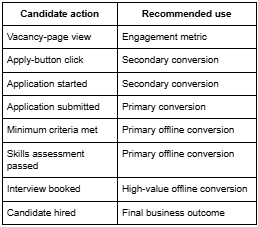
The exact stages will depend on the recruitment process, but they should be agreed upon before the campaign launches.
2. Build campaigns around role and location
Avoid placing unrelated vacancies inside one general “jobs” campaign.
A cleaner structure separates campaigns according to meaningful differences in budget, geography, job family or business priority.
For example:
Campaign: Maintenance recruitment – Victoria
Ad group: Maintenance fitter jobs
Ad group: Industrial electrician jobs
Ad group: Maintenance supervisor jobs
Campaign: Warehouse recruitment – Melbourne
Ad group: Forklift operator jobs
Ad group: Pick packer jobs
Ad group: Warehouse supervisor jobs
Campaign: Horticulture traineeships – Victoria
Ad group: Horticulture traineeship
Ad group: Nursery traineeship
Ad group: Entry-level horticulture jobs
This structure makes it easier to:
- Assign budgets to priority vacancies
- Match ads closely to search terms
- Direct candidates to the correct vacancy
- Compare performance by job family
- Pause filled positions without affecting unrelated roles
- Identify which roles generate qualified candidates
Do not create so many ad groups that each receives too little traffic or conversion data. Combine closely related job titles where the candidate intent and landing page are substantially the same.
3. Select keywords based on candidate intent
Google Ads uses keyword match types to determine how closely a person’s search must relate to a keyword before an ad can enter the auction. The available targeting options include broad match, phrase match and exact match. Google Ads explains the current matching options here.
Recruitment keyword research should consider:
- Job title
- Common title variations
- Location
- Employment type
- Shift
- Industry
- Qualification
- Experience level
- Sponsorship availability
- Candidate urgency
For a maintenance fitter vacancy, the initial keyword list might include:
- maintenance fitter jobs
- mechanical fitter jobs
- industrial fitter jobs
- maintenance fitter jobs Melbourne
- food manufacturing maintenance jobs
- afternoon-shift fitter jobs
- 482 sponsorship fitter jobs
Exact and phrase match
Exact and phrase match can be useful at the beginning of a campaign when:
- The budget is limited
- The role has a clearly defined title
- Candidate relevance is more important than reach
- The account has limited historical conversion data
These match types provide greater control, although they should not be interpreted as literal-only matching. Google may match searches according to meaning and intent.
Broad match
Broad match can help discover relevant searches that were not included in the original keyword list. However, it requires reliable conversion tracking, appropriate bidding and regular search-term analysis.
If the campaign records every application as equally valuable, broad match may optimise towards people who are likely to submit an application—not necessarily those likely to qualify.
For that reason, broader targeting becomes more useful when qualified-candidate outcomes are returned to Google Ads.
4. Build a recruitment-specific negative keyword list
Negative keywords prevent advertisements from appearing for searches that are not relevant to the vacancy. Google recommends using the search terms report to identify additional negative-keyword opportunities. See Google’s guidance on negative keywords.
Possible recruitment negatives include:
- job description
- duties
- resume template
- interview questions
- salary guide
- course
- training provider
- university
- volunteer
- unpaid
- definition
- meaning
However, negative keywords must be assessed in context.
For example, excluding “training” could remove irrelevant course-related searches, but it could also prevent a traineeship campaign from reaching suitable candidates. Excluding “salary” may remove research queries, while also blocking candidates who are comparing genuine opportunities.
Review the search terms report regularly and add negatives based on demonstrated irrelevance rather than assumptions alone.
5. Write advertisements that qualify candidates
A recruitment ad should do more than generate a click. It should help the right candidate recognise the opportunity while allowing unsuitable candidates to self-select out.
Google’s responsive search ads allow advertisers to provide multiple headlines and descriptions, which Google can combine and test. Google provides current responsive search ad guidance here.
Useful headline elements include:
- Exact job title
- Location
- Pay range
- Shift or roster
- Employment type
- Required qualification
- Major benefit
- Sponsorship availability
Example responsive search ad
Headlines
- Maintenance Fitter Jobs Melbourne
- $42–$48 Per Hour + Super
- Permanent Afternoon Shift
- Food Manufacturing Experience
- Apply for the Maintenance Role
- Work With an Established Employer
Descriptions
- Permanent maintenance fitter opportunity in Melbourne. View the requirements, roster and pay range before applying.
- Experienced mechanical fitter? Apply online for an afternoon-shift role with a leading food manufacturer.
Each headline should communicate a distinct piece of information. Repeating slightly different versions of “Apply Now” provides fewer meaningful combinations for Google to test.
Avoid advertising benefits, salaries or working arrangements that are not confirmed. The advertisement and landing page should communicate the same offer.
6. Send traffic to a dedicated vacancy page
Do not send every recruitment campaign to a general careers page containing dozens of vacancies.
The landing page should closely match the candidate’s search and advertisement. It should clearly show:
- Position title
- Location
- Salary or pay range, where available
- Employment type
- Shift or roster
- Responsibilities
- Essential requirements
- Desirable experience
- Employer or industry context
- Application process
- Privacy information
- Clear application button
The application experience should also work properly on mobile. Candidates should not need to search the website again after clicking an advertisement for a specific role.
Where possible, retain the advertising parameters when a candidate moves from the landing page into an applicant tracking system. Otherwise, campaign attribution may be lost between the website and application form.
7. Track applications correctly
A vacancy-page view should not be recorded as an application.
The conversion should fire only when there is reliable evidence that the application was completed—for example:
- A unique application confirmation page
- A successful form-submission event
- A confirmed event returned by the applicant tracking system
Google Ads conversion tracking can be implemented using the Google tag or Google Tag Manager. Enhanced conversions can supplement existing tracking by securely sending hashed first-party data, such as an email address, to improve measurement accuracy. See Google’s enhanced-conversion documentation.
A basic tracking plan might include:
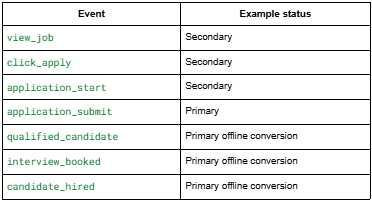
Use consistent event names across the website, analytics platform, applicant tracking system and reporting dashboard.
Test the complete candidate journey before launching the campaign, including:
- Mobile application
- Desktop application
- Form validation
- Confirmation event
- Cross-domain tracking
- Duplicate submissions
- Returning users
- Applicant tracking system redirects
8. Import candidate-quality outcomes
Online conversion tracking shows which advertisements generated applications. Offline conversion tracking helps show what happened after those applications entered the recruitment process.
Google’s enhanced conversions for leads can use hashed first-party data collected through a form and match it with later offline outcomes. Google currently recommends this approach for advertisers beginning offline lead measurement. Read Google’s enhanced conversions for leads guidance.
For recruitment, imported outcomes could include:
- Minimum requirements met
- Phone screening passed
- Skills assessment completed
- Skills assessment passed
- Reference checks completed
- Interview attended
- Candidate placed
This changes the optimisation question from:
Which keywords generate the most applications?
to:
Which keywords generate candidates who progress through the hiring process?
That distinction is important. A low-cost keyword may appear efficient while producing mostly unsuitable candidates. A more expensive keyword may generate fewer applications but a substantially higher interview or placement rate.
Only collect and use candidate information where there is an appropriate privacy basis, transparent disclosure and compliance with applicable privacy and advertising requirements.

9. Measure recruitment performance beyond CPA
Cost per application is useful, but it should not be treated as the final measure of success.
Track the full recruitment funnel:
Application conversion rate
Applications ÷ advertisement clicks × 100
This indicates how effectively the vacancy page converts traffic into applications.
Cost per application
Advertising spend ÷ submitted applications
This shows the cost of generating application volume.
Qualified-applicant rate
Qualified applicants ÷ submitted applications × 100
This indicates the proportion of applicants who meet the role’s agreed requirements.
Cost per qualified applicant
Advertising spend ÷ qualified applicants
This is often more useful than cost per application because it accounts for candidate suitability.
Interview rate
Candidates interviewed ÷ submitted applications × 100
This shows how many applicants progress to a meaningful hiring stage.
Cost per hire
Advertising spend ÷ completed hires
This connects campaign performance to the final recruitment outcome, although it may take longer to collect enough data.
Example
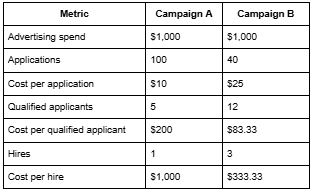
Campaign A appears stronger when judged by application cost. Campaign B performs better when candidate quality and hires are considered.
10. Optimise in the correct order
Recruitment campaigns should be optimised systematically.
First: confirm measurement
Check whether applications and later-stage outcomes are being recorded accurately. Optimising against incorrect data will amplify the problem.
Second: review search intent
Use the search terms report to identify:
- Irrelevant searches
- New job-title variations
- Unexpected locations
- Research-only searches
- High-quality queries worth isolating
- Negative-keyword opportunities
Third: compare candidate quality
Analyse qualified-applicant rate by:
- Campaign
- Ad group
- Keyword
- Search term
- Device
- Location
- Vacancy
- Landing page
Fourth: improve advertisements
Test different combinations of:
- Salary transparency
- Shift details
- Location
- Job title
- Required experience
- Employer benefits
- Application call to action
Fifth: improve the vacancy page
If advertisements receive relevant clicks but applications remain low, review:
- Mobile usability
- Page speed
- Application length
- Missing salary information
- Unclear requirements
- Excessive form fields
- Applicant tracking system errors
Sixth: adjust bidding and budgets
Once conversion measurement is reliable, allocate more budget to campaigns producing qualified applicants and hires—not simply the campaigns generating the cheapest submissions.
11. Be cautious with remarketing and audience targeting
Recruitment involves employment opportunities and candidate information, so audience selection and data use require particular care.
Google notes that additional policies apply to personalised advertising features, including remarketing and custom audiences. Advertisers should review the current requirements before using these features. See Google Ads’ policy guidance.
Recruiters should also consider whether targeting decisions could unfairly limit access to employment opportunities.
Use role requirements, search intent and location carefully, and avoid relying on audience assumptions that are not genuinely connected to the position.
Google Ads recruitment campaign checklist
Before launching, confirm that:
- Each priority role has an appropriate campaign or ad group
- Keywords reflect how candidates actually search
- Negative keywords have been reviewed
- Advertisements include important qualifying information
- Each ad links to the correct vacancy
- The landing page works on mobile
- Application submissions are tracked accurately
- Cross-domain tracking has been tested
- Qualified-candidate stages can be reported
- Search terms will be reviewed regularly
- Privacy and advertising requirements have been considered
- Filled vacancies can be paused promptly
Final takeaway
Successful recruitment advertising is not about generating the highest