PLC Engineer Recruitment in Food Production

Key Takeaways
- Food production lines need automation specialists who understand washdown ratings, hygiene protocols, and rapid changeovers.
- Effective screening requires testing hands-on fault-finding under simulated pressure, not just reviewing software certifications.
- Modern lines require engineers to balance Programmable Logic Controllers, Human-Machine Interfaces (HMIs), and plant-wide supervisory software.
- A structured hiring process helps you secure skilled technical talent before your competitors do.
Why Food Manufacturing Automation Needs Dedicated Specialists
Food processing lines operate under different conditions than standard factories. A general automation engineer might know how to write code for a clean warehouse robot, but food plants introduce unique environmental and operational challenges. When you plan for food manufacturing automation, you must find specialists who understand these specific conditions.
A Wikipedia Programmable Logic Controller overview shows how these digital computers control manufacturing machinery. In food facilities, these devices control sensitive variables like cook temperatures, pasteurization timers, filling weights, and high-speed sorting.
Here are the main plant conditions your automation team must handle daily:
- Washdown and Chemical Cleaning: Food equipment faces hot water, high pressure, and caustic cleaning agents. Engineers must know how to protect sensors, cabinets, and wiring.
- Hygienic Standards: Hardware installations must avoid food traps, open crevices, or materials that could introduce contaminants into food streams.
- Strict Temperature Control: Systems must manage continuous refrigeration, proofing rooms, blast freezers, and baking tunnels without temperature swings.
- High-Speed Throughput: Packaging and bottling lines can process hundreds of units each minute. Code must be lean, deterministic, and free of delays.
- Zero-Tolerance for Cross-Contamination: Automated cleaning systems (Clean-in-Place or CIP) depend on exact valve sequencing to prevent chemicals or allergens from mixing with finished food.
Selecting staff through dedicated Food Production Recruitment channels helps you target candidates who already respect these sanitation and safety rules.
Key Challenges in Programmable Logic Controller Hiring
The demand for controls professionals is higher than the supply. Many facilities struggle with programmable logic controller hiring because multiple industries compete for the same small talent pool.
When hiring for food plants, you will encounter several specific hurdles:
1. Mixed Hardware Platforms
Food plants often expand over decades. As a result, you might have one line controlled by an Allen-Bradley ControlLogix unit, a packaging machine running on Siemens S7-1500, and an older case packer using an Omron or Mitsubishi system. Finding candidates who are comfortable working across multiple platforms is difficult.
2. The Shift-Work Factor
Food production runs around the clock. Automation failures do not stick to business hours. Many senior engineers prefer steady day shifts in design houses or systems integrators rather than working on-call shifts in a 24/7 processing facility.
3. Gap Between Theory and Practical Plant Work
A candidate may hold an electrical engineering degree and understand ladder logic on paper, yet struggle when standing in front of a live, noisy production line with product piling up on a conveyor. You need engineers who can balance software theory with physical mechanics.
Key Insight: Working with a specialized Manufacturing Recruitment Agency allows you to tap into pre-vetted engineers who are already accustomed to factory floors and shift environments.

Sourcing Strategies for Food and FMCG Automation Talent
To build a reliable candidate pipeline, you need to look beyond generic job boards. High-performing automation professionals are rarely actively job-hunting; they are busy keeping plants running.
WHERE TO SOURCE CONTROLS TALENT
System Integrators Cross-Skilled Trades Adjacent Sectors
(Designers seeking (Electricians moving to (Beverage, Pharma,
plant stability) automation roles) Packaging lines)
Use these practical avenues to source candidates:
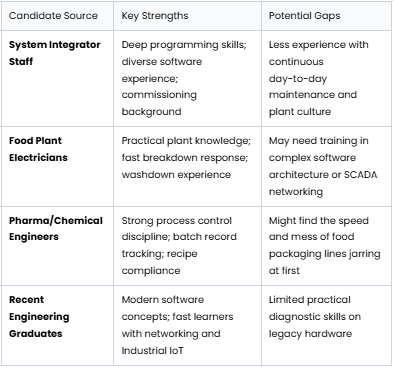
- Target System Integrator Engineers: Engineers working for automation system integrators often spend years traveling from site to site. Many eventually look for a stable, permanent position with a single food manufacturer to cut down on travel.
- Cross-Train Internal Maintenance Technicians: Look at your existing electrical maintenance team. Skilled dual-trade electricians who know your plant machinery can learn PLC programming quickly with the right training. Partnering with a Trade Recruitment Agency can help you find maintenance electricians with basic controls exposure who are ready to step up.
- Recruit from Adjacent Process Industries: If you cannot find candidates directly from food plants, look at brewing, pharmaceutical, dairy, or chemical processing. These fields share identical priorities: sanitary piping, clean-in-place cycles, recipe handling, and compliance tracking.
How to Screen Candidate Troubleshooting Capabilities
A broken line means immediate product loss, especially with perishable raw ingredients like meat, dairy, or dough. When assessing candidates during your PLC engineer recruitment campaign, diagnostic speed is the most critical attribute to evaluate.
5-STEP TROUBLESHOOTING LOGIC FLOW
│
1. Identify Physical Symptom
│
2. Check Field Sensor & Wiring
│
3. Inspect PLC I/O Indicators
│
4. Review Code & Interlocks
│
5. Apply Fix & Verify Operation
Practical Assessment Methods
Do not rely solely on standard interview questions. Use practical technical assessments to see how candidates think through a breakdown:
- The Live Ladder Logic Test: Present the candidate with a printout or a screen capture of a routine ladder logic routine. Introduce an artificial error (such as a missing latching contact, an incorrect timer value, or an unfulfilled safety interlock) and ask them to spot the fault.
- The "Ghost Fault" Scenario: Describe an intermittent issue: "A carton sealer stops randomly twice per shift, but shows no hardware alarm. How do you find the root cause?" Look for candidates who check field conditions first (photo-eyes, reflector alignment, loose wiring) before jumping into changing lines of code.
- Safety Circuit Diagnosis: Ask the candidate to explain the difference between a standard input and a safety-rated dual-channel input. A food plant engineer must understand safety categories and emergency stop circuits thoroughly.
Pro Tip: Look for candidates who mention checking physical inputs and mechanical limits before touching software. In food plants, roughly 85% of automation stops are caused by dirty sensors, mechanical jams, or damaged cables, rather than corrupted PLC code.
Sample Technical Screening Questions
- "Can you explain how you use cross-referencing and trend charts inside your software to catch a fast-dropping input signal?"
- "Tell me about a time an intermittent field device caused a line stop. How did you track it down without halting production for hours?"
- "What steps do you take before pushing an online code change to a running food processing line?"
Evaluating HMI Interface Proficiency
Human-Machine Interfaces (HMIs) bridge the gap between complex software and plant floor workers. In food plants, operators work wearing protective gloves, masks, and earplugs. An interface that is confusing or slow leads to input mistakes, wrong batch recipes, and safety accidents.
When screening for HMI competence, verify that the applicant understands interface design principles rather than just basic graphics placement:
1. Usability for Line Operators
Ask the candidate how they arrange control screens. A good engineer designs displays with the operator in mind:
- High-contrast visual elements that indicate running states clearly.
- Large touch targets for operators wearing gloves.
- Logical screen layouts that prevent accidental starts, stops, or recipe changes.
2. Alarm Management
A poor HMI design floods the screen with hundreds of minor warnings, leading to alarm fatigue. Ask candidates how they organize alarms. They should explain how they prioritize alarms (Warning, Fault, Critical Emergency) and provide actionable messages that direct the operator to the exact physical station where the problem occurred.
3. Recipe and Parameter Control
Food plants switch between product flavors, carton sizes, and pack formats multiple times a day. Engineers must know how to build clean recipe management systems. Screen candidates for their ability to set parameter boundaries so operators cannot accidentally set an oven temperature too low or a depositor stroke too high.
SCADA Technician Staffing and System Evaluation
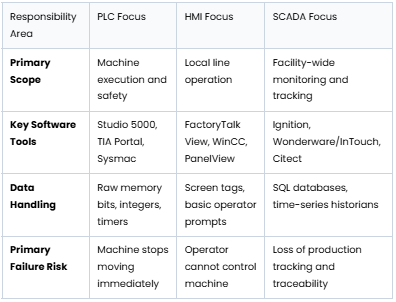
While PLCs manage individual machines, Supervisory Control and Data Acquisition (SCADA) systems monitor and coordinate the entire processing plant. Finding the right professionals for SCADA technician staffing ensures your plant captures real-time data, maintains batch genealogy, and tracks overall equipment effectiveness (OEE).
Essential SCADA Competencies for Food Plants
- Database and SQL Skills: Modern food lines must log process data (cook temperatures, fill volumes, metal detector checks) for food safety audits. SCADA specialists must know how to write queries, log records, and connect control networks to enterprise databases.
- Industrial Networking: Food lines span large physical buildings. Specialists must configure managed switches, VLANs, and fieldbus networks (like EtherNet/IP, Profinet, or Modbus TCP) to prevent network lag from dropping machine communications.
- Historian Configuration: When a product recall occurs, the company must prove every batch met safety limits. Technicians must understand how to set up data historians to log continuous process variables reliably.
- Cybersecurity Fundamentals: Connecting processing lines to internal networks increases exposure to cyber risks. Candidates should know basic network isolation, firewall rules, and user permission models.
Building an Effective Industrial Control Hiring Process
To succeed in industrial control hiring, your recruitment process must move swiftly. Highly qualified controls specialists rarely stay on the market for more than two weeks. A prolonged or disjointed interview schedule will cause you to lose candidates to competing manufacturers.
Follow this structured hiring workflow:
STREAMLINED 4-STAGE HIRING PROCESS
│
Stage 1: Phone Screen (15-20 Mins)
- Confirm commute, hardware fit, shift flexibility
│
Stage 2: Technical Review (45 Mins)
- Scenario analysis, troubleshooting logic, architecture
│
Stage 3: Plant Walk-Through (60 Mins)
- Observe candidate reactions to noise, washdown, hardware
│
Stage 4: Formal Offer (Within 48 Hours)
- Competitive pay, clear responsibilities, swift turnaround
Step 1: Craft an Accurate Job Specification
Avoid generic job listings that ask for every software tool ever written. Specify your primary PLC platforms, your network standards, and the physical working environment. Clearly state whether the role includes rotating shifts or emergency breakdown support.
Step 2: Conduct a Focused Phone Screen
Spend 20 minutes confirming basic parameters:
- Experience with your specific hardware families.
- Comfort working in wet, chilled, or hot manufacturing environments.
- Expectations around pay, call-out duties, and shift rotations.
Step 3: Conduct the On-Site Plant Walk-Through
Never hire a control engineer without walking them through your facility while the line is running. Observe their reactions:
- Do they pay attention to the machines and safety zones?
- Do they show genuine interest in the physical mechanisms?
- Are they comfortable with the smells, noise, and washdown environments typical of food manufacturing?
Step 4: Act Quickly with Offers
When you locate the right specialist, make an offer quickly. Outline your pay structure, technical training opportunities, and growth pathways. If you need dedicated permanent hires, choosing Permanent Recruitment Services provides you with screened candidates and market salary guidance to help secure your top choice.
If your plant is facing an immediate gap in automation support or an upcoming capital installation, you can Request Staff Now to connect with available technical specialists.

Frequently Asked Questions
What certifications should I look for in a food processing PLC engineer?
Certifications from major hardware vendors (such as Rockwell Automation, Siemens, or Schneider Electric) show formal training. However, practical experience in manufacturing plants often matters more than vendor certificates. Look for certified training paired with at least two to three years of plant-floor maintenance experience.
How does food automation experience differ from automotive automation?
Automotive plants focus heavily on robotic welding, heavy transfer presses, and dry assembly. Food plants operate around sanitary designs, high-pressure chemical washdowns, perishable products, precise thermal processes, and high-speed packaging. An engineer from an automotive plant will know PLC logic well, but will need coaching on hygienic practices and washdown protection.
Should we hire an in-house PLC engineer or use an external contractor?
If your facility has multiple automated lines running two or three shifts, an in-house engineer is more cost-effective. An internal engineer responds to downtime immediately, understands machine quirks, and refines recipes continuously. External contractors work well for major capital upgrades or greenfield plant installations, but relying on them for routine breakdowns leads to costly production stops.
What are the most common PLC brands used in the food processing sector?
Rockwell Automation (Allen-Bradley) and Siemens are the most common platforms found across food manufacturing plants. Omron, Beckhoff, and Schneider Electric are also widely used, especially on European packaging equipment and specialized processing skids.
For more details on hiring strategies and workforce solutions, review our Client FAQs.
Conclusion
Sourcing the right automation specialists for food lines is an ongoing challenge, but it protects your plant from expensive downtime, safety issues, and product waste. Focus your recruitment on verified troubleshooting speed, sound HMI design principles, and an understanding of hygienic plant realities.
By building a structured evaluation process and moving decisively when talented candidates appear, you can build an engineering team that keeps your processing lines running at full capacity.
Need expert controls engineers for your processing plant?
Contact the technical staffing specialists at Chandler Personnel today to source experienced PLC, HMI, and SCADA professionals tailored to your food manufacturing requirements.