A pallet racking inspection routine gives a Victorian warehouse a way to catch a bent upright, a missing clip or an overloaded bay before it becomes a collapse. This guide is for warehouse managers in Victoria who want a check their own crew can run between formal inspections, a same-day habit for reporting damage and a clear picture of who inspects and when. It draws on WorkSafe Victoria's pallet racking guidance, which covers standard selective pallet racking. Other types, such as cantilever, drive-in or push-back racking, may need extra measures.
Why racking damage is a people problem first
Racking damage often starts with a small knock that nobody mentions. WorkSafe Victoria says damaged or overloaded racking can collapse onto employees stacking pallets and cause serious injury or death. The crew sees the damage first, so the routine has to make speaking up easy.
The same page says employers, contractors and self-employed persons must make racking equipment, and the way it is used, safe for employees and others, so far as is reasonably practicable.
What the crew checks between formal inspections
WorkSafe Victoria says racking should be inspected frequently for damage and overloading, and that informal inspections should follow the recommendations of the manufacturer or a competent person, for example daily or weekly. So the first step is to ask your racking supplier or a competent person for that recommendation and write it down.
WorkSafe also says racking should be set up, operated and maintained according to the manufacturer's instructions and AS 4084.2:2023, the Australian Standard for the operation and maintenance of steel storage racking. The page says "should", so treat it as guidance and ask your supplier what applies to your system. The standard has its own checklist, and WorkSafe suggests using simple gauges or measuring tools.
Loads, beams and uprights
- Unit loads. Pallets should match the racking design, sit level and key into the beams, with loose goods wrapped or strapped. Goods hanging over the pallet edge can mean the load does not suit the racking.
- Clearances. Loads touching uprights or beams, or standing over-height, can cause damage.
- Beams. Look for heavy deflection, beam connectors that are no longer parallel and obvious signs of a hit. A beam that has popped out of its upright is hanging on one end connector and could collapse.
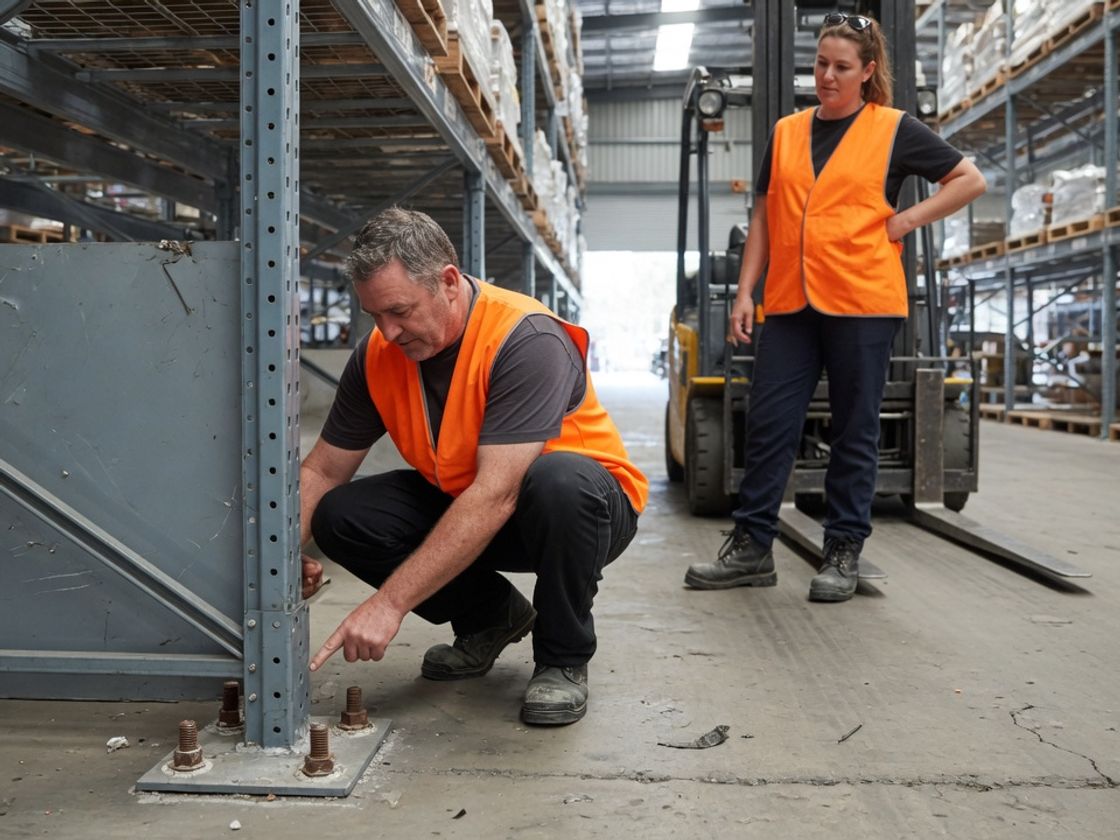
- Uprights. Look for twisting, splits, cracks or significant damage, and for racking that has gone out of plumb, which WorkSafe says to raise with the manufacturer or installer.
Clips, signs and floor fixings
- Safety clips. Check that beam connectors and safety clips are all in place. WorkSafe says replacement clips must be a design approved by the equipment manufacturer, and that clips which keep getting dislodged are a reason to call the manufacturer or installer.
- Safe working load signs. The safe working load (SWL) is the maximum weight of unit loads that should be placed on the racking. WorkSafe says bays should display the SWL signs provided by the designer, and that the load on each beam and on the whole bay should stay within them.
- Floor fixings. Check they are installed and undamaged. WorkSafe says at least two anchors are needed in each footplate.
WorkSafe also suggests using the inventory management system to monitor the total weight going into racking and to report bays at capacity, which ties the stock record to the racking check.
Report and tag damage the same day
WorkSafe Victoria says employees should report any damage to their employer immediately so it can be inspected and assessed. Employers should record the damage, for example with labelled stick-on tags that show where it is and how serious it is. After the assessment, management should tell the health and safety representative. Where nobody on site is confident to assess the damage, ask the racking supplier or a competent person.
Example: a knocked upright in bay 14
Here is an example with illustrative details. A forklift operator clips the base of an upright in bay 14 while putting away a pallet at 10:40 am. The operator stops and tells the supervisor straight away. The supervisor tags the upright to show where the damage is and stops new pallets going into that bay until it has been assessed. WorkSafe's damage flowchart, which follows section 5.5 of AS 4084.2:2023, then sorts the damage into three classes:
- Very serious damage. Damage that needs immediate attention. Immediately off-load all affected bays and repair before reuse.
- Hazardous damage. Damage that needs action as soon as possible. Mark it with a dated hazardous damage tag, do not reload the affected locations once the goods are removed, and repair as soon as possible. If the repair has not happened within four weeks, treat it as very serious damage.
- Acceptable damage. Damage that needs watching. Label it with an acceptable damage tag and record the date. Review it at the next inspection within 12 months, and move to the hazardous steps if it gets worse.
In every case the report is made at once and the damage is recorded. If a person is hurt, or racking collapses, WorkSafe may need to be notified immediately, so check its notifiable incident criteria.
Formal pallet racking inspection by a competent person
WorkSafe Victoria says a competent person should complete a formal inspection of pallet racking every 12 months. The inspector should give the employer a written report with their observations and proposals for any corrective actions. If the racking is more than 8 metres high, a work platform that raises the inspector should be used to inspect the upper levels.
WorkSafe describes a competent person as someone who has acquired, through training, qualification or experience, the knowledge and skills to carry out the task. Ask for evidence of that experience with racking before you book. Keep the report beside your tag records, because its findings tell the crew what to watch in the next informal inspection.
Brief new starters and casual operators on day one
Operating instructions need to suit the racking on your site. WorkSafe says operating instructions should cover several points as a minimum, including the requirement to report any damage from impact so it can be assessed, a ban on climbing racking and adherence to the safe working loads. A casual or labour hire operator may be on site for one shift, so tell them at the start where the tags are kept, who to tell and that every knock is reported, however small.
Chandler Personnel runs site inductions on behalf of clients, so a client can ask the provider to cover the damage-reporting rule in the site induction. Checks on a forklift operator's licence and competency are covered in the post on forklift driver hire, and the racking rules build on those checks. Busy periods bring extra operators onto site, and the post on seasonal forklift safety covers those weeks from the hiring side.
If you need more operators or crew, Chandler Personnel provides warehouse labour hire in Victoria and warehousing and logistics staffing, including forklift drivers.
Related Resources
- Warehouse labour hire in Victoria
- Warehousing and logistics staffing
- Forklift driver hire
- Seasonal forklift safety
- Forklift drivers
- WorkSafe pallet racking guidance
Common Questions About Pallet Racking Inspection
1. How often should pallet racking be inspected in Victoria?
WorkSafe Victoria says informal inspections should follow the recommendations of the manufacturer or a competent person, for example daily or weekly. It also says a competent person should complete a formal inspection every 12 months, with a written report to the employer. Ask your racking supplier for the informal frequency that suits your system.
2. Who counts as a competent person for a racking inspection?
WorkSafe Victoria describes a competent person as someone who has acquired, through training, qualification or experience, the knowledge and skills to carry out the task. For racking, ask the inspector about their experience with racking before you book, and keep the written report they give you.
3. What should I do if a forklift hits an upright?
Report it to your supervisor immediately, record the damage with a labelled tag and stop loading that bay until it has been assessed. WorkSafe's flowchart classes damage as very serious, hazardous or acceptable, and each class has its own action. If anyone is hurt or the racking collapses, check whether WorkSafe must be notified immediately.
4. What does a safe working load sign mean?
It tells the crew the maximum weight of unit loads that should go into each bay and onto each beam level. WorkSafe says the SWL should never be exceeded for the unit load, the pallet beam or the bay, and that bays should display the signs.
5. Do labour hire forklift operators need to know about racking damage reporting?
Yes. WorkSafe says operating instructions should include the requirement to report any impact damage so it can be assessed. Every operator on your site, whether permanent, casual or labour hire, should know that rule, so cover it in your site induction and show them where the damage tags are kept.
Report every racking knock today
WorkSafe's guidance points to three habits: check the racking often, report every knock and have a competent person inspect it every 12 months. Ask your supplier for the informal inspection frequency and write it down. Then brief your next casual operator on the reporting rule before their first pallet.