Mechatronics Technician Recruitment: A Logistics Guide

Key Takeaways
- Modern supply chains need hybrid workers who understand mechanical, electrical, and computerized systems.
- A structured skill matrix helps you separate basic maintenance workers from true multi-trade technicians.
- Multi-disciplinary trade vetting must include hands-on testing, schematic reading, and safety checks.
- Partnering with an experienced Trade Recruitment Agency reduces time-to-fill for hard-to-find technical roles.
- Clear growth tracks and training options keep high-performing technicians in your facility long term.
The Rise of Distribution Center Automation
Logistics facilities look very different today than they did ten years ago. Traditional forklifts and manual pallet jacks now share floor space with complex machinery:
- Autonomous mobile robots (AMRs) that move goods across the warehouse floor.
- Automated storage and retrieval systems (ASRS) that stack bins high into the ceiling.
- High-speed sorting conveyors driven by optical scanners and programmable logic controllers (PLCs).
- Robotic pick-and-place stations with pneumatic grippers and machine vision.
Because of this shift toward distribution center automation, standard maintenance teams face new challenges. A purely mechanical millwright may struggle to diagnose why a fieldbus network dropped offline. In the same way, a standard electrician might not know how to fix a binding mechanical drive.
To learn more about the blend of disciplines behind these systems, read the Wikipedia Mechatronics Overview. Understanding this blend helps you write better job descriptions and set realistic expectations for your facility.
Key Insight: Automation reduces manual handling, but it increases the technical demand on your maintenance crew. When automated lines fail, you need workers who understand the entire system, not just one part.

Why Hybrid Technical Skills Matter
In high-volume supply chains, speed is everything. Every minute a packing line sits idle translates directly into delayed shipments and lost revenue. When an error occurs, you cannot afford to have a mechanical tech blame an electrical fault, while the electrician blames a mechanical jam.
This challenge makes electromechanical technician staffing a smart priority for operations managers. Hybrid specialists offer clear operational advantages:
- Faster root-cause analysis: They look at the machine as a single unit rather than isolated parts.
- Fewer handoffs: One technician can diagnose a sensor error, replace the switch, and adjust the physical bracket.
- Lower overhead costs: You can maintain higher uptime with a smaller, more versatile core maintenance team.
- Better preventive care: Cross-trained technicians notice early signs of wear across mechanical drives, wiring harnesses, and control panels.
If your facility operates in Victoria and needs immediate support on the floor, working with a specialist in Labour Hire Melbourne allows you to bring in skilled technical workers quickly during peak periods.
Mechatronics Hiring Guide: Building a Skill Matrix
Before you post a job listing, you must define the exact technical capabilities your equipment requires. A skill matrix keeps your hiring team aligned. It also gives HR leaders a clear checklist to evaluate candidates who come from different trade backgrounds.
Here is a practical breakdown to use as your mechatronics hiring guide:
Core Competency Areas
- Mechanical Systems
- Alignment of gearboxes, pulleys, and drive shafts.
- Preventive service on roller conveyors and belt drives.
- Servicing pneumatic valves, cylinders, and air prep units.
- Safe operation of hand tools, machine tools, and measuring gear like calipers.
- Electrical and Electronic Hardware
- Reading industrial electrical schematics and wiring plans.
- Troubleshooting three-phase motors, variable frequency drives (VFDs), and servo systems.
- Testing 24V DC control circuits using digital multimeters.
- Replacing faulty photo-eyes, proximity switches, and safety interlocks.
- Control Systems and Software
- Connecting a laptop to PLCs to view live ladder logic code.
- Recognizing communication faults on industrial networks like Ethernet/IP or Profinet.
- Clearing faults and updating parameters on Human-Machine Interfaces (HMIs).
- Basic calibration of barcode readers and vision sensors.
- Safety and Compliance
- Applying Lockout/Tagout (LOTO) rules on mixed energy systems (electric and air).
- Knowledge of local machine safety regulations and arc flash basics.
- Safe working habits around high-speed automated machinery.
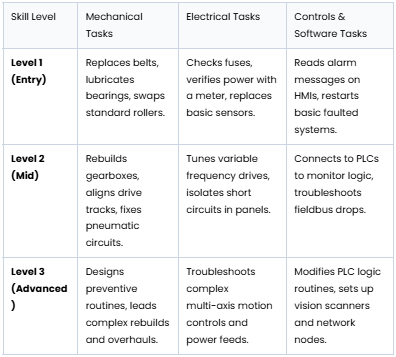
Pro Tip: Do not expect every applicant to score at Level 3 across all three pillars. Most candidates lean stronger toward either mechanical or electrical work. Aim for Level 2 or above in their primary field and at least Level 1 in their secondary field.
Multi-Disciplinary Trade Vetting in Automated Warehouse Hiring
Resumes can look impressive on paper, but hands-on trade skills require direct testing. A technician might list "PLC experience," but in practice, they may have only hit a reset button on a touch screen.
When conducting automated warehouse hiring, set up a multi-step screening process:
Step 1: Practical Schematic Reading
Give the applicant an actual electrical drawing from one of your facility's conveyor lines:
- Ask them to trace power from the main disconnect down to a specific 24V optical sensor.
- Ask how they would confirm if a failure is caused by a blown fuse, a broken wire, or a bad sensor.
- Listen for safe testing habits, such as testing their meter on a known live source first.
Step 2: Mechanical Troubleshooting Scenarios
Describe an operational issue common to distribution hubs:
- "A sorter belt is tracking hard to the left and heating up at the drive roller. What steps do you take?"
- Look for answers that check tension, pulley alignment, bearing wear, and debris buildup before making random adjustments.
Step 3: Controls and Sensor Testing
Show the applicant a standard photo-eye connected to a test power block:
- Ask them to explain the difference between PNP and NPN sensor outputs.
- Ask how they would test the signal pin to verify if the sensor triggers properly when an item passes.
If your internal HR team lacks the technical background to conduct these hands-on tests, working through the Chandler Recruitment Process helps bridge the gap. Experienced recruiters can screen for trade licenses and verify foundational skills before candidates arrive at your site for interviews.
Practical Sourcing Strategies for Specialized Talent
Because hybrid technicians are in high demand, standard job boards often yield few qualified applicants. You need a broader sourcing plan to find technicians with the right trade background:
- Look at Parallel Industries: Candidates from food processing, automotive assembly, and packaging lines often transition easily into logistics. These industries use identical components, such as air cylinders, sensors, and servo motors.
- Connect with Technical Colleges: Build relationships with trade schools offering electromechanical and robotics certificates. Sponsoring apprentice programs lets you train technicians directly on your warehouse hardware.
- Upskill Internal Maintenance Staff: Take your dedicated mechanical fitters and send them to focused electrical courses. Likewise, provide mechanical training to your electricians.
- Engage Trade Specialists: Partner with experts in Warehousing and Logistics Recruitment. An agency with a dedicated trade desk maintains active relationships with passive candidates who are not actively reading job boards.
Comparing Permanent Staffing and Flexible Labor
Every distribution facility has different operational needs throughout the year. Peak shipping seasons, equipment retrofits, and new line launches require different staffing levels than normal daily operations.
Reviewing your long-term and short-term options will help you build a resilient maintenance department:
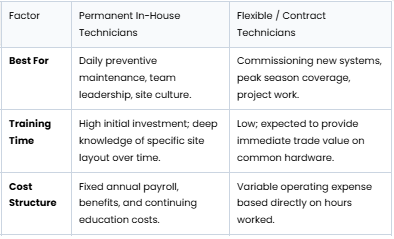

For long-term leadership and core reliability roles, look into Permanent Recruitment Services. For seasonal peaks, line installations, or planned overhauls, short-term trade placements keep your machinery running without adding long-term payroll overhead.
Interview Framework for Hybrid Technicians
When you sit down with shortlisted candidates, focus your questions on how they think under pressure. Maintenance work in an active fulfillment center can be loud, fast, and stressful. You need technicians who stay calm, follow safety procedures, and communicate clearly.
Use these questions during your technical interviews:
Behavioral and Safety Questions
- "Tell me about a time when an operations supervisor wanted a machine restarted immediately, but you felt it was not safe to run. How did you handle the situation?"
- "What is your personal routine for applying Lockout/Tagout when working on a machine with both electrical feeds and air lines?"
Problem-Solving Questions
- "Walk me through how you find an intermittent fault on a conveyor line that only stops running twice a week."
- "If an operator tells you that a robotic cell keeps stopping on an axis error, what are your first three diagnostic steps?"
Collaboration and Communication Questions
- "How do you log your shift notes so the incoming maintenance tech knows what you fixed and what still needs attention?"
- "Describe a situation where you had to explain a complex technical breakdown to an operations manager who did not have a trade background."
Key Insight: Clear communication is just as valuable as technical skill. A technician who documents repairs accurately in your Computerized Maintenance Management System (CMMS) helps prevent recurring breakdowns across all shifts.
Retention Strategies for Next-Gen Distribution Centers
Hiring skilled technicians is only half the battle; keeping them engaged is equally critical. Skilled mechatronics workers have options in the job market. If they feel their skills are stalling or their work environment is unorganized, they will look elsewhere.
Consider these practical steps to build loyalty on your maintenance team:
- Offer Continuing Education: Fund certifications in PLC platforms, robotic safety, or thermal imaging. Technicians appreciate employers who invest in their professional growth.
- Provide Quality Tools: Working with broken diagnostic meters, worn hand tools, or poorly stocked spare parts rooms frustrates good technicians. Equip your team with reliable gear.
- Create Clean Handover Procedures: Build structured communication habits between operational leaders and maintenance crews. Technicians do their best work when operations teams treat them as partners rather than emergency repair workers.
- Recognize Preventive Success: Celebrate weeks with zero unplanned downtime. Maintenance teams often get noticed only when things break. Rewarding smooth, continuous operation shifts your culture toward true equipment reliability.

Frequently Asked Questions
What is the difference between an electromechanical technician and a mechatronics technician?
An electromechanical technician traditionally focuses on mechanical equipment powered by electricity, such as motors, switches, and wiring harnesses. A mechatronics technician covers those same areas, but also works with software, sensors, computerized PLCs, and automated communication networks.
What licenses should I look for when hiring mechatronics staff?
Licensing depends on your state and local rules. In many regions, working inside electrical panels above certain voltages requires a formal electrical license (such as an A-Grade license in Australia). For positions handling structural parts and precision machine alignments, mechanical fitting qualifications are standard.
How can small logistics operators compete for technical talent?
Smaller facilities can attract skilled technicians by offering cleaner work environments, stable day-shift schedules, varied job responsibilities, and clear support for trade upskilling. Technicians often prefer having a broader role across a smaller facility over doing repetitive tasks in a massive hub.
How long does mechatronics technician recruitment usually take?
Because these hybrid skills are specialized, filling a role through traditional job posts can take six to ten weeks. Working with a dedicated trade recruitment partner who maintains an existing pool of pre-screened talent can reduce this timeline to two to three weeks.
Final Thoughts
Modern supply chains rely heavily on automated systems to meet customer expectations. As you add more complex machinery to your facility, the success of your operation rests on the technicians who keep those systems moving. By defining a clear skill matrix, using practical vetting methods, and offering genuine career development, you can build a resilient maintenance team.
If you need help identifying qualified trade specialists for your fulfillment facility, contact the team at Chandler Personnel. You can Request Staff Now to connect with skilled candidates who match your operational requirements.
Ready to build a reliable maintenance team for your automated facility?
Contact Chandler Personnel today to connect with pre-vetted mechatronics specialists and trade professionals ready to support your operations.