Instrumentation Technician Hiring for Hazardous Sites
Key Takeaways
- Hazardous industrial facilities require technicians with certified competence in explosive atmospheres, not just general factory maintenance experience.
- Successful instrumentation technician hiring depends on verifying verified credentials such as Electrical Equipment in Hazardous Areas (EEHA) training.
- Practical assessments must test real-world loop troubleshooting, instrument calibration, and Safety Instrumented Systems (SIS).
- Dual-trade technicians (electrical and instrumentation) provide greater flexibility for high-risk chemical, gas, and manufacturing environments.
- Structured safety screening reduces regulatory risks, unplanned downtime, and process safety incidents.
Operating a chemical processing facility, refinery, or combustible dust plant leaves no room for error. A single loose terminal or an incorrectly sealed conduit can trigger a catastrophic ignition. Because of these risks, instrumentation technician hiring requires a much stricter technical process than standard maintenance recruitment. You need professionals who understand how delicate low-voltage measurement loops operate inside volatile, high-pressure environments.
Finding these candidates is hard. Modern control systems demand a mix of classical mechanical knowledge, electronics skill, and digital networking ability. When you place these demands inside explosive zones, the talent pool shrinks fast. This guide breaks down the technical hiring protocol you need to identify, screen, and select qualified instrumentation and control personnel for high-risk industrial plants.
Understanding Hazardous Area Instrumentation Challenges
Working with hazardous area instrumentation means dealing with environments where flammable gases, vapors, mists, or combustible dusts remain present. In these plants, field devices must never become an ignition source.
Your technicians work on instruments that monitor process variables like pressure, temperature, level, and flow. If a sensor drifts or fails, your distributed control system (DCS) receives bad data. This can cause emergency shutdowns, environmental leaks, or physical damage to plant assets.
Technicians must know how to inspect and maintain equipment based on specific explosion-protection techniques. Below is a breakdown of the standard protection methods your candidates should understand:
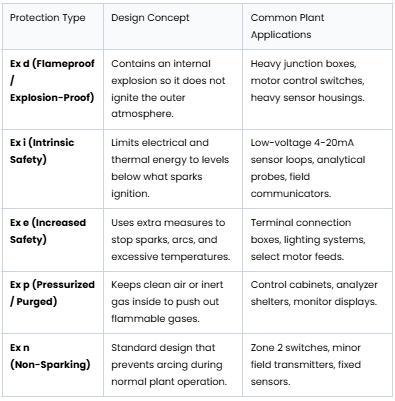
If an applicant does not understand the difference between Intrinsic Safety (Ex i) and Flameproof (Ex d) enclosures, they cannot safely service equipment in your chemical plant.
Critical Certifications and EEHA Competency Standards
You cannot take a candidate's resume at face value when safety is on the line. When running process control technician recruitment, your primary filter must focus on formal certifications for explosive atmospheres.
In Australia and international markets adhering to IEC standards, the benchmark credential is the Electrical Equipment in Hazardous Areas (EEHA) competency framework. This maps to the AS/NZS 60079 and IEC 60079 series of standards.

Essential Credentials to Inspect
- Certificate III in Electrotechnology Electrician / Certificate III in Instrumentation and Control: The trade foundation. Many facilities prefer dual-trade candidates who hold both qualifications.
- EEHA Competency Certification (AS/NZS 60079 or IECEx CoPC): Confirms the person can select, install, set up, test, and maintain explosion-protected gear.
- Hazardous Area Refresher Training: Standards change over time. Verify that the candidate completed a refresher course within the last two to three years.
- Safety Instrumented Systems (SIS) Training: Useful for technicians working on emergency shutdown valves, burner management systems, and functional safety devices (IEC 61511).
Pro Tip: Always ask for the candidate's Statement of Attainment. Check the unit codes. For example, look for specific competencies such as UEERA0043 (Conduct visual and close inspection of electrical installations in hazardous areas) and UEERA0044 (Conduct detailed inspection of electrical installations in hazardous areas).
Hiring managers often choose to partner with an experienced Trade Recruitment Agency to verify electrical trade licenses and check trade registries before bringing candidates on-site.
Process Control Technician Recruitment Protocols
Process control technicians link physical equipment to the digital systems running your facility. They do not just swap broken components. They diagnose why control loops fail, track signal noise, and prevent process upsets.
Process Variable -> Transmitter -> 4-20mA Loop -> I/O Module -> Controller (DCS/PLC) -> Final Control Element (Valve)
When screening applicants, check their depth of knowledge across the complete control loop:
1. Loop Communication Protocols
Your candidates should show direct experience with:
- Analogue 4-20 mA with HART: Calibrating smart instruments, adjusting zero and span, and reading digital diagnostics over analogue wiring.
- Fieldbus Technologies: Troubleshooting Foundation Fieldbus, Profibus PA, or Modbus networks. They must know how bus terminators, voltage drops, and shield grounding affect signal health.
- WirelessHART / ISA100: Working with battery-operated wireless monitors placed in remote plant zones.
2. Final Control Elements and Actuators
Transmitters gather data, but valves make physical process changes. Look for:
- Experience setting up smart valve positioners (e.g., Fisher FIELDVUE, Samson, Metso).
- Ability to rebuild control valve packing, bench-set actuators, and conduct stroke tests.
- Knowledge of fail-safe setups (Fail Open, Fail Closed, Fail in Last Position) to maintain plant safety during an air or power loss.
3. Loop Tuning and Control Dynamics
Ask candidates how they address real-time process swings:
- How do they fix an oscillating temperature loop on an exothermic chemical reactor?
- Do they understand how proportional, integral, and derivative (PID) terms alter valve response?
- Can they tell the difference between sticky valve packing and incorrect PID values?
Calibration Technician Hiring and Bench Testing Standards
Accurate measurement is critical for product quality, regulatory compliance, and process safety. Improper calibration can hide dangerous high-pressure events or cause run-away chemical reactions. Because of this risk, calibration technician hiring demands strict evaluation of an applicant's bench habits and field test methods.
A reliable technician treats calibration as a methodical science. They do not guess, skip steps, or sign off on test tags without proving accuracy across the complete range.
Essential Calibration Competencies
- Multivariable Verification: Checking primary elements across pressure, differential pressure, resistance temperature detectors (RTDs), thermocouples, Coriolis flowmeters, and pH sensors.
- Traceability Practices: Using calibration tools verified by bodies like the National Association of Testing Authorities (NATA) or equivalent national metrology labs.
- Calculating Maximum Permissible Error (MPE): Understanding instrument datasheets to judge whether measured drift falls inside acceptable plant tolerances.
- Documenting Test Results: Writing clean As-Found and As-Left calibration records for quality audits and chemical safety watchdogs.
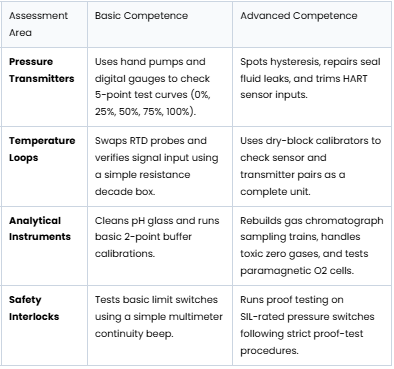
The table below provides a quick scoring model you can use when evaluating calibration skills:
Industrial Automation Staffing and Systems Integration
Instrumentation technicians must also work closely with programmable logic controllers (PLCs) and distributed control systems (DCS). While system programmers write the core logic, field technicians find the line breaks, bad input cards, and field bus errors that stop production.
Core Systems Knowledge for High-Risk Plants
When planning your industrial automation staffing, prioritize candidates who show skills in these areas:
- Safety PLCs: Familiarity with specialized safety platforms like Triconex, HIMA, or Allen-Bradley GuardLogix. Candidates must respect that safety code and standard process logic stay completely separate.
- I/O Channel Troubleshooting: Ability to follow control drawings, track terminal blocks, test input card fuses, and spot ground faults on ungrounded DC field supplies.
- Variable Speed Drives (VFDs): Setting up motor drive parameters, verifying communication drops, and checking safe torque off (STO) safety inputs.
- Cabinet Housekeeping in Ex Areas: Knowledge of ducting, terminal spacing, partition barriers between intrinsically safe and non-intrinsically safe circuits, and shield ground drain wires.
Using structured Permanent Recruitment Services helps you find automation specialists who bring both field-level instrument skills and software diagnostic capability.
A Step-by-Step Technical Assessment Framework
Do not rely on traditional conversational interviews when hiring for hazardous plants. A structured, hands-on screening framework will confirm whether a technician possesses the necessary technical capability.
Step 1: Document & Credential Audit
│
Step 2: Written Technical Screening
│
Step 3: Practical Bench Test
│
Step 4: Safety & Hazardous Area Interview
│
Step 5: Final Onboarding & Verification
Step 1: Document and Credential Audit
Before speaking with an applicant, confirm their background:
- Request copies of all trade licenses and EEHA qualification cards.
- Check expiration dates on all safety tickets and high-risk work licenses.
- Confirm experience levels using employment records.
Step 2: Written Technical Screening
Give the candidate a short 30-minute test. Use real electrical diagrams and process schematics:
- Have them read a Piping and Instrumentation Diagram (P&ID) and trace a control loop.
- Ask them to calculate current values from engineering units (e.g., "What is the mA output for a 0-200 kPa transmitter measuring 150 kPa?").
- Include questions about intrinsic safety barrier limits and earthing requirements.
Step 3: Practical Bench Test
Bring the candidate to a test bench. Give them an out-of-spec transmitter, a communicator, a power supply, and a pressure source:
- Task: Calibrate the unit, identify an intentional error (such as a reversed HART connection or a configured dampening delay), and produce an As-Left report.
- Look For: Do they check the tools for current calibration tags? Do they follow static protection steps? Do they handle delicate parts carefully?
Step 4: Hazardous Area Scenario Interview
Ask open-ended questions about how they manage safety on the floor:
- "You find a missing bolt on an Ex d flameproof junction box inside a Zone 1 area. What do you do?" (Correct answer: They must report it, not just install any random bolt from their toolbox, because flameproof certification demands exact bolt grades and thread depths).
- "How do you test an instrument loop in a hazardous area when you must open an enclosure?" (Look for answers that cover gas testing, hot work permits, or working under strict intrinsic safety rules).
To evaluate how well an applicant fits your plant's safety standards, you can review your internal systems against a structured OHS Scorecard before bringing new workers into hazardous production units.
Sourcing Strategies for High-Risk Environments
Finding skilled technicians requires looking beyond generic job boards. Technical talent in this field is scarce, and the best technicians rarely look at job ads.
1. Source Across Adjacent Sectors
If you cannot find technicians from chemical processing, look into related sectors with similar clean, hazardous, or automated standards:
- Cleanroom and Biotech: The Pharmaceutical Recruitment Australia sector trains technicians to keep strict calibration records, follow tight cleanroom safety, and manage high-precision control loops.
- Food and Beverage Processing: Technicians in these plants manage complex valve banks, pasteurization temperature loops, and washdown instrumentation.
- Heavy Manufacturing: Working with a specialized Manufacturing Recruitment Agency can connect you with industrial electricians who already have extensive experience with drive cabinets, automation networks, and dangerous machinery.
2. Monitor Broader Labor Trends
Skilled trade shortages remain a major topic across national industries. Data from the Australian Bureau of Statistics tracks ongoing shifts in engineering and trade wages, showing strong market demand for certified technicians. Staying updated on wage shifts helps you make competitive offers that attract experienced, safety-minded technicians.
3. Build a Long-Term Pipeline
Instead of waiting for an unexpected resignation or unplanned shutdown, build a continuous pipeline of talent:
- Sponsor industrial apprenticeships to develop your own dual-trade instrument technicians.
- Provide pathways for standard industrial electricians to earn their EEHA qualification on-site.
- Keep in touch with contract technicians who worked during your last major maintenance turnaround.
Technical Candidate Interview Scorecard
Keep your interview panel consistent by using a standardized scoring rubric. Grade every candidate on a scale of 1 to 5 for each technical category:
Score: 1 = Inadequate | 3 = Competent / Meets Standard | 5 = Advanced / Subject Matter Expert
- Hazardous Area Principles: Understanding of explosion-protection methods, area classifications, and cable gland sealing.
- Calibration Rigor: Ability to conduct five-point calibrations, calculate error, and use field communicators correctly.
- Loop Troubleshooting: Clear, logical methods for tracking broken loops, signal noise, and failed cards.
- Safety Culture: Clear commitment to permit systems, isolation steps (LOTO), and reporting near-misses.
- Drawing Literacy: Fast, accurate reading of P&IDs, single-line diagrams, loop drawings, and termination schedules.
If an applicant scores below a 3 in either Hazardous Area Principles or Safety Culture, do not hire them for a high-risk plant. A lack of technical knowledge can be trained on the bench, but an unsafe attitude in an explosive atmosphere presents too high a risk for your team and facility.
When you need skilled trade professionals who meet these safety and technical benchmarks, you can quickly Request Staff Today from Chandler Personnel to keep your plant operating safely and efficiently.
Conclusion: Protecting Plant Safety and Uptime
Operating a hazardous industrial facility requires constant care, clear processes, and skilled professionals. Every valve, probe, sensor, and cable gland contributes to plant safety. A single bad connection or an uncalibrated safety sensor can cause unplanned shutdowns, environmental contamination, or industrial accidents.
Focusing your hiring process on verified EEHA credentials, practical calibration tests, and safety awareness helps you build a dependable technical workforce. Take time to inspect trade documents, test applicants on a live bench, and evaluate their real-world problem-solving skills. Partnering with skilled technical staffing providers helps you fill critical roles with qualified, certified technicians who will protect your plant's equipment, process safety, and long-term production goals.

Frequently Asked Questions
What makes hazardous area instrumentation different from standard plant control?
Hazardous area instrumentation operates where flammable gases, vapors, or combustible dusts create an explosion risk. The instruments and wiring methods must use specialized explosion-protection techniques, such as Intrinsic Safety (Ex i) or Flameproof (Ex d) enclosures. These designs prevent the equipment from generating sparks or heat capable of igniting the surrounding environment.
How often do EEHA qualifications need refresher training?
Industry best practices and standard operating frameworks recommend that technicians complete an EEHA refresher course every two to three years. This training reviews updates to the AS/NZS or IEC 60079 standards, reminds technicians of safe maintenance habits, and checks their practical knowledge of equipment inspections.
What is the benefit of hiring dual-trade electrical and instrumentation technicians?
A dual-trade technician holds recognized qualifications in both electrical work and process instrumentation. In a hazardous facility, this allows one technician to run high-voltage cable, mount control cabinets, balance low-voltage sensor loops, calibrate smart transmitters, and verify intrinsic safety barriers. Hiring dual-trade staff reduces maintenance handoffs, improves job-site safety, and lowers plant labor costs.
Can general calibration skills transfer into hazardous chemical facilities?
Yes, basic calibration practices apply across all manufacturing sectors. However, technicians moving into chemical facilities must learn hazardous area protection rules, intrinsically safe barriers, and site-specific safety permits. They must also learn how to isolate, vent, and clear hazardous process fluids before disconnecting any field device.
Need Certified Technical Talent for Your Facility?
Chandler Personnel provides qualified, safety-tested instrumentation and electrical specialists for chemical, manufacturing, and industrial plants.
Request Staff Today to connect with experienced trade professionals.