Hydraulics Pneumatics Technician Hiring Guide

Key Takeaways
- Fluid power workers need both mechanical assembly knowledge and deep diagnostic skills.
- Schematic tests help you separate genuine troubleshooters from parts replacers.
- Safety testing around stored hydraulic and pneumatic energy protects your facility from severe workplace accidents.
- Partnering with specialized recruiters speeds up the search for hard-to-find trade professionals.
- Structured training and clear safety programs help you retain experienced specialists over the long term.
Sourcing Channels: Fluid Power Technician Recruitment
Finding the right people begins with knowing where fluid power technicians work and train. General job boards often yield applicants who only know how to swap basic oil filters or screw pipes together. Targeted fluid power technician recruitment requires looking into industries that use intense physical force and automated air systems daily.
You will find strong candidates within these main areas:
- Heavy Industrial Manufacturing: Technicians working on stamping presses, plastic injection molding machinery, and automated assembly systems.
- Mobile Plant and Mining Equipment: Mechanics who rebuild hydraulic excavators, drill rigs, and heavy haulage braking circuits.
- Metal Fabrication and Processing: Fitters working with forging presses, rolling mills, and high-pressure water cutting units.
- Food and Beverage Packaging: Specialists experienced in clean, dry pneumatic lines, pick-and-place grippers, and air logic control.
To access these talent pools quickly, many plants partner with a specialized Manufacturing Recruitment Agency. Agencies that focus on industrial sectors maintain active lists of pre-qualified fitters who understand heavy plant environments.
You can also look at trade schools that offer fluid power certifications. Many technicians enter the field through a formal mechanical trade apprenticeship before focusing on fluid systems. Working with a dedicated Trade Recruitment Agency gives you direct access to tradespeople who have completed these certified pathways.

Technical Vetting for an Industrial Hydraulics Specialist
A capable industrial hydraulics specialist needs more than basic wrench skills. High-pressure hydraulic circuits run at pressures exceeding 3,000 to 5,000 PSI. At these pressures, minor assembly errors lead to major mechanical failures or dangerous oil leaks. For an overview of basic fluid laws, review the Wikipedia Hydraulics Overview to see how fluid pressure converts to physical power.
When vetting candidates, evaluate their knowledge across these four core areas:
- Fluid Conditioning and Filtration:
- Understanding ISO 4406 fluid cleanliness codes.
- Identifying filter bypass problems and oil oxidation signs.
- Managing heat build-up with heat exchangers and cooling circuits.
- Hydraulic Pumps and Motors:
- Diagnosing variable-displacement axial piston pumps and gear pumps.
- Setting pump load-sensing compensators correctly.
- Identifying pump cavitation versus aeration through sound and vibration.
- Valve Diagnostics and Setups:
- Adjusting direct-acting and pilot-operated pressure relief valves.
- Calibrating proportional valves and directional spool valves.
- Setting counterbalance valves to prevent suspended loads from falling.
- Cylinder and Actuator Maintenance:
- Inspecting rod seals, piston seals, and wiper rings for wear.
- Diagnosing internal cylinder bypass without taking the unit off the machine.
- Cushion adjustment to stop mechanical shock at stroke ends.
Pro Tip: Ask candidates how they identify pump cavitation. A skilled technician will explain that cavitation produces a sound like gravel moving through the pump housing, caused by low inlet pressure or restricted suction lines.
Testing Schematic Reading and Circuit Literacy
The fastest way to test a fluid power technician is to hand them an engineering drawing. True experts do not troubleshoot by guessing or replacing components until the machine works. They read fluid schematics to trace pressure, pilot signals, and return lines directly to the source of the trouble.
1. ISO 1219 Symbol Identification
Give the candidate an industrial circuit drawing that uses ISO 1219 symbols. Ask them to point out and explain:
- Normally open vs. normally closed valves.
- Pilot lines (dashed lines) vs. main working lines (solid lines).
- Fixed-displacement vs. variable-displacement pumps.
- Check valves with and without pilot-to-open functions.
2. Tracing Circuit Sequences
Ask the applicant to explain a machine sequence step by step. Have them point out:
- Which solenoid fires first to move cylinder A forward.
- How pressure builds up to open a sequence valve.
- What triggers cylinder B to retract once cylinder A hits full extension.
- How the system vents back to the reservoir when idling.
3. Fault Finding on Paper
Mark a fault on the schematic, such as "Cylinder 2 drifts downward under load." Ask the candidate what components could cause this issue. A novice will only blame the cylinder seals. A qualified specialist will also check the pilot check valve, the spool valve centering springs, and the pressure relief settings.
Safety Diagnostic Tests in Mechanical Fitting Recruitment
Safety is the top concern when performing mechanical fitting recruitment for fluid systems. Stored fluid and air pressure carry extreme risks. Oil injected under the skin can lead to amputation, while uncontrolled compressed air can cause severe eye injuries and whip hoses loose.
Use direct safety evaluations during the interview to confirm the technician follows safe work methods.
Safety Testing Matrix
Use this reference table to evaluate technician safety responses during your vetting process:
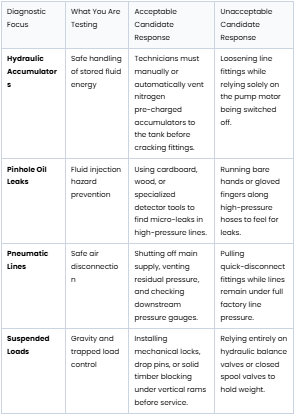
Practical Safety Scenarios
Present the technician with practical safety situations:
- Scenario A: An accumulator circuit shows 0 PSI on the main pump gauge, but the machine will not drop its tooling head.
- Expected Answer: The tech recognizes that a closed isolation valve or jammed check valve may trap high pressure between the accumulator and the tooling head. They must check line points with a portable test gauge before opening pipes.
- Scenario B: A pneumatic supply hose needs replacement on a gantry loader.
- Expected Answer: The candidate follows lockout-tagout (LOTO) protocols, dumps the air preparation unit using a lockable ball valve, checks the soft-start dump valve, and tests the line before removing fittings.
If you need long-term staff who follow these safety protocols consistently, consider using Permanent Recruitment Services to build a dependable, qualified team.
Practical Interview Tactics for Heavy Plant Technician Hiring
When conducting heavy plant technician hiring, you need interview questions that move past theoretical talk. You want to see how the person tackles dirty, noisy, and stressful plant problems.
Hands-On Technical Interview Questions
Question 1: "The main hydraulic pump on a molding press is whining loudly, and the oil looks milky. What are the two distinct problems here, and how do you fix them?"
- Good Answer: The milky appearance indicates water contamination in the oil, possibly from a leaking oil cooler or bad reservoir breathing cap. The whining suggests pump cavitation or aeration caused by water lowering the fluid quality, or a clogged suction strainer. The technician recommends isolating the water source, flushing the oil, replacing filter elements, and testing pump tolerances.
- Red Flag: The candidate suggests just topping off the oil or turning up the pressure relief valve.
Question 2: "An air cylinder on a high-speed packing line moves forward smoothly, but it stutters and chatters on the return stroke. How do you find the cause?"
- Good Answer: The technician checks for bad exhaust flow controls (meter-out controls), worn rod guide bushings causing mechanical binding, uneven air supply pressure, or dry seals needing lubrication.
- Red Flag: The candidate assumes the cylinder is broken and suggests throwing it out without checking the speed control mufflers or air line pressure.
Question 3: "Explain how you set the pressure on a proportional relief valve safely during machine commissioning."
- Good Answer: The applicant explains that they verify the mechanical relief valve is set slightly higher than the proportional valve as a safety backup. They check the electrical input current, use a calibrated digital pressure transducer, and bring the pressure up slowly while watching for oil leaks.
- Red Flag: The technician sets values by feel or tightens screws down completely without a pressure gauge attached.
To make sure your technical hiring is accurate, use a structured vetting workflow. You can review the Chandler Recruitment Process to see how structured candidate vetting identifies the best trade talent.
Retaining Fluid Power Specialists in Industrial Facilities
Attracting top technicians is only half the battle. Fluid power mechanics are in high demand across mining, production, and mechanical construction. If your facility does not provide the right environment, skilled staff will quickly move on to other plants.
Use these approaches to retain your mechanical specialists:
1. Supply Modern Diagnostic Tools
Skilled technicians become frustrated when forced to work with worn-out tools or inadequate test gear. Provide your maintenance team with:
- High-grade digital pressure gauges with data logging.
- Proper hydraulic flow meters and load valves for bench testing.
- Ultrasonic air leak detectors to find pneumatic leaks fast.
- Clean, covered hose crimping stations and contamination capping kits.
2. Keep the Plant Clean and Dry
Hydraulic technicians understand that dirt is the number one enemy of fluid power systems. When plants treat oil leaks as normal, good technicians get discouraged. Show that your facility respects their trade by:
- Fixing oil drips and blown seals quickly instead of using drip pans forever.
- Providing desiccant breathers on all oil reservoirs.
- Keeping bulk oil storage areas clean, dry, and climate-controlled.
- Installing bulk oil filter carts to pre-clean all new oil before it goes into machinery.
3. Provide Continuous Technical Training
Fluid power technology connects closely with industrial electronics and programmable logic controllers (PLCs). Help your technicians grow by funding advanced courses:
- Electro-hydraulic proportional valve setup and tuning.
- Fieldbus communication networks for digital pneumatic manifolds.
- Preventative maintenance training for oil condition monitoring.
- Workplace health and safety refresher courses on pressurized fluid management.
4. Provide Clear Career Paths
Show your technicians where their work can lead. A mechanical fitter can advance into a Maintenance Planner, Reliability Specialist, or Plant Maintenance Supervisor role. When technicians see clear advancement paths within your business, they are much more likely to stay.
Summary of Recruitment Best Practices
Building an outstanding fluid power team requires careful work at every stage of the hiring process. Use this quick comparison to confirm your recruitment approach covers all bases:
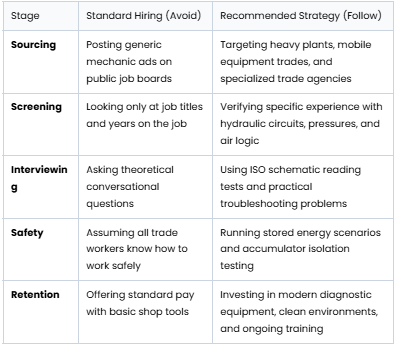
Working with experienced recruitment partners can make this entire process easier. You can learn more About Chandler Personnel to see how deep staffing experience supports industrial plant managers. When you need to scale your maintenance team with proven talent, you can Request Staff Today to get the right people on your shop floor.

Frequently Asked Questions
What certifications should I look for in a fluid power specialist?
Look for tradespeople who hold trade certificates in Mechanical Fitting or Plant Maintenance. Additional credentials from recognized fluid power societies or factory training from major component makers are strong indicators of quality.
How does a pneumatic technician differ from a hydraulic technician?
Hydraulic technicians focus on high-pressure fluid systems designed to lift heavy loads and produce high physical force. Pneumatic technicians work with compressed air systems designed for high-speed actuation, air logic, packaging, and clean automation. Many specialists handle both, but hydraulics involves much higher pressures and contamination risks.
Why is ISO schematic reading necessary for maintenance technicians?
Without schematic reading skills, technicians are forced to guess which valve or hose is causing an issue. A technician who reads ISO symbols can trace the problem logically through pilot lines and control ports, fixing issues faster with less machine downtime.
How can a plant verify if an applicant respects fluid power safety?
Give them a scenario involving a stopped machine that uses an accumulator or a vertical cylinder. If the applicant does not mention locking out the machine, mechanically blocking the vertical load, and bleeding the accumulator pressure to zero before opening lines, they lack necessary safety habits.
Ready to find the right fluid power mechanics for your manufacturing plant? Connect with our trade staffing team to source, vet, and place skilled technicians who keep your equipment running safely.