Hiring Boilermakers in Australia: The Tickets, Weld Tests and Talent Pools That Get You a Productive Fabricator
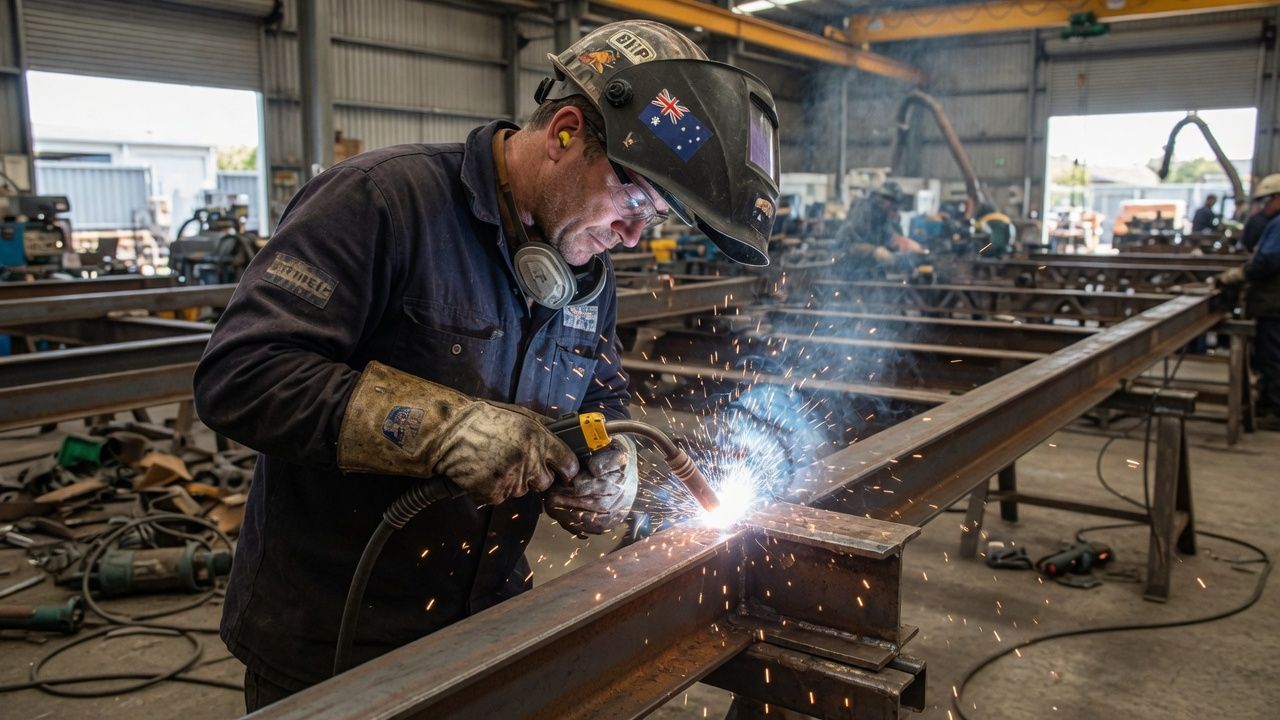
Hiring boilermakers is one of the harder jobs in Australian industry right now. Defence shipbuilding, mining shutdowns, water infrastructure and food plant upgrades are all pulling from the same pool of trade-qualified fabricators, and a resume that says "boilermaker" can mean anything from twenty years of coded pressure pipe to two years of tacking light gauge brackets in a shed.
The difference between those two people shows up on your first weld inspection, not at interview. This guide covers what to check on paper, how to run a weld test that actually tells you something, where fabricators genuinely come from, and what you should expect to pay by shift in 2026.
Key Takeaways
- The baseline qualification is a Certificate III in Engineering (Fabrication Trade), usually MEM30322 or an earlier equivalent, issued by a registered training organisation.
- A trade certificate is not a welding ticket. Structural work is qualified against AS/NZS 1554 and pressure work against AS 1796, and those qualifications are process, position, material and thickness specific.
- Run a timed practical weld test on coupons that match your actual job, then cut and bend them or send them for inspection. Paper alone will not tell you who can produce sound welds.
- Indicative 2026 labour hire pay rates sit around $43 to $55 per hour for day shift workshop boilermakers, with night shift and shutdown rates commonly $60 to $75 per hour.
- Most available boilermakers are not on job boards. They come out of shutdown crews, closing fabrication shops, apprenticeship pipelines and labour hire pools.
What a Boilermaker Actually Is in an Australian Workshop
In practice, "boilermaker" is the trade name for a metal fabricator who marks out, cuts, forms, fits and welds structural and plate steel. The job is roughly half layout and fitting, half welding. A candidate who welds beautifully but cannot set out a mitred elbow or square a frame off a drawing will slow your shop down just as much as a poor welder.
The recognised entry qualification is the Certificate III in Engineering (Fabrication Trade), completed through a four year apprenticeship. You can confirm the code and currency of any training record against the register of nationally recognised trade qualifications before you make an offer. If a candidate holds an overseas trade certificate, treat it as a starting point and lean harder on the practical assessment rather than trying to interpret the paperwork yourself.
Structural Work Versus Pressure Vessel Work
This is the split that most employers get wrong when they write a job ad. Structural fabrication, meaning beams, columns, chutes, hoppers, platforms and plant steelwork, is welded to AS/NZS 1554 Structural steel welding, with weld category SP or GP specified by the designer. Pressure equipment, meaning boilers, pressure vessels and pressure piping, sits under AS 1796 Certification of welders and welding supervisors and the AS/NZS 3992 and AS 1210 family.
A boilermaker qualified for AS 1796 Class 1 or 2 pipe welding has been tested and certified by an approved examining body against a defined range. A structural fabricator may never have held a coded ticket in their life and still be excellent at what your shop does. Decide which stream you need before you start screening, because the two groups command different rates and take different lengths of time to find.
Reading Tickets Without Being Misled
Welding qualifications are range based. A ticket is only valid for a combination of process, parent material, thickness range, joint type and welding position, and it lapses if the holder stops welding in that range or fails to have continuity recorded. When you review a candidate's file, ask four questions of every certificate.
- Which process? GMAW and FCAW (MIG) for production structural work, GTAW (TIG) for stainless, aluminium and root runs on pipe, SMAW (stick) for site work, repairs and heavy sections in wind.
- Which positions? 3G and 4G, or 5G and 6G on pipe, tells you far more than a flat-position-only certificate.
- Which material and thickness? Mild steel plate at 10mm does not qualify someone for 6mm stainless or 25mm structural.
- Who issued it and when? A certificate from a recognised examining body with current continuity beats an unsigned workshop letter every time.
Alongside the welding paperwork, check the site tickets your job genuinely needs: construction induction (white card), working at heights, confined space entry, elevated work platform, forklift licence, overhead crane and dogging or rigging where slinging is part of the role. Hot work permit awareness and correct PPE habits, including a proper auto-darkening helmet, leathers, respiratory protection for galvanised or coated steel, and fume extraction discipline, are behavioural markers worth watching during the practical. Our guide to the must-have skills as a welder breaks down the technical and safety habits that separate a steady producer from a risk.
The Weld Test: How to Run One That Tells You Something
A twenty minute weld test on a scrap offcut proves almost nothing. Build a test that mirrors your work and grade it consistently for every candidate.
Give the candidate a simple fabrication drawing with dimensions, weld symbols and a tolerance note, then ask them to mark out, cut, fit and weld a small assembly in a set time, typically 60 to 90 minutes. Watch the setup as closely as the arc: how they read the symbol, how they tack, how they control distortion, how they handle consumables and machine settings, and whether they clean and inspect their own work before handing it over.
Finish with destructive testing. A nick break or a guided bend on a coupon will show lack of fusion, porosity and cracking in minutes, and for anything going into a code job you can send coupons for macro or radiographic examination. Document the result against a scorecard so hiring decisions across your supervisors stay comparable.
Boilermaker Screening Scorecard
- Trade qualification - What to look for: Certificate III in Engineering (Fabrication Trade) or verified overseas equivalent; Weighting: Pass or fail gate
- Welding qualification - What to look for: Current ticket matching your process, position, material and thickness range under AS/NZS 1554 or AS 1796; Weighting: 20%
- Drawing interpretation - What to look for: Reads weld symbols, datums, tolerances and revision status without prompting; Weighting: 20%
- Fit-up and layout - What to look for: Square, correct root gap, distortion controlled, parts within tolerance; Weighting: 20%
- Weld quality - What to look for: Passes bend or nick break, sound profile, no undercut or visible porosity; Weighting: 25%
- Safety and site tickets - What to look for: White card, heights, confined space as required, hot work permit awareness, correct PPE without reminders; Weighting: 15%
Where Boilermakers Actually Come From
Good fabricators rarely sit on the market for long, so successful boilermaker recruitment is about being present in the places they move through rather than waiting for applications.
- TAFE and RTO apprenticeship pipelines. Third and fourth year apprentices are worth courting early, and a host arrangement through a group training organisation lowers your risk.
- Fabrication shops winding down. When a local shop loses a contract or closes, a whole crew becomes available at once, usually with compatible skills.
- Shutdown and maintenance crews. Experienced shutdown fabricators are used to pressure, permits and confined space work. Many will consider steady day shift work after years of FIFO rosters.
- Labour hire pools. A specialist trades and services recruitment partner already holds tested, ticketed fabricators who can start within days, which matters when a project slips forward.
- Referrals from your own welders. Tradespeople know who is good. A paid referral scheme is usually cheaper than an ad campaign.
Employers looking for manufacturing recruitment support for production fabrication should also think about the mix of hire types. Using labour hire for a peak and converting proven performers through permanent recruitment gives you a trial period that a resume screen never will.
What You Should Expect to Pay in 2026
Boilermakers are covered by the Manufacturing and Associated Industries and Occupations Award 2020 for most workshop roles, typically at C10 level or above, though enterprise agreements and site allowances push real rates well past the award minimum. The figures below are indicative market ranges, not award minimums, and vary by state, site and ticket level.
- Workshop boilermaker, day shift - Indicative pay rate (AUD per hour): $43 to $55; Notes: Charge rates through a labour hire provider typically land $58 to $77 including on-costs
- Afternoon or night shift - Indicative pay rate (AUD per hour): Base plus 15% to 30% shift loading; Notes: Loading percentages set by award or enterprise agreement
- Coded pressure pipe welder - Indicative pay rate (AUD per hour): Premium above structural rates; Notes: Driven by ticket scarcity and inspection requirements
- FIFO shutdown, 12 hour shifts - Indicative pay rate (AUD per hour): $65 day shift, $71 to $74 night shift; Notes: Based on current advertised WA shutdown campaigns
When you build a budget, cost the loaded hour rather than the headline rate. Superannuation, workers compensation, payroll tax, leave, consumables and downtime between jobs all sit behind that number, which is why a labour hire charge rate looks higher than a direct wage but often costs less across a variable workload.
Practical Steps That Shorten Your Time to Hire
Write the ad around the work, not the job title. State the process, the material, the thickness range, the shift pattern and the site tickets required. Fabricators self-select accurately when you give them real detail, and you will get fewer irrelevant applications.
Book weld tests within 48 hours of first contact. Good fabricators are usually holding two or three conversations at once, and the employer who tests first generally hires. Keep a standing test rig and a supervisor rostered to run it, so hiring skilled tradesmen never waits on someone's calendar.
Finally, keep a warm bench. Even when you are fully staffed, maintain a short list of tested fabricators you would take back tomorrow. A tradesmen labour hire agency does exactly this on your behalf, which is what makes a three day mobilisation possible when a client brings a delivery date forward.
Related Resources
Trades and Services Recruitment | Chandler Personnel
Manufacturing Recruitment | Chandler Personnel
Permanent Recruitment | Chandler Personnel
Must-Have Skills as a Welder | Chandler Personnel Blog
My Skills | The National Directory of Vocational Education and Training Organisations and Courses
Manufacturing and Associated Industries and Occupations Award 2020 Summary | Fair Work Ombudsman
Frequently Asked Questions
What qualification does a boilermaker need in Australia?
The standard qualification is a Certificate III in Engineering (Fabrication Trade), currently MEM30322, completed through a four year apprenticeship with a registered training organisation. Earlier codes such as MEM30305 and MEM30319 remain valid for people who completed under them.
Is a boilermaker the same as a welder?
No. A boilermaker is a trade-qualified fabricator who marks out, cuts, forms, fits and welds. A welder may only weld. When you hire welders Australia wide for production work, a pure welder can be the right and cheaper choice, but a boilermaker is needed where layout and fitting are part of the job.
What is the difference between AS/NZS 1554 and AS 1796?
AS/NZS 1554 is the structural steel welding standard covering weld categories SP and GP for beams, plate and plant steelwork. AS 1796 covers certification of welders and welding supervisors for boilers, pressure vessels and pressure piping. Pressure work requires the tighter certification path.
How long should a pre-employment weld test take?
Allow 60 to 90 minutes for a layout, fit-up and weld exercise on a small assembly, plus time for a bend or nick break test. Anything shorter usually only tests one weld run rather than the skills the role actually needs.
How quickly can a labour hire provider supply a boilermaker?
With tested fabricators already on the bench, a provider can usually mobilise within two to five business days for standard workshop roles. Coded pressure welders and confined space qualified fabricators take longer because the pool is smaller.
Should we hire casual or permanent?
Match the hire type to the workload. Project peaks, shutdowns and seasonal runs suit casual labour hire, while a steady order book justifies permanent employment, which is generally cheaper per hour and better for retaining skills in your shop.
Conclusion
Hiring boilermakers comes down to three things: knowing whether you need structural or pressure capability, testing candidates practically against the work you actually do, and being present in the places fabricators move between. Build a scorecard, keep a test rig ready, and pay the market rate for the ticket level you need. If you would rather not run that process in-house, Chandler Personnel can present tested, ticketed fabricators from our existing pool. Call (03) 9656 9777 to talk through your fabrication requirements and shift pattern.