Fitter and Turner Recruitment: How to Assess Machining and Fabrication Skills Before You Hire
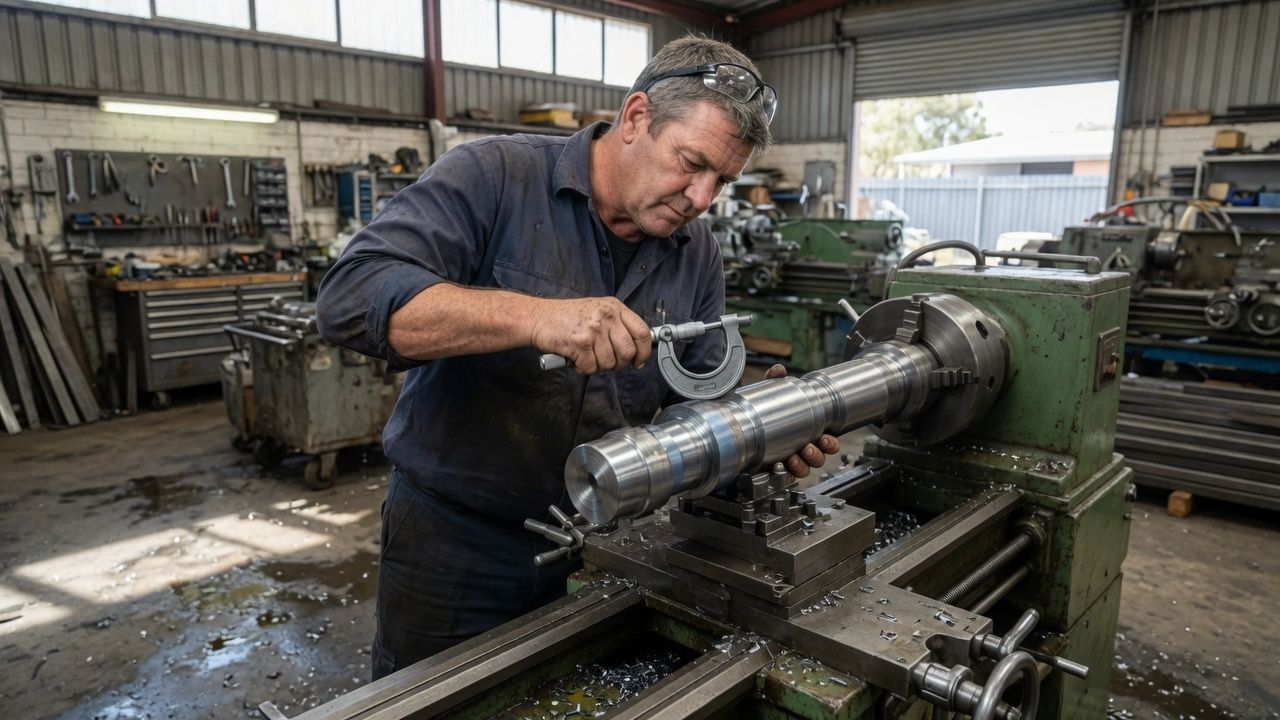
Most bad machining hires are not caught at interview. They are caught three weeks later, when a shaft comes off the lathe half a thou oversize or a keyway is cut on the wrong centreline. Fitter and turner recruitment fails for a simple reason: employers interview for attitude and industry background, then assume the trade certificate covers the metalwork.
It often does not. A Certificate III in Engineering (Mechanical Trade) can be earned in a plant maintenance environment where the apprentice barely touched a centre lathe. If your workshop makes parts rather than changes them out, test for machining ability directly. This guide sets out what to check, a bench test you can run in under an hour, interview questions with model answers, and how to treat overseas qualifications fairly.
Key Takeaways
- A fitter and turner makes and fits precision components. A maintenance fitter keeps existing plant running. They are different hires with different evidence requirements.
- Test measurement first. If a candidate cannot read a 0-25mm micrometer and a vernier to 0.02mm reliably, nothing else in the workshop is trustworthy.
- A 45 to 60 minute bench test covering measurement, drawing interpretation and a short turning task separates real machinists from resume machinists.
- Overseas qualifications should be checked through Trades Recognition Australia rather than judged on the certificate wording alone, then confirmed with a practical test.
- Indicative Australian rates for a qualified fitter and turner sit around $38 to $52 per hour depending on state, shift pattern and CNC capability, above the Manufacturing and Associated Industries and Occupations Award 2020 minimum.
Fitter and Turner, Maintenance Fitter or Mechanical Fitter: Which One Do You Actually Need?
The three titles get used interchangeably on job ads, and that is where the mis-hire starts. The distinction is what the person produces on a normal day.
- Fitter and turner - Core output: Machined parts made to drawing, then fitted and assembled; Hire them when: You cut metal in-house: shafts, bushes, spacers, sleeves, one-off repairs; Evidence to ask for: Manual lathe and mill hours, tolerance work, photos of finished parts
- Maintenance fitter - Core output: Plant uptime, breakdown response, planned servicing; Hire them when: Your problem is downtime on conveyors, pumps, gearboxes or packaging lines; Evidence to ask for: Fault-finding examples, shutdown work, hydraulics and pneumatics
- Mechanical fitter - Core output: Installation, alignment and assembly of mechanical plant; Hire them when: You are installing or relocating equipment, or doing heavy assembly; Evidence to ask for: Laser alignment, rigging tickets, install projects
Plenty of tradespeople cover two of these, very few cover all three well. If your workshop runs a machine shop alongside a breakdown crew, hire for the machining and train the plant knowledge: machining judgement takes years to build, plant familiarity takes weeks. If the reverse is true for your site, our maintenance fitter recruitment guide covers that screening path.
The Technical Skills Worth Screening For
Measurement and metrology
This is the foundation and where most screening stops short. A competent fitter and turner reads a 0-25mm outside micrometer without hesitation, uses a vernier or digital caliper knowing it is the less accurate instrument, and understands why you never measure a hot part straight off the machine.
Ask how they check a bore. The answer you want involves a bore gauge or internal micrometer, not a caliper jammed into the hole. Ask what they do with a dial test indicator and you should hear about clocking work true in a four-jaw chuck and checking runout.
Tolerances, fits and GD&T
Shaft and bearing work is where tolerance understanding pays for itself. A candidate should talk about clearance, transition and interference fits in practical terms: a light press for a bearing inner race on a rotating shaft, a slip fit for a housing that comes apart in the field. Mentioning H7/g6 or similar ISO fit designations unprompted is a strong sign.
On geometric dimensioning and tolerancing, keep it realistic. Most Australian general engineering shops do not need a GD&T specialist, but a fitter and turner should recognise the common control frames and know what concentricity, perpendicularity and surface finish callouts ask them to hold.
Manual machining and CNC crossover
On a centre lathe, listen for speeds and feeds reasoning, insert selection or tool grinding, parting off without chatter, single-point threading, taper turning, and steady rest use on long work. On the mill, look for squaring up stock, edge finding, slot and keyway cutting, boring heads and rotary table basics.
CNC crossover is worth paying for. A manual machinist who can also edit G-code at the control, set work offsets and prove out a program commands noticeably more per hour. Be honest about which your job actually needs before you screen candidates out.
Drawing interpretation, fabrication and assembly
Hand a candidate a real drawing from your shop and ask them to talk through it. They should identify the datum, third angle projection, section views, thread callouts, tolerance blocks and material specification. Then ask what they would machine first and why, which reveals whether they think in setups.
Fabrication and assembly round out the trade: cutting and drilling, tapping blind holes without snapping the tap, fitting keys and keyways, shimming, pressing bearings, and knowing when to heat a component rather than force it. For trade hiring beyond the machine shop, our trades and services recruitment team screens across the mechanical trades group.
A Practical Bench Test You Can Run in Under an Hour
Run this with your leading hand present, on a machine the candidate has not used before, and tell them they may ask questions. How someone behaves on unfamiliar equipment is part of the assessment.
- Measure three prepared gauge pieces with a micrometer and a vernier - Time: 10 min; Pass looks like: Within 0.01mm on the micrometer, zeroes the instrument first, repeats a doubtful reading; Fail signal: Over-tightens the thimble, ignores the ratchet, cannot read the vernier scale
- Read a supplied drawing aloud and state the tightest tolerance on it - Time: 10 min; Pass looks like: Finds the datum, the fit callout and the surface finish requirement; Fail signal: Reads nominal sizes only and skips the tolerance block
- Clock a piece of round bar true in a four-jaw chuck - Time: 10 min; Pass looks like: Under 0.05mm runout, methodical jaw adjustment, no forcing; Fail signal: Random jaw movement, gives up, or asks for a three-jaw instead
- Turn a short step to a nominated diameter and length - Time: 20 min; Pass looks like: Roughs then finishes, measures before the final cut, clean shoulder; Fail signal: Cuts straight to size, no trial cut, poor finish, unsafe speeds
- Safety observation across all tasks - Time: Ongoing; Pass looks like: Chuck key removed every time, guards in place, no gloves near rotating work; Fail signal: Leaves the chuck key in, wears gloves at the lathe, loose sleeves
Score each line out of five and set your own threshold. The chuck key habit alone tells you more than a page of references. When we run this for clients as a fitter staffing agency, the safety column most often decides the shortlist.
Interview Questions and the Answers That Signal Real Experience
- "A shaft needs to take a bearing that will be removed in the field. What fit do you cut?" A good answer names a light interference or transition fit on the rotating member, a slip fit in the housing, and checking the bearing maker's recommended shaft tolerance rather than guessing.
- "Your part is 0.03mm oversize after the finishing cut. What happened?" Expect tool wear, deflection on long unsupported work, thermal growth, or measuring a warm part. A weak answer blames the machine.
- "How do you cut a keyway if the broach is unavailable?" Slotting on the mill with an endmill, or a shaper if the shop has one, with talk of setting the centreline and getting the depth right.
- "Talk me through parting off 50mm bar without chatter." Rigidity, minimal overhang, correct blade height on centre, appropriate speed reduction, plenty of coolant.
- "When would you refuse to machine a part?" Listen for unclear drawings, unsafe workholding or a material specification that does not match the job, raised with the supervisor rather than worked around.
Keep the structure identical for every candidate so you compare like with like. Our published interview questions for maintenance fitters work well as a second round when the role carries breakdown duties alongside machining.
Assessing Overseas Qualifications Without Guessing
Australia draws machining talent from the Philippines, India, the United Kingdom, South Africa and Ireland, and the paperwork rarely matches MEM30219 wording. Trades Recognition Australia administers the skills assessments used for migration and recognition, and a completed assessment outcome is far more meaningful than a translated certificate.
Confirm the assessment outcome document rather than the certificate title, check visa work rights and any occupational restrictions before making an offer, then run the same bench test you run for local candidates. Training emphasis also differs by country: a British time-served turner may be stronger on manual work than CNC, while someone from a large production plant may be excellent on CNC setup and lighter on one-off repair work. Neither is a problem if you know which your job needs.
Where Fitters and Turners Come From, and What to Pay
Supply is thin and ageing. Realistic sources are general engineering workshops restructuring, mining and shutdown contractors between campaigns, defence and rail maintenance contractors, TAFE apprenticeship graduates, and skilled migrants already onshore. Referral from your existing tradespeople remains the strongest channel, so make the referral payment worth talking about.
Treat published pay averages as indicative. Qualified fitters and turners in Australian general engineering commonly sit around $38 to $52 per hour, with CNC capability, shift loadings, remote work and shutdown premiums pushing above that. The Manufacturing and Associated Industries and Occupations Award 2020 sets the floor, not the market rate, and paying at the floor in a thin market lengthens your vacancy rather than saving money.
If you need people on the floor while a permanent search runs, manufacturing and production labour hire lets you trial machinists on real work first. A fitter recruitment agency that pre-tests candidates also saves you bench-testing applicants who were never going to pass. When you are ready to brief a role, request staff and set out the machines, tolerances and shift pattern involved.
Related Resources
Manufacturing and Production Labour Hire | Chandler PersonnelTrades and Services Recruitment | Chandler PersonnelMaintenance Fitter Recruitment Guide | Chandler PersonnelInterview Questions for Maintenance Fitters | Chandler PersonnelRequest Staff | Chandler PersonnelTrades Recognition AustraliaManufacturing and Associated Industries and Occupations Award 2020
Frequently Asked Questions
What qualification should a fitter and turner hold in Australia?
A Certificate III in Engineering (Mechanical Trade), currently coded MEM30219, completed through a four-year apprenticeship. Check the electives and the host employer, because the same certificate can come from a machine shop or a plant maintenance background.
How do I know if a candidate can really run a manual lathe?
Put them on one. A 20 minute turning task with a nominated diameter and tolerance settles it faster than any interview. Watch whether they take a trial cut and measure before the finishing pass, the habit that separates trained machinists from machine operators.
Is a fitter and turner the same as a machinist?
Not quite. A machinist runs machines and makes parts. A fitter and turner makes parts and also fits and assembles them into working mechanical assemblies, which brings in bearing fits, shimming, alignment and diagnosing why an assembly does not run true.
What should I pay a fitter and turner?
Indicatively $38 to $52 per hour for a qualified tradesperson in general engineering, with more for CNC capability, afternoon or night shift, shutdown work and remote sites. Confirm the award classification and any enterprise agreement before setting an offer.
Can I hire fitters on a temporary basis before offering a permanent role?
Yes. Temporary-to-permanent arrangements are common in machining, because a bench test cannot replicate a full week of real jobs. A few weeks on your machines, drawings and materials gives both sides a proper look before anyone signs.
How long does it take to fill a fitter and turner vacancy?
In a tight market, plan for four to eight weeks for a permanent hire, shorter if you take a temporary placement first. A recruitment agency for fitters with a tested pool can usually present shortlisted candidates within days.
Conclusion
Fitter and turner recruitment works when you stop treating the trade certificate as proof of machining ability and start testing for it directly. Measurement accuracy, drawing interpretation and a short turning task tell you in under an hour what a resume cannot. Decide first whether you need a machinist, a maintenance tradesperson or both, then screen against that decision rather than a generic job title. Pull together a drawing, two gauge pieces and a spare lathe this week, and run your next three candidates through the same test.