HVAC Refrigeration Technician Hiring for Cold Chains
Key Takeaways
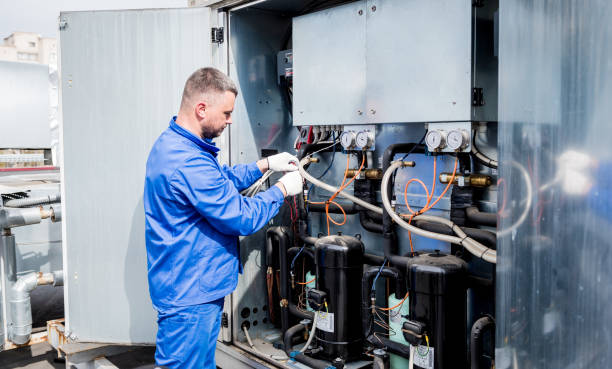
- Cold chains require specialized technicians with skills in industrial cooling, ammonia (NH3), and CO2 systems, rather than just standard domestic HVAC.
- Full Arctick licensing (Refrigerant Handling Licence) is legally required in Australia to handle fluorocarbon refrigerants safely.
- Emergency breakdown response skills, such as fast fault-finding and electrical diagnostics, prevent catastrophic inventory loss.
- Routine preventative maintenance schedules protect refrigeration equipment, lower energy bills, and stop system failures before they occur.
- Working with a dedicated workforce partner helps you locate certified tradespeople quickly during tight labor markets.
Understanding Cold Chain Technician Staffing Demands
Cold chains handle fresh produce, dairy, frozen foods, vaccines, and chemical supplies. These items rely on uninterrupted climate control from the farm or laboratory to the end consumer. If a cooling failure happens in a distribution hub, the entire chain breaks.
Specialized cold chain technician staffing focuses on mechanics who understand the demands of industrial distribution centers. These buildings often run central plant rooms with large screw compressors, evaporative condensers, and pumped liquid feed systems.
Technicians working in these facilities need to balance multiple responsibilities:
- Monitoring bulk storage rooms kept at minus 25 degrees Celsius or below
- Managing blast freezers that pull heat out of food rapidly
- Maintaining staging docks held at controlled temperatures to protect loading processes
- Controlling computerized building management systems (BMS) to balance energy use with cooling demand
If your facility processes fresh meat, packaged meals, or dairy, you can learn more about finding staff through Food Production Recruitment options that align with strict hygiene and cooling standards.
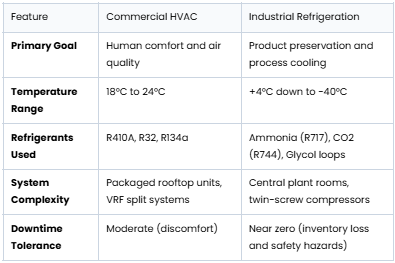
The table below outlines the core differences between standard commercial HVAC roles and industrial refrigeration positions:
Technical Licensing: Why Arctick Certification Is Mandatory
You cannot compromise on trade qualifications when filling refrigeration roles. In Australia, any technician who works with fluorocarbon refrigerants must hold an Arctick licence, formally called a Refrigerant Handling Licence (RHL).
The Australian Refrigeration Council (ARC) administers this licensing system. It confirms that the tradesperson has completed formal training to prevent emissions of synthetic greenhouse gases and ozone-depleting substances.

Essential Licences and Certifications
When reviewing candidate resumes, verify that they hold the following credentials:
- Certificate III in Refrigeration and Air Conditioning: This four-year trade qualification forms the foundation of a technician's technical education. It covers thermodynamics, piping, electrical controls, and component overhaul.
- Arctick Full Refrigerant Handling Licence: A full licence allows technicians to buy, recover, decant, and charge refrigerants. Be cautious of restricted licences, which may only allow a person to service car air conditioning or split systems.
- Restricted Electrical Licence: Refrigeration mechanics constantly troubleshoot electrical contactors, circuit boards, and electric motors. A disconnect/reconnect electrical licence allows them to work on wiring without calling an outside electrician for simple part swaps.
- Natural Refrigerants Certification: Ammonia (NH3) and Carbon Dioxide (CO2) are common in large cold warehouses. Ammonia is toxic and mildly flammable, while CO2 runs at high operating pressures. Technicians must have dedicated safety tickets to work on these plant systems.
Pro Tip: Always check the candidate's licence number directly on the official ARC website before conducting an interview. This confirms their licence is current and shows whether they have any working conditions attached to their trade registration.
Climate Control Technical Hiring for Emergency Breakdown Response
Refrigeration systems run continuously under heavy load. Compressors work hardest during hot summer days, which is also when power grids fluctuate and machinery tends to fail. Fast emergency response capabilities are a central focus of climate control technical hiring.
A mechanical failure in a cold storage warehouse is an emergency. If your compressor racks trip on high pressure and temperatures climb, you may have only a few hours to find the issue before thousands of pallets of stock spoil.
Emergency Breakdown Diagnostic Path:
Alarm Triggers -> Check Pressures/Temps -> Electrical & PLC Check -> Isolate Fault -> Replace Part -> Evacuate/Recharge -> System Restart
Critical Skills for Breakdown Situations
Your technicians must possess practical problem-solving skills under pressure. During the interview process, evaluate candidates on these technical capabilities:
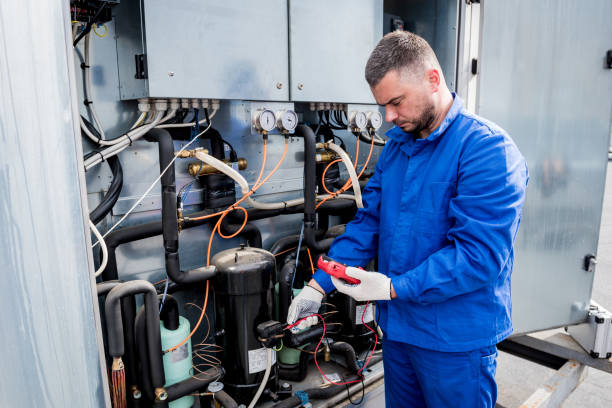
- Rapid Electrical Troubleshooting: Modern refrigeration uses programmable logic controllers (PLCs), variable speed drives (VFDs), and safety switches. A mechanic must be able to read wiring diagrams, trace faults with a multimeter, and locate failed sensors quickly.
- Leak Detection and Isolation: High-pressure refrigerant leaks can empty an entire charge into the atmosphere, causing plant shutdown and safety alerts. Mechanics must know how to isolate pipe sections using manual valves and use electronic sniffers or ultrasonic detectors.
- Component Replacement Speed: Technicians must be capable of rebuilding expansion valves, swapping out solenoid coils, or changing heavy oil pumps without causing secondary contamination in the refrigerant lines.
- Refrigerant Recovery Knowledge: Mechanics must know how to pump down massive systems safely into storage receivers, keeping the gas contained while repairs take place.
Distribution companies often depend on integrated warehouse support. For help sourcing warehouse personnel alongside your maintenance teams, review our services in Warehousing and Logistics Recruitment.
Preventative Maintenance Capabilities to Protect Operations
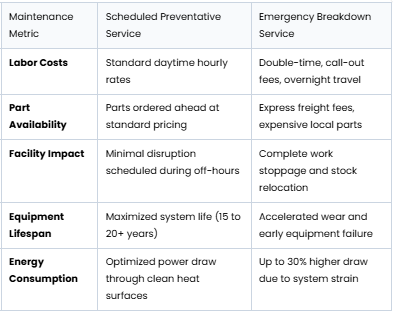
Emergency breakdowns cost significantly more than planned maintenance. A technician who only knows how to fix broken equipment is only solving half of your operational challenges. You need technicians who spot wear, leaks, and pressure drops long before they trigger an alarm.
A strong preventative maintenance program keeps your facility running efficiently and lowers your power consumption. Cooling systems consume large amounts of electricity in industrial settings; dirty coils, incorrect refrigerant charges, or worn compressor valves can drive power bills up substantially.
Core Maintenance Tasks to Look For
When assessing candidates, confirm they are comfortable managing these routine maintenance duties:
- Vibration Analysis on Compressors: Checking bearing wear on large open-drive and semi-hermetic screw compressors helps predict mechanical failure months ahead of time.
- Oil Sampling and Acid Testing: Compressor oil lubricates moving parts and cools the system. Testing oil for acid, moisture, and metal particles warns the technician of internal motor burnouts or mechanical friction.
- Superheat and Subcooling Calculations: Checking these metrics confirms that the expansion valves feed the correct amount of liquid refrigerant into the evaporator coils without flooding the compressor.
- Defrost Cycle Management: Ice accumulation on evaporator coils stops airflow and acts as an insulator, driving storage temperatures up. Technicians must check defrost heaters, hot-gas defrost valves, and drain lines regularly.
- Condenser Water Treatment and Cleaning: For water-cooled plants, technicians must clean cooling towers, descale heat exchangers, and coordinate with water-treatment contractors to prevent scale and biological growth.
The table below contrasts the actual costs of scheduled maintenance against emergency repair work:
Key Insight: Ask candidates to describe their daily maintenance logs during interviews. Technicians who maintain organized logs and understand performance trends are far more valuable than mechanics who rely solely on automated alarms.
Best Practices for Industrial Refrigeration Recruitment
Finding certified tradespeople requires a structured recruitment process. Trade shortages mean that experienced mechanics often have multiple job offers. To attract the right workers, you need a clear recruitment plan.
Recruitment Process Flow:
1. Job Scope Definition -> 2. Technical Skill Check -> 3. Practical Interview -> 4. Licence Verification -> 5. Offer & Onboarding
1. Define the Machine Types Accurately
Do not write a generic job posting for an "Air Conditioning Mechanic" if you run a free-standing ammonia cold store. Be specific about the equipment in your building:
- Name the compressor brands (e.g., Frick, Mycom, Bitzer, Copeland)
- State the refrigerants in use (e.g., R717, R744, R404A, R134a)
- Clarify whether the role focuses on plant room work, rack maintenance, or general building HVAC
2. Run Practical Scenario-Based Interviews
Trade resumes can look similar on paper. Use technical scenario questions to test how candidates think on their feet:
- "The high-pressure cut-out on a screw compressor trips during a 38-degree summer afternoon. What are the first three checks you run?"
- "You smell a minor ammonia leak near an evaporator coil inside a blast freezer. What safety steps do you take before entering space?"
- "How do you diagnose an expansion valve that is hunting and causing liquid floodback?"
3. Check Pay Rates Against Industry Standards
Qualified refrigeration technicians earn strong wages due to their specialized skills. Ensure that your pay packages match trade expectations and legal award requirements. You can verify minimum award wages and overtime rules by checking with the Fair Work Ombudsman.
4. Provide Long-Term Career Pathways
Industrial technicians prefer working for businesses that invest in trade tooling, safety gear, and ongoing education. Offering factory training on new natural refrigerant systems or PLC controls will make your business far more attractive to skilled candidates. If you need assistance building long-term talent structures, our team offers Permanent Recruitment Services to support your workforce goals.
Partnering with an HVAC Trade Recruitment Agency
Filling specialized trade vacancies internally can pull your engineering and facility managers away from their day jobs. Sourcing mechanical trades requires technical networks, active headhunting, and an understanding of licensing legislation.
Partnering with a specialized Trade Recruitment Agency simplifies your hiring process. A focused agency helps cold chain managers in several ways:
- Established Trade Talent Pools: Experienced recruitment agencies stay in constant contact with qualified technicians who might not look at regular job boards.
- Rigorous Qualification Screening: Recruiters verify trade certificates, Arctick credentials, and working rights before presenting resumes to your team.
- Fast Hiring Timelines: When an in-house technician resigns, open shifts create immediate stress on remaining staff. A specialized recruitment agency helps fill roles quickly to keep plants covered.
- Flexible Staffing Models: Whether you need full-time plant technicians, shut-down maintenance crews, or seasonal breakdown coverage, an agency can adapt to your seasonal production needs.
At Chandler Personnel, we understand the technical requirements that cold chain operations face every day. Our team works hard to match your business with mechanics who possess the trade credentials, safety focus, and practical skills your industrial chillers require.
If you need qualified tradespeople for your plant rooms today, you can Request Staff Now or Contact Us Today to speak with our trade recruiters.
Frequently Asked Questions
What is the difference between commercial HVAC and industrial refrigeration?
Commercial HVAC focuses mainly on air conditioning and climate control for human comfort in buildings like offices, schools, and shopping centers. Industrial refrigeration focuses on cold storage, manufacturing plants, and food distribution. Industrial systems run at lower temperatures, use larger central plant equipment, and operate with industrial refrigerants like ammonia and carbon dioxide.
Why is an Arctick licence mandatory for refrigeration technicians in Australia?
Under the Ozone Protection and Synthetic Greenhouse Gas Management Regulations, it is illegal for anyone to handle fluorocarbon refrigerants without a licence. The Arctick licence proves that the mechanic has completed formal trade training to handle, recover, and store refrigerants safely without releasing harmful gases into the atmosphere.
How often should preventative maintenance be performed on industrial cold chain systems?
Most facilities run basic preventative maintenance checks weekly or monthly, with deeper mechanical services carried out quarterly and annually. Tasks like checking oil levels, inspecting belts, and monitoring temperatures are done frequently, while compressor overhauls, vibration analysis, and relief valve replacements happen on broader annual schedules.
Can an HVAC technician work on ammonia refrigeration plants without special training?
No. Ammonia is classified as an industrial refrigerant that is toxic and potentially hazardous if mishandled. Technicians must complete specialized natural refrigerant training modules and safety certifications before servicing, charging, or repairing ammonia systems.
What should I check when verifying a candidate's trade credentials?
You should check their Certificate III in Refrigeration and Air Conditioning, verify their Arctick Refrigerant Handling Licence on the ARC national register, confirm they have a restricted electrical licence, and verify any additional tickets such as Working at Heights, Confined Spaces, or Ammonia Safety.
Conclusion
Running an efficient cold chain operation requires steady, reliable cooling systems. From bulk food warehouses to pharmaceutical cold storage, mechanical reliability rests in the hands of the technicians who look after your cooling plants.
Focusing your hiring efforts on verified Arctick licences, hands-on breakdown diagnostic skills, and strong preventative maintenance capabilities will protect your valuable inventory and keep your facility running smoothly. By taking the time to screen for the right credentials, or by partnering with trade recruitment professionals, you can build an engineering team that keeps your supply chain cold, compliant, and operational year-round.
Need qualified refrigeration mechanics or HVAC technicians for your facility?
Chandler Personnel connects cold chain operators with fully certified, safety-focused trade professionals.
Request Staff Now to discuss your maintenance and breakdown staffing requirements.