CAD CAM Draftsperson Hiring: Complete Workshop Guide

Key Takeaways
- Focus on real-world manufacturing knowledge, not just software certifications.
- Use structured portfolio reviews to check for clear dimensions and tolerances.
- Run timed, hands-on 3D modeling and toolpath tests before making an offer.
- Match software expertise (like SolidWorks or Mastercam) to your shop's setup.
- Partner with specialized staffing teams to find pre-vetted trade talent quickly.
Understanding Draftsperson Recruitment Australia Standards
Drafting needs vary across different sectors, but workshops share common requirements. When you look at Wikipedia Computer-Aided Design history, CAD tools started as simple electronic drafting boards. Today, CAD and CAM work together to bridge the gap between creative design and the physical shop floor.
When you manage draftsperson recruitment Australia standards, you must look for people who know local drafting rules. In Australia, this means familiarity with AS 1100 technical drawing standards. Your drawings must use correct symbols, line weights, projection methods, and dimensioning styles.
Draftspeople must also understand how local workshops run. A draftsperson who knows Australian steel sections, sheet sizes, and standard fasteners will save you money on materials. When hiring through a dedicated Trade Recruitment Agency, you can check if candidates have direct experience with local fabricators and machinists.

Mechanical CAD Designer Hiring: Screening Key Skills
The first step in your screening process is separating general draftspeople from mechanical specialists. An architectural or civil draftsperson may know CAD software well, but they often lack the mechanical knowledge needed for parts manufacturing.
During mechanical CAD designer hiring, your initial resume screening should look for four core areas:
- Geometric Dimensioning and Tolerancing (GD&T): Can the applicant apply datum points, runout, and true position correctly?
- Design for Manufacturability (DFM): Do their models account for tool access, standard drill bit sizes, and material bend allowances?
- Materials Knowledge: Do they understand the differences between machining mild steel, stainless steel, aluminum, and engineering plastics?
- CAM Understanding: Do they know how their models translate into G-code, tool selections, and feeds and speeds?
Comparing CAD and CAM Skillsets
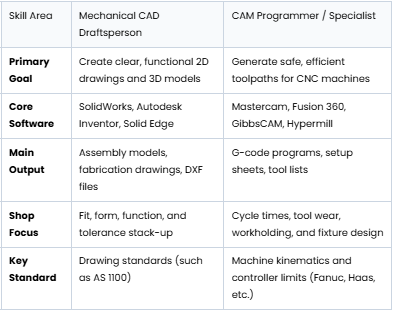
To build a balanced team, you must understand the difference between drafting work and manufacturing programming:
Solidworks Draftsperson Staffing and Tool Checks
SolidWorks is one of the most common design tools used in engineering workshops today. Because of this, solidworks draftsperson staffing is a regular requirement for growing shops. However, seeing a software logo on a resume does not tell you how well someone works under pressure.
When checking software skills, watch for good modeling habits. Poor modeling habits slow down your entire team when files need changes later.
Look for these specific software practices:
- Fully Defined Sketches: Every sketch should use clean dimensions and geometric relations (like concentric, parallel, or tangent). Unconstrained sketches cause errors when parts update.
- Logical Feature Trees: A good designer uses simple, logical features. They avoid messy workarounds that crash when another team member opens the file.
- Top-Down and Bottom-Up Assembly Skills: Can they build assemblies using standard mates without over-constraining the model?
- Sheet Metal and Weldment Modules: If your shop builds frames or enclosures, make sure the candidate knows how to use native sheet metal and weldment tools rather than basic extrusions.
- Drawing Sheet Templates: Check if they know how to link custom properties (like part numbers, material, and finish) directly to drawing title blocks.
Pro Tip: Ask candidates how they handle revision control. A great draftsperson knows how to update an existing model without breaking linked production drawings or BOMs (Bills of Materials).
Portfolio Reviews: What to Look For
Never hire a draftsperson based solely on an interview conversation. You must review their past work. A portfolio shows their attention to detail, presentation clarity, and technical range.
Request a portfolio that includes both 3D CAD models and finalized 2D shop drawings. When reviewing these samples, look for the following items:
- Drawing Layout and Readability: Are the views organized logically? Can a fabricator or machinist read the dimensions without hunting across the page?
- Tolerance Application: Did the candidate place tight tolerances only where necessary, or did they apply unrealistic tolerances everywhere? Tight tolerances add unnecessary machining costs.
- Weld Symbols: If reviewing structural or sheet metal work, check the weld symbols. Are they placed correctly, showing size, type, and finish requirements?
- Section and Detail Views: Look for complex internal features. Did the candidate create clear section views to explain hidden details?
- Bill of Materials (BOM): Verify that assembly drawings include clear item callouts, quantities, and raw material descriptions.
If a candidate cannot share previous client work due to non-disclosure agreements, ask them to bring non-proprietary models or personal design projects that show their skillset.
Drafting Specialist Recruitment: Running Practical Tests
Interviews show how well someone speaks, but practical tests show how well they work. Successful drafting specialist recruitment relies on real-world tests administered during the interview process.
Give the candidate a quiet workstation, your preferred software, and a clear set of instructions. Limit the test to 60 to 90 minutes.
Practical Test Options
You can choose from three common test styles depending on your shop's needs:
- The Reverse Engineering Test: Hand the candidate a physical machined or fabricated part along with calipers, micrometers, and thread gauges. Ask them to measure the part, model it in 3D, and produce a fully dimensioned 2D production drawing.
- The Drawing from 3D Model Test: Give the candidate a completed 3D assembly model. Ask them to create a detailed fabrication drawing for one part and a complete assembly drawing with a BOM.
- The CAM Toolpath Test: Provide a 3D step file of a prismatic part. Ask the candidate to define the stock, choose cutting tools, set work coordinates, and program toolpaths to machine the feature within a set time.
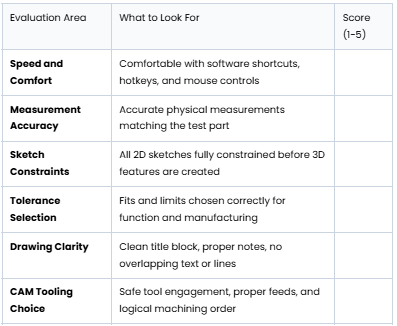
Skills Evaluation Matrix
Use a simple grading rubric to score candidate tests consistently:
Interview Questions for CAD/CAM Candidates
Once the practical test is complete, use the face-to-face interview to check communication skills, shop awareness, and problem-solving steps.
Here are questions to ask during your interview:
Technical CAD Questions
- "Walk me through your process for modeling a sheet metal bracket with multiple bends. How do you decide on the bend deduction or K-factor?"
- "How do you decide between using a machined component versus a welded fabrication for a load-bearing bracket?"
- "What steps do you take when a production drawing has an error spotted by a machinist on the shop floor?"
Practical CAM Questions
- "How do you determine the correct feeds and speeds when programming a cutter for an unfamiliar material?"
- "What is your strategy for workholding and fixture design when machining a thin-walled part?"
- "Can you explain the difference between climb milling and conventional milling, and when would you use each?"
Teamwork and Process Questions
- "Tell me about a time you had to make a fast drawing revision to keep a machine running. How did you document the change?"
- "How do you communicate with machine operators when a drawing has tight tolerances or complex setup instructions?"
For common hiring questions and advice on candidate vetting, you can read our Client FAQs page.
The Value of Shop Floor Experience
A common problem in engineering design is the disconnect between the drafting office and the shop floor. A draftsperson who has spent time running lathes, operating press brakes, or welding frames is exceptionally valuable.
When you screen candidates, look closely at their work history:
- Apprenticeship Background: Candidates who began their careers as fitter-machinists, boilermakers, or toolmakers often make outstanding draftspeople. They know what tools can and cannot do.
- Hands-On Troubleshooting: Ask candidates how often they walk out to the factory floor to check parts. Good designers regularly talk with operators to see how designs assemble in real life.
- Tooling Awareness: Draftspeople with shop experience design around standard tooling. They avoid designing deep pockets with sharp inside corners that standard endmills cannot cut.
If you are looking for candidates who combine office design skills with factory floor experience, partnering with a specialized Manufacturing Recruitment Agency can save you valuable time.
Avoiding Common Hiring Mistakes
Hiring mistakes cost both time and money. To keep your hiring process effective, avoid these common traps:
- Relying Only on Degrees: A university degree in mechanical engineering does not guarantee drafting competence. Many degree programs spend very little time on detailed 2D drafting or CAM programming. Always test hands-on skills.
- Ignoring Communication Skills: Draftspeople do not work in isolation. They must talk to clients, lead engineers, purchasing agents, and machine operators. Make sure your candidate speaks and writes clearly.
- Skipping Reference Checks: Always talk to former workshop managers. Ask specific questions about the candidate's drawing accuracy, speed, and how their designs ran on the shop floor.
- Underestimating Software Differences: While CAD concepts transfer between programs, shifting from an older 2D tool to a parametric 3D modeler takes time. If you need someone productive on day one, hire for your exact software platform.
When you need long-term stability in your design department, using Permanent Recruitment Services helps you find professionals who fit your company culture and project timeline.

Frequently Asked Questions
What is the difference between a CAD draftsperson and a CAM programmer?
A CAD draftsperson creates 2D drawings and 3D computer models of components and assemblies. A CAM programmer takes those 3D models and creates the toolpaths, cutting instructions, and G-code needed for CNC machines to manufacture the parts. Some workshops hire one person to do both jobs, while larger operations separate the roles.
How can I test CAD skills if I do not know how to use the software myself?
If you do not use the software yourself, have your shop foreman or senior machinist assist in the evaluation. Hand the candidate a physical part to measure and draw. Then, have your machinist review the final 2D drawing to see if they could make the part accurately using only the candidate's print.
Is it better to hire a mechanical engineer or a trade-qualified draftsperson?
It depends on your workshop's needs. If you need structural calculations, heat transfer analysis, and new product invention, an engineer is appropriate. If you need clean production drawings, fast sheet metal flat patterns, and shop-floor manufacturing support, a trade-qualified draftsperson is often faster, more practical, and more cost-effective.
Where can I find qualified mechanical draftspeople?
You can post openings on industry job boards or review active listings on the Chandler Job Board. For hard-to-find roles or fast placements, working with a technical recruiter helps you reach passive candidates who are not actively searching public boards.
Final Steps for Your Workshop
Hiring the right CAD/CAM draftsperson protects your workshop from production delays and costly material waste. By combining portfolio reviews, hands-on modeling tests, and structured interviews, you can identify draftspeople who write clean code and build accurate drawings.
Take the time to evaluate both digital software skills and physical manufacturing knowledge. When you find a draftsperson who respects shop-floor realities, your machine operators will work faster, your scrap rates will drop, and your workshop can deliver customer orders on time.
If you are ready to add qualified drafting and CAM talent to your engineering team, contact our staffing specialists and Request Staff Now.
Ready to find the right drafting talent for your engineering workshop? Contact the recruitment team at Chandler Personnel today to source, test, and place experienced CAD/CAM professionals tailored to your manufacturing requirements.