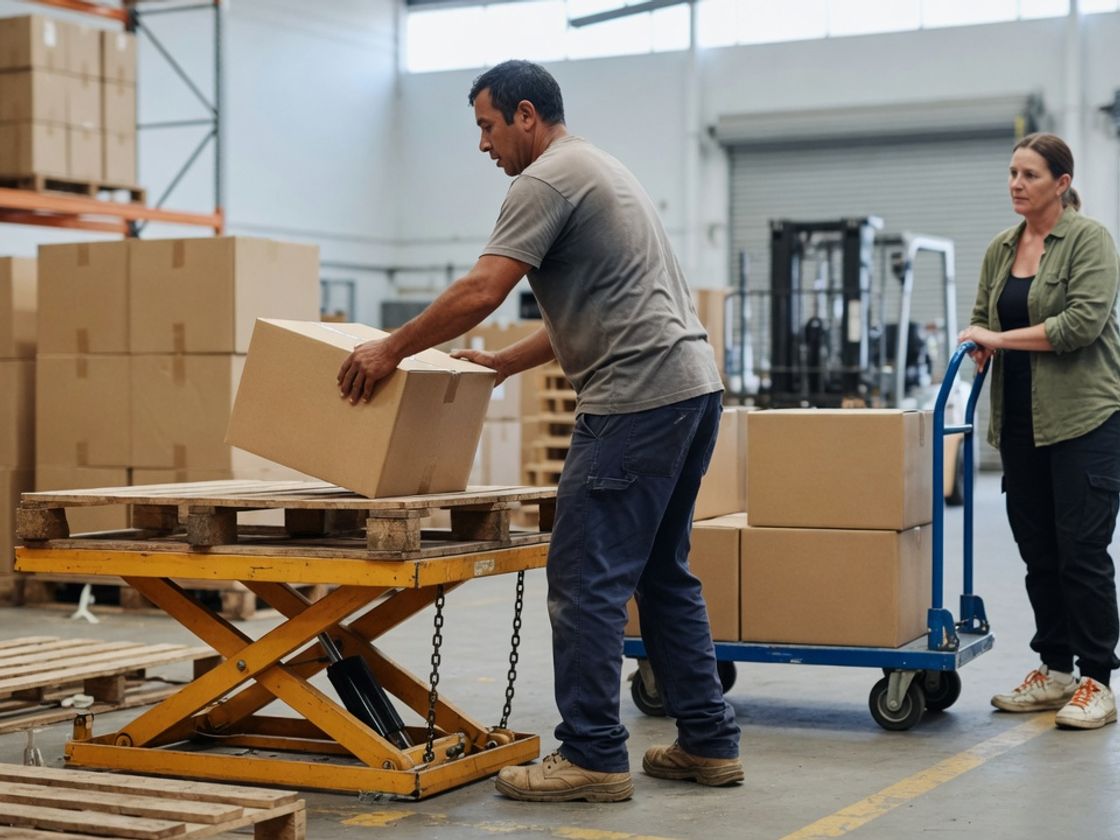
Manual handling in a warehouse is the lifting, lowering, pushing, pulling, carrying and holding that picking, packing and putaway involve on every shift. This guide is for supervisors in Victoria who want to take that risk out of the task itself, using the order of controls WorkSafe Victoria sets out, and who need to brief casual and labour hire workers from their first shift.
What counts as hazardous manual handling in a warehouse
Manual handling is work where you lift, lower, push, pull, carry, move, hold or restrain something. WorkSafe Victoria's manual handling basics page says it becomes hazardous when it involves repeated, sustained or high force, sustained awkward posture, repetitive movements, sustained vibration, or loads that are unstable, unbalanced or hard to hold.
Not all manual handling is hazardous. The same page gives steering a heavily loaded trolley through a busy warehouse as an example that can be, and notes that it takes more bending and twisting of the back to pick up a box from the floor than from a bench at mid-thigh height.
Walk the floor and list the tasks
Start by listing the work that involves lifting, lowering, pushing, pulling or carrying, shift by shift, with where it happens and who does it. WorkSafe says you do not need a formal risk assessment if there is already information about the risk and how to control it.
WorkSafe Victoria's guidance on moving or lifting lists the common sources of risk. Use them as prompts for the walk-around:
- Storage. Shelves above shoulder height, or too little storage.
- Floors and clutter. Clutter that makes access difficult, and uneven floors. The tidy routine is a separate housekeeping job.
- Aids. No equipment to move the object, or a mismatch between the object and the equipment available.
- People and time. Not enough people for the task, or limited time, such as no time to wait for help.
- The load. Heavy, awkward or bulky objects.
Ask the people who do the task. The same page says employers have a duty to consult, so far as reasonably practicable, with employees and any health and safety representatives (HSRs) when identifying hazardous manual handling.
Change the task, the pallet and the aid before you train
WorkSafe Victoria's training page says training must not be the first option an employer uses to control hazardous manual handling risk. Warehouse ergonomics starts with the task: does the lift need to happen at all?
Eliminate and change first
Eliminating means preventing the hazardous manual handling altogether, if you can. WorkSafe's example is using bulk bags of stock that are handled with a forklift. If you cannot eliminate the risk, WorkSafe says you must change the workplace to lower it: change the layout, the systems of work or the things used, or introduce mechanical aids, alone or in combination.
Example: a heavy carton at the base of a pallet
Here is an example with illustrative details. Pickers at a distribution centre break down mixed pallets, and the heaviest cartons were loaded first, so they sit at the base. Each time a picker reaches the bottom layer, they bend and twist to lift a heavy carton from near floor level.
Apply the controls in order. First, ask whether the hand lift can be removed, for instance by having the supplier send the heavy line on its own pallet, so a picker moves it with a pallet truck and lifts no carton.
If it cannot, change the work. Change what goes on the pallet and how it is built, for example by asking for the heavy line in smaller, lighter cartons, and stand the pallet on a lift table so the layer being picked stays close to bench height. WorkSafe's moving or lifting page lists reducing the size or weight of objects among its controls, and adjustable-height trolleys among its equipment. Training then supports those changes, and it is about this job: how the lift table works and who to tell when it fails.
Information and training last
WorkSafe says information, instruction or training can support the higher order controls, and can be used on its own only when none of them is reasonably practicable. Extra people can help when a lift is planned as a team lift: the moving or lifting page says to have enough employees for the task when team handling and to match them to each other.
What good training covers and when to repeat it
WorkSafe Victoria's manual handling training page says employers should provide practical and easily understood training, in language and examples that everyone understands. It should cover:
- The work. How to do the work safely, including using the mechanical aids, tools, equipment and safe work procedures on your site.
- Reporting. How to report problems or maintenance issues, such as a faulty mechanical aid.
"How to lift" training, including lifting with a straight back, stretching and warm up programs, or relying on workers to use "good" posture, is not useful for preventing or reducing MSDs (musculoskeletal disorders). WorkSafe says an employer is not meeting the legal requirement to control hazardous manual handling risks if they rely on it.
Who gets trained, and when
Suitable training must be given to new employees and contractors as part of their induction. For a warehouse that takes on casual and labour hire workers, the first-shift induction is a practical place for the task-specific brief.
Chandler Personnel, which offers warehouse labour hire in Victoria, also runs site inductions on behalf of clients, so a client can ask the provider to cover the task-specific manual handling brief in the site induction. Peak intakes put many new starters through at once, and the post on seasonal pick packer hiring covers that hiring side.
Training is not a one-off. WorkSafe says it should happen when someone starts a new job or role, when processes or equipment change, and regularly and at least annually. Keep records of the date, the topics and the names and signatures of the trainer and each person who attended.
When the training itself must be reviewed
WorkSafe Victoria says employers must review the training:
- before changes that affect how or where the work is done, including new controls or changes to process, plant or equipment
- if the employer gets new or more information about hazardous manual handling
- when an employee or contractor suffers an MSD, or there is a notifiable incident involving hazardous manual handling
- if the risk control measures do not control the risk
- when an HSR requests it, or if the OHS legislation changes
Check the controls are working
WorkSafe says to review your risk controls to make sure they are working properly. Watch the changed task on a real shift, and ask the picker whether the lift table is where it is needed, whether the trolley is free and whether the new pallet build helped.
Casual crews need the same check. On their first shift, watch how they do the changed task and confirm they know where the aids are and how to report a fault. Larger peak crews add supervision load, which the post on supervising a larger peak crew covers, and the guide to 24/7 shift safety covers fatigue controls for night crews. You can also look at the OHS scorecard on the Chandler Personnel website.
Related Resources
- Warehouse labour hire in Victoria
- OHS scorecard
- Supervising a larger peak crew
- Seasonal pick packer hiring
- 24/7 shift safety
- WorkSafe manual handling basics
- WorkSafe on moving or lifting
Common Questions About Manual Handling in a Warehouse
1. What is hazardous manual handling?
WorkSafe Victoria describes it as manual handling that involves repeated, sustained or high force, sustained awkward posture, repetitive movements, sustained vibration, handling people or animals, or loads that are unstable, unbalanced or hard to hold. Not all manual handling is hazardous, so check each task.
2. What manual handling controls should a warehouse use first?
WorkSafe Victoria says to eliminate the risk first, then change the workplace or the work, for example the layout, systems of work, the things used or mechanical aids. Information, instruction and training come last. In a warehouse that can mean changing how a pallet is built or adding a lift table.
3. Does training alone control manual handling risk?
No. WorkSafe Victoria says training must not be the first option, and that it can be used on its own only when no higher order control is reasonably practicable. It also says "how to lift" training does not reduce risk and an employer who relies on it is not meeting the legal requirement.
4. When must manual handling training be reviewed?
WorkSafe Victoria says to review it before changes to how or where the work is done, on new information, after an MSD or a notifiable incident, if the controls do not control the risk, when an HSR asks and if the OHS legislation changes. The training itself should also be repeated at least annually.
5. How do I check manual handling controls with a temporary crew?
Watch the crew do the changed task on their first shift, ask what slowed them down and confirm they know where the aids are and how to report a faulty one. If the controls do not control the risk, WorkSafe Victoria says to review the training.
Change the task, then train the person
WorkSafe Victoria puts changing the task, the pallet build and the aids ahead of training, and treats training as the support layer. Walk the floor this week, list the tasks and fix the worst one with a control from the start of the order. If you use labour hire, ask your provider to cover that task in the next site induction.